element14 Community
element14 Community
    Register Log In
  • Site
  • Search
  • Log In Register
  • Community Hub
    Community Hub
    • What's New on element14
    • Feedback and Support
    • Benefits of Membership
    • Personal Blogs
    • Members Area
    • Achievement Levels
  • Learn
    Learn
    • Ask an Expert
    • eBooks
    • element14 presents
    • Learning Center
    • Tech Spotlight
    • STEM Academy
    • Webinars, Training and Events
    • Learning Groups
  • Technologies
    Technologies
    • 3D Printing
    • FPGA
    • Industrial Automation
    • Internet of Things
    • Power & Energy
    • Sensors
    • Technology Groups
  • Challenges & Projects
    Challenges & Projects
    • Design Challenges
    • element14 presents Projects
    • Project14
    • Arduino Projects
    • Raspberry Pi Projects
    • Project Groups
  • Products
    Products
    • Arduino
    • Avnet & Tria Boards Community
    • Dev Tools
    • Manufacturers
    • Multicomp Pro
    • Product Groups
    • Raspberry Pi
    • RoadTests & Reviews
  • About Us
  • Store
    Store
    • Visit Your Store
    • Choose another store...
      • Europe
      •  Austria (German)
      •  Belgium (Dutch, French)
      •  Bulgaria (Bulgarian)
      •  Czech Republic (Czech)
      •  Denmark (Danish)
      •  Estonia (Estonian)
      •  Finland (Finnish)
      •  France (French)
      •  Germany (German)
      •  Hungary (Hungarian)
      •  Ireland
      •  Israel
      •  Italy (Italian)
      •  Latvia (Latvian)
      •  
      •  Lithuania (Lithuanian)
      •  Netherlands (Dutch)
      •  Norway (Norwegian)
      •  Poland (Polish)
      •  Portugal (Portuguese)
      •  Romania (Romanian)
      •  Russia (Russian)
      •  Slovakia (Slovak)
      •  Slovenia (Slovenian)
      •  Spain (Spanish)
      •  Sweden (Swedish)
      •  Switzerland(German, French)
      •  Turkey (Turkish)
      •  United Kingdom
      • Asia Pacific
      •  Australia
      •  China
      •  Hong Kong
      •  India
      • Japan
      •  Korea (Korean)
      •  Malaysia
      •  New Zealand
      •  Philippines
      •  Singapore
      •  Taiwan
      •  Thailand (Thai)
      • Vietnam
      • Americas
      •  Brazil (Portuguese)
      •  Canada
      •  Mexico (Spanish)
      •  United States
      Can't find the country/region you're looking for? Visit our export site or find a local distributor.
  • Translate
  • Profile
  • Settings
Community Hub
Community Hub
Member's Forum Triac not shutting off (24v AC sprinkler valve control)
  • Blog
  • Forum
  • Documents
  • Quiz
  • Events
  • Leaderboard
  • Polls
  • Files
  • Members
  • Mentions
  • Sub-Groups
  • Tags
  • More
  • Cancel
  • New
Join Community Hub to participate - click to join for free!
Actions
  • Share
  • More
  • Cancel
Forum Thread Details
  • State Verified Answer
  • Replies 34 replies
  • Answers 16 answers
  • Subscribers 566 subscribers
  • Views 5520 views
  • Users 0 members are here
  • valve
  • ac
  • triac
  • sprinkler
  • 24v
  • opensprinkler
Related

Triac not shutting off (24v AC sprinkler valve control)

ntewinkel
ntewinkel over 9 years ago

Hi All,


I'm working on replacing my aging and broken sprinkler controller, and found some open source software (OpenSprinkler) to run on a Raspberry Pi that handles the scheduling very nicely (plus it has an app for my phone).

With that software I'm able to control a couple of shift registers to turn LEDs on and off, simulating the sprinkling zones.


I'm not very familiar with TRIACs (read: not at all familiar, never used them before image), but recently I learned that the sprinkler valves use 24v AC and that TRIACs would be a good way to switch them, with relays generally being rather big once you get 16 of them lined up, and regular power transistors only being good for DC.


I bought some BRT12H "non-zero crossing" opto-isolating TRIACs (datasheet: http://www.vishay.com/docs/83689/83689.pdf), because they seemed to meet the desirements of opto-isolating and AC for 250mA.


I hooked them up (with 220ohm resistors from shift registers to TRIACs), and it all looked promising when I turned the first zone on (sprinklers worked, yay!), but then it wouldn't shut off (sprinklers still working, not yay!). It only shuts off if I remove the 24v power momentarily.


I've done some Googling around but have not yet found any solution, and to be honest it's not making a whole lot of sense to me (yet... hopefully yet).


I did find out that TRIACs (in general?) need to cross zero (volts?) to turn off. I'm not sure what this "non-zero crossing" bit means but I have a nagging suspicion that it's a key part of the issue.

Should I have bought "zero crossing" TRIACs instead?


Can anyone help shed some light?  ...and hopefully also shed a solution image


ps, I did see that I can buy a pre-built board for not too expensive (about $80 after shipping and taxes), but it's a cool DIY project and it would be far more satisfying (and educational) to build it myself.


edit: While doing more searching for answers I noticed that SSRs (solid state relays) do exist that are tiny chips, like this one, DIP-8: http://www.sharpsma.com/webfm_send/335  - very cool.


Thanks!

-Nico

  • Sign in to reply
  • Cancel

Top Replies

  • jw0752
    jw0752 over 9 years ago in reply to ntewinkel +3 suggested
    Hi Nico, AC solenoids will convert to DC solenoids quite easily if you are willing to reduce the voltage. What will remain constant for proper operation is the wattage of the solenoid. For example your…
  • D_Hersey
    D_Hersey over 9 years ago in reply to jw0752 +2 suggested
    You are using LV, so it probably won't matter as much, but for line potentials, only certain types of Cs are a good choice in this rough service, metallized polyester being one.
  • jc2048
    jc2048 over 9 years ago in reply to ntewinkel +2 suggested
    "And what is the best way to figure out the values?" Iteration. Increase the capacitor value and decrease the resistor value a bit and try again. But when you get down to a resistor value of 100 ohms and…
Parents
  • D_Hersey
    0 D_Hersey over 9 years ago

    Sometimes, snubbers are needed with relays as well.  The inductive spike can pit or weld the contacts.

    • Cancel
    • Vote Up +1 Vote Down
    • Sign in to reply
    • Verify Answer
    • Reject Answer
    • Cancel
  • ntewinkel
    0 ntewinkel over 9 years ago in reply to D_Hersey

    Aww man! There's no getting away from this lesson on snubbers, is there?


    I was having no luck with the R(620ish)-C(10nF) attempt - the valve stayed on, so I'll have to revisit that math. I've also set it up on a separate little breadboard for easy testing.


    So to make sure I'm heading towards the right path, is the snubber designed based on the inductive load then (in my case the sprinkler valve) ? (as opposed to the triac ratings?)


    And what is the best way to figure out the values? My multimeter can check for inductance of the sprinkler valve coil. And I can get the Amps used. Or can it all be based on the general values that most 24v sprinkler valves have?


    Thanks,

    -Nico

    • Cancel
    • Vote Up 0 Vote Down
    • Sign in to reply
    • Verify Answer
    • Cancel
  • mcb1
    0 mcb1 over 9 years ago in reply to ntewinkel

    Personally I don't think the snubber is going to resolve your issues.


    The load size is not enough to generate large spikes that will overwhelm or damage the switching components.

    It is also not likely to cause EMC, as you're using solid state devices, rather than contacts.

    The frequency of switching is not high so again unlikely to cause EMC.


    One of our members of another club has been killing solenoids, and it seems it is due to DC.

    However he's switching AC so I'm not 100% on how he's getting a DC component in the solenoids.


    Mark

    • Cancel
    • Vote Up +1 Vote Down
    • Sign in to reply
    • Verify Answer
    • Reject Answer
    • Cancel
  • ntewinkel
    0 ntewinkel over 9 years ago in reply to mcb1

    One of our members of another club has been killing solenoids, and it seems it is due to DC.

    However he's switching AC so I'm not 100% on how he's getting a DC component in the solenoids.


    I was reading about that on OpenSprinkler.com (Understanding 24VAC Sprinkler Valves « RAYSHOBBY.NET - paragraph at bottom) - seems that DC causes it to draw far more current. Apparently he was able to make the 24AC valves work well using 9v, by giving it a quick 12v burst to activate the solenoid and then using 9v dc to hold it.


    That's something I'm interested in trying at some point too, given that 9v adapters are smaller and easier to find, and work well with my favourite dev environments.


    OpenSprinkler has schematics available, and it looks like they just use triacs (not opto-isolated), and I don't see any snubber parts. The only other parts around the triacs are MOVs that they use for protection from outside issues: "Also solder the 10 metal oxide varistors (MOVs). Each MOV is a blue, disc-shaped component. It’s non-polar, and its main purpose is to absorb transient high voltage and protect the circuit from power surge or lightening."

    https://github.com/rayshobby/opensprinkler/tree/master/OpenSprinkler%20Controller/hardware/v2.2


    Which is why I'm thinking maybe the BRT12H was a bad choice.


    -Nico

    • Cancel
    • Vote Up 0 Vote Down
    • Sign in to reply
    • Verify Answer
    • Cancel
  • jc2048
    0 jc2048 over 9 years ago in reply to ntewinkel

    "And what is the best way to figure out the values?"


    Iteration. Increase the capacitor value and decrease the resistor value a bit and try again. But when you get down to a resistor value of 100 ohms and up to a capacitance value of 100nF, stop and have a think about whether the problem might be something else.


    What's going on is quite complicated and involves the coil, the snubber components and the triac. Modelling that lot is complicated. Changing a couple of values on a breadboard is easy.


    Could you tell us what the inductance and resistance of the solenoid are, as measured by your meter?

    • Cancel
    • Vote Up +2 Vote Down
    • Sign in to reply
    • Verify Answer
    • Reject Answer
    • Cancel
Reply
  • jc2048
    0 jc2048 over 9 years ago in reply to ntewinkel

    "And what is the best way to figure out the values?"


    Iteration. Increase the capacitor value and decrease the resistor value a bit and try again. But when you get down to a resistor value of 100 ohms and up to a capacitance value of 100nF, stop and have a think about whether the problem might be something else.


    What's going on is quite complicated and involves the coil, the snubber components and the triac. Modelling that lot is complicated. Changing a couple of values on a breadboard is easy.


    Could you tell us what the inductance and resistance of the solenoid are, as measured by your meter?

    • Cancel
    • Vote Up +2 Vote Down
    • Sign in to reply
    • Verify Answer
    • Reject Answer
    • Cancel
Children
  • ntewinkel
    0 ntewinkel over 9 years ago in reply to jc2048
    Iteration

    Ah thanks, that I can do image


    I tested two valves:

    Resistance is 25 ohms (one was 25.3 and the other was 25.6)  (and ps, directly connecting the tester wires to each other gave 0, just making sure)

    Inductance is 90 mH (one was 89, the other 91)


    Thanks,

    -Nico

    • Cancel
    • Vote Up 0 Vote Down
    • Sign in to reply
    • Verify Answer
    • Cancel
  • jc2048
    0 jc2048 over 9 years ago in reply to ntewinkel

    Now I'm confused.


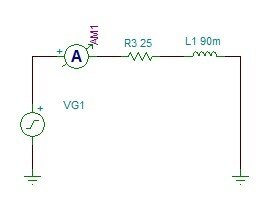
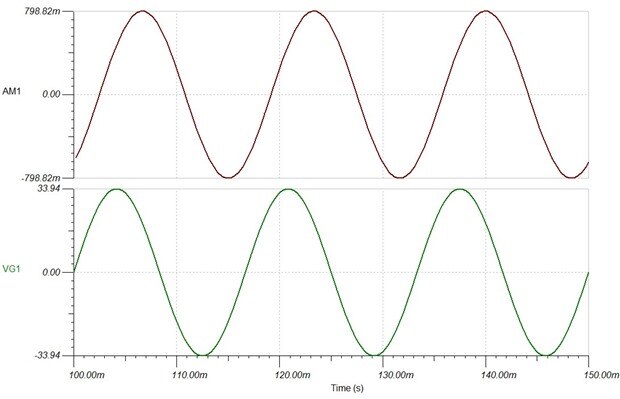
    Here's a very simple simulation. Voltage source (24Vac) driving a coil with the values you just gave.


    imageimage


    For 24Vac rms, the peak voltage is 33.94V. The simulation gives the current as 798mA peak (which is 564mA rms) - it's a bit less than you would expect from the dc resistance because the inductance is already having an effect, even at 60Hz. So where did the figure of 250mA come from? Am I missing something? Or have I got it wrong? [Might have done - it is the end of a long day.]


    Can you do an experiment?


    Connect the solenoid to the transformer. Measure the voltage across it. Then put the meter in series with it and measure the current. We can then see how well it matches the simulation. If it does then your 300mA triac probably isn't the part to be using.

    • Cancel
    • Vote Up +1 Vote Down
    • Sign in to reply
    • Verify Answer
    • Reject Answer
    • Cancel
  • ntewinkel
    0 ntewinkel over 9 years ago in reply to jc2048

    The simulation gives the current as 798mA peak

    ...

    where did the figure of 250mA come from?


    Hi Jon,

    Thanks for doing the simulation - I didn't even think of that idea. what software did you use for that?


    The 250mA number came from OpenSprinkler.com. I can't find the link I had before, but Ray gives similar numbers in the forum: https://opensprinkler.com/forums/topic/extension-board-fuse-usage/   "Each valve draws about 400 to 500mA impulse current and 250 to 350mA holding current."

    He talks in more detail about the valves here: Understanding 24VAC Sprinkler Valves « RAYSHOBBY.NET

    He mentions that the inductance changes when the coil energizes because the pin gets pulled in.


    I pulled the coil out of the valve, and it read 82 mH (less then than 90 when installed, maybe the pin is slightly pressed when installed).

    When I pushed the solenoid in, it read 115mH.


    The transformer gives 27 volts, or 26.5 when a zone is activated. I also tested around the sprinkler coil and got the same number (26.5v)


    Checking for amperage, it only reads 213 mA, which is less than I expected, but that's good news.

    I wasn't able to see any current spike - I assume it's just too quick to measure with this multimeter.


    In summary:

    26.5 volts

    213 mA (energized valve coil)

    Solenoid inductance: 90mH, when pressed in = 115mH.


    ps, it took me a moment but I did remember to set the multimeter to AC for the readings! image


    Thanks,

    -Nico

    • Cancel
    • Vote Up +1 Vote Down
    • Sign in to reply
    • Verify Answer
    • Cancel
  • ntewinkel
    0 ntewinkel over 9 years ago in reply to ntewinkel

    I realized that I replaced a couple of sprinkler valves recently, and those were the ones I was testing my circuit with, so I measured one of them just to make sure (previous numbers were from an original, but working, valve). Results were actually a bit better...


    (Valve in ground, measured from panel in garage)

    Resistance 32 ohm

    Inductance 85 mH

    When on, uses 189 mA  (hooray, the new valves save me power! image)


    Cheers,

    -Nico

    • Cancel
    • Vote Up 0 Vote Down
    • Sign in to reply
    • Verify Answer
    • Cancel
  • jw0752
    0 jw0752 over 9 years ago in reply to ntewinkel

    Hi Nico,


    AC solenoids will convert to DC solenoids quite easily if you are willing to reduce the voltage. What will remain constant for proper operation is the wattage of the solenoid. For example your solenoids appear to be about 6 Watts. 24 V AC * 250 mA. As you have stated the coil resistance is 32 ohms so the DC voltage at which 6 watts will be produced in this resistance is V = SQRT(32 Ohms * 6 Watts)  = SQRT( 192)  = 13.9 Volts. In reality your solenoids will likely energize at 9-10 Volts. You can experiment with this and of course the new lower voltage across the 32 Ohms will produce a current of about 430 mA. You can experiment with your solenoids to see how this works out. I would probably try 12 volts and see how well the solenoids respond. Be certain to test them under pressure as the plunger has to be pulled, not only against the force of the spring but also against the force created by the pressure of the water over the area of the opening in the valve seat.


    DC solenoids do not convert to AC solenoids as easily. The plunger of an AC solenoid is especially designed not to react to the fluctuating magnetic field. The plunger of a DC solenoid on the other hand will react and you will hear a buzz that will be the plunger chattering against its stop. Over time this produces metal wear and failure. It is also quite annoying to listen to. You can relate this to the way AC and DC relays act when subjected to voltage for which they are not designed.


    For the fun of it I ran an experiment with a 120 VAC solenoid I had here in the shop and I was able to convert it to proper operation using 40 Volts DC at 190mA   where it originally was 120 Volts @ 70 mA.


    John

    • Cancel
    • Vote Up +3 Vote Down
    • Sign in to reply
    • Verify Answer
    • Reject Answer
    • Cancel
  • jc2048
    0 jc2048 over 9 years ago in reply to ntewinkel

    The simulator is TI-TINA. It's a cut-down version of a commercial offering which is given away for free by Texas Instruments.


    http://www.ti.com/tool/tina-ti


    The schematic capture is irritating - you draw the nets on, so it's very easy to get nets that don't join or bits that sit on top of each other. The simulation warns you if there are dangling connections, but you still have to go back and repair something the software should just get right.


    There is a reasonable range of library parts built in, which is good. It's good because importing component models is a bit of a pain [that's the case with any simulator - it isn't a deficiency of this particlar one].


    You could also try Linear Technology's offering


    http://www.linear.com/designtools/software/


    I tried this a long time back and it was very biassed to Linear's own devices [understandably], but perfectly useable. I really ought to give it another go because I'm sure they'll have developed it further in the meantime. [TI's offering is also biassed, but since their catalogue includes so many generic parts you don't really notice.]


    Since they are free, you could install both and see which you like using.


    I was being stupid about the solenoid; of course the inductance changes as the plunger moves because the magnetic circuit changes. Don't even know where you'd start to model that, though.

    • Cancel
    • Vote Up +2 Vote Down
    • Sign in to reply
    • Verify Answer
    • Reject Answer
    • Cancel
  • mcb1
    0 mcb1 over 9 years ago in reply to jw0752

    jw0752

    Thanks for the explanation regarding DC solenoids.

    I had always thought that you couldn't really change an AC one, but it seems that it's the DC ones that aren't happy.


    Mark

    • Cancel
    • Vote Up +1 Vote Down
    • Sign in to reply
    • Verify Answer
    • Cancel
element14 Community

element14 is the first online community specifically for engineers. Connect with your peers and get expert answers to your questions.

  • Members
  • Learn
  • Technologies
  • Challenges & Projects
  • Products
  • Store
  • About Us
  • Feedback & Support
  • FAQs
  • Terms of Use
  • Privacy Policy
  • Legal and Copyright Notices
  • Sitemap
  • Cookies

An Avnet Company © 2025 Premier Farnell Limited. All Rights Reserved.

Premier Farnell Ltd, registered in England and Wales (no 00876412), registered office: Farnell House, Forge Lane, Leeds LS12 2NE.

ICP 备案号 10220084.

Follow element14

  • X
  • Facebook
  • linkedin
  • YouTube