element14 Community
element14 Community
    Register Log In
  • Site
  • Search
  • Log In Register
  • Community Hub
    Community Hub
    • What's New on element14
    • Feedback and Support
    • Benefits of Membership
    • Personal Blogs
    • Members Area
    • Achievement Levels
  • Learn
    Learn
    • Ask an Expert
    • eBooks
    • element14 presents
    • Learning Center
    • Tech Spotlight
    • STEM Academy
    • Webinars, Training and Events
    • Learning Groups
  • Technologies
    Technologies
    • 3D Printing
    • FPGA
    • Industrial Automation
    • Internet of Things
    • Power & Energy
    • Sensors
    • Technology Groups
  • Challenges & Projects
    Challenges & Projects
    • Design Challenges
    • element14 presents Projects
    • Project14
    • Arduino Projects
    • Raspberry Pi Projects
    • Project Groups
  • Products and Partners
    Products and Partners
    • Arduino
    • Avnet & Tria Boards Community
    • Dev Tools
    • Manufacturers
    • Multicomp Pro
    • Product Groups
    • Raspberry Pi
    • RoadTests & Reviews
  • About Us
    About the element14 Community
  • Store
    Store
    • Visit Your Store
    • Choose another store...
      • Europe
      •  Austria (German)
      •  Belgium (Dutch, French)
      •  Bulgaria (Bulgarian)
      •  Czech Republic (Czech)
      •  Denmark (Danish)
      •  Estonia (Estonian)
      •  Finland (Finnish)
      •  France (French)
      •  Germany (German)
      •  Hungary (Hungarian)
      •  Ireland
      •  Israel
      •  Italy (Italian)
      •  Latvia (Latvian)
      •  
      •  Lithuania (Lithuanian)
      •  Netherlands (Dutch)
      •  Norway (Norwegian)
      •  Poland (Polish)
      •  Portugal (Portuguese)
      •  Romania (Romanian)
      •  Russia (Russian)
      •  Slovakia (Slovak)
      •  Slovenia (Slovenian)
      •  Spain (Spanish)
      •  Sweden (Swedish)
      •  Switzerland(German, French)
      •  Turkey (Turkish)
      •  United Kingdom
      • Asia Pacific
      •  Australia
      •  China
      •  Hong Kong
      •  India
      •  Japan
      •  Korea (Korean)
      •  Malaysia
      •  New Zealand
      •  Philippines
      •  Singapore
      •  Taiwan
      •  Thailand (Thai)
      •  Vietnam
      • Americas
      •  Brazil (Portuguese)
      •  Canada
      •  Mexico (Spanish)
      •  United States
      Can't find the country/region you're looking for? Visit our export site or find a local distributor.
  • Translate
  • Profile
  • Settings
Community Hub
Community Hub
Member's Forum Question regarding thermal resistance of a UA7805 regulator
  • Blog
  • Forum
  • Documents
  • Quiz
  • Events
  • Leaderboard
  • Polls
  • Files
  • Members
  • Mentions
  • Sub-Groups
  • Tags
  • More
  • Cancel
  • New
Join Community Hub to participate - click to join for free!
Actions
  • Share
  • More
  • Cancel
Forum Thread Details
  • State Verified Answer
  • Replies 16 replies
  • Answers 4 answers
  • Subscribers 630 subscribers
  • Views 2679 views
  • Users 0 members are here
Related

Question regarding thermal resistance of a UA7805 regulator

Andrew J
Andrew J over 7 years ago

From the datasheet, the TO-220 package has the following thermal characteristics:


Rja = 19C/W

Rjc(top) = 17C/W

Rjp(top) = 3C/W  (jp in this case means Junction-to-exposed pad)


Am I right in thinking that for a TO-220, the Rjp value is a reference to the tab when used with a heatsink?  Typically, Rjc would be used, but if this was the case, then adding a heatsink of any thermal resistance > 2C/W would make it worse!  An older version of this datasheet just referred to:

Rja = 19C/W

Rjc = 3C/W


This would tie in with my interpretation.


Thanks,


Andrew

  • Sign in to reply
  • Cancel
  • Andrew J
    0 Andrew J over 7 years ago

    Just following up.  I ordered a Traco Power part and it fits comfortably on the PCB I designed without obstructing anything.  Very pleased with that.

    • Cancel
    • Vote Up +1 Vote Down
    • Sign in to reply
    • Verify Answer
    • Cancel
  • Andrew J
    0 Andrew J over 7 years ago in reply to shabaz

    Measuring current for reading three thermistors and displaying text values on the LCD is drawing approximately 0.235mA - although it does vary between that and 0.224mA.  I could get away with a 15C/W heatsink which can be quite small (and I think I might squeeze in just) but I much prefer your idea especially as it's a pin equivalent, fits and a lot more efficient.  I also don't know if it will work a lot harder once I get the graphics going and the voltage/current monitoring.  Got one on order so I will be able to test it out tomorrow hopefully.

    • Cancel
    • Vote Up +1 Vote Down
    • Sign in to reply
    • Verify Answer
    • Cancel
  • shabaz
    0 shabaz over 7 years ago in reply to Andrew J

    Hi Andrew,


    You might find the Arduino takes much less power on average (but I'm not sure.. also depends on which Arduino) in which case the 7805 may be fine with a smaller heatsink, but in any case that DC-DC converter should be ok without a heatsink.

    • Cancel
    • Vote Up +1 Vote Down
    • Sign in to reply
    • Verify Answer
    • Cancel
  • Andrew J
    0 Andrew J over 7 years ago in reply to shabaz

    Doug / Shabaz,


    that's brilliant thanks.  I didn't realise such things existed. 


    The Arduino takes 5v input, 5.5V max, 320mA (average use of features) and inverting charge pump (LTC1683) 3.5V to 5.5V max, 14mA so a 5V 1A converter should be sufficient - possibly 500mA, although the datasheet for the Arduino mentions the provision of a 5V 1A supply.  Is there anything in the datasheet I need to be picking up on?


    The Traco Power component, for example, gives 50mV pk-pk; 0.4% regulation load variation.  It doesn't state any thermal characteristics except "Allows full load operation upto +70C ambient without heatsink"


    Can't thank you enough!

    • Cancel
    • Vote Up +3 Vote Down
    • Sign in to reply
    • Verify Answer
    • Cancel
  • shabaz
    0 shabaz over 7 years ago in reply to dougw

    There's several that are designed to replace a 7805 almost directly (taking up almost the same amount of space), e.g.:

    https://uk.farnell.com/c/power-line-protection/power-supplies/dc-dc-converters/dc-dc-linear-regulator-converters?output-…

    • Cancel
    • Vote Up +4 Vote Down
    • Sign in to reply
    • Verify Answer
    • Reject Answer
    • Cancel
  • dougw
    0 dougw over 7 years ago in reply to Andrew J

    Could you add an external DC-DC converter module to get the voltage down where you want it?

    • Cancel
    • Vote Up +4 Vote Down
    • Sign in to reply
    • Verify Answer
    • Reject Answer
    • Cancel
  • Andrew J
    0 Andrew J over 7 years ago in reply to shabaz

    No, that was an example.  I need to get rid of 6w.  In my original calcs, without Arduino, current draw is in small mA so power dissipation was tiny.  If I’d have realised in time, I would have gone with a different approach: the issue is the voltage drop from a rectified 24V input to 5V output which I initially was going to do something about just because of inefficiency but didn’t because, well, I had an LM7805 to hand and it was going to work.

    • Cancel
    • Vote Up +2 Vote Down
    • Sign in to reply
    • Verify Answer
    • Cancel
  • shabaz
    0 shabaz over 7 years ago in reply to Andrew J

    Hi Andrew,


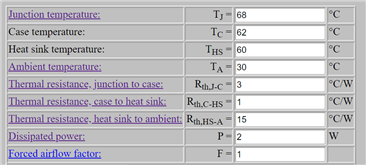
    How much power needs to be dissipated? I saw a value of 2W in an earlier comment, is that an example, or the actual value?

    If it's 2W, then it shouldn't need a large heatsink, e.g.:

    image


    A 15 degC/W heatsink will be quite small, so might fit if there's a bit of space around the TO220.

    • Cancel
    • Vote Up +2 Vote Down
    • Sign in to reply
    • Verify Answer
    • Reject Answer
    • Cancel
  • Andrew J
    0 Andrew J over 7 years ago in reply to shabaz

    Working at it! 


    Just realised a big rookie mistake: forgetting to take into account the current requirements of an Arduino which is going to cause big thermal problems for my LM7805.  I've gone from negligible power dissipation to extremely significant with PCBs due for delivery on Thursday and no room for a heatsink - minimum of 8C/W so quite large.  Thinking of pros and cons of either:

    1. redesigning and re-ordering a PCB with room for a heatsink
    2. off-boarding the LM7805 and connecting with short wires and the LM7805 on a heatsink
    3. redesigning and re-ordering 2 PCBs, providing a 5V@0.5A PSU and dropping the LM7805 altogether.

    Option 2 is the easiest and cheapest but option 3 is the best but most expensive.  Once I start soldering though, option 3 becomes VERY expensive!


    What I think I'll do is option 2.  At the moment, I can envisage other problems surfacing that will require reworking so it would make sense to wait until that happens.  I just need to watch the impact of doing it.  Also V2 of my project would be a lot cheaper to create as I'll have the vast majority of the parts already.  I'm prototyping that part of the circuit now to verify the impact.


    Hey ho.  I can commend myself for spotting it before I fry everything whilst kicking myself for missing it when I spent so long on the design and thermal calcs in the first place!!

    • Cancel
    • Vote Up +1 Vote Down
    • Sign in to reply
    • Verify Answer
    • Cancel
  • shabaz
    0 shabaz over 7 years ago in reply to Andrew J

    Hi Andrew,


    I think you're doing fine, since you spotted this in the datasheet. I personally don't know it in detail either, I don't calculate heatsinks often enough, and it wasn't taught at uni either, I guess it's more "on the job".. I just knew where to look for the ballpark, because I've used that website before, and found it useful.

    It's a confusing datasheet, where their Rjc(top) doesn't seem to mean what Rjc usually refers to.

    • Cancel
    • Vote Up +2 Vote Down
    • Sign in to reply
    • Verify Answer
    • Cancel
>
element14 Community

element14 is the first online community specifically for engineers. Connect with your peers and get expert answers to your questions.

  • Members
  • Learn
  • Technologies
  • Challenges & Projects
  • Products
  • Store
  • About Us
  • Feedback & Support
  • FAQs
  • Terms of Use
  • Privacy Policy
  • Legal and Copyright Notices
  • Sitemap
  • Cookies

An Avnet Company © 2026 Premier Farnell Limited. All Rights Reserved.

Premier Farnell Ltd, registered in England and Wales (no 00876412), registered office: Farnell House, Forge Lane, Leeds LS12 2NE.

Follow element14

  • X
  • Facebook
  • linkedin
  • YouTube