element14 Community
element14 Community
    Register Log In
  • Site
  • Search
  • Log In Register
  • Community Hub
    Community Hub
    • What's New on element14
    • Feedback and Support
    • Benefits of Membership
    • Personal Blogs
    • Members Area
    • Achievement Levels
  • Learn
    Learn
    • Ask an Expert
    • eBooks
    • element14 presents
    • Learning Center
    • Tech Spotlight
    • STEM Academy
    • Webinars, Training and Events
    • Learning Groups
  • Technologies
    Technologies
    • 3D Printing
    • FPGA
    • Industrial Automation
    • Internet of Things
    • Power & Energy
    • Sensors
    • Technology Groups
  • Challenges & Projects
    Challenges & Projects
    • Design Challenges
    • element14 presents Projects
    • Project14
    • Arduino Projects
    • Raspberry Pi Projects
    • Project Groups
  • Products
    Products
    • Arduino
    • Avnet & Tria Boards Community
    • Dev Tools
    • Manufacturers
    • Multicomp Pro
    • Product Groups
    • Raspberry Pi
    • RoadTests & Reviews
  • About Us
  • Store
    Store
    • Visit Your Store
    • Choose another store...
      • Europe
      •  Austria (German)
      •  Belgium (Dutch, French)
      •  Bulgaria (Bulgarian)
      •  Czech Republic (Czech)
      •  Denmark (Danish)
      •  Estonia (Estonian)
      •  Finland (Finnish)
      •  France (French)
      •  Germany (German)
      •  Hungary (Hungarian)
      •  Ireland
      •  Israel
      •  Italy (Italian)
      •  Latvia (Latvian)
      •  
      •  Lithuania (Lithuanian)
      •  Netherlands (Dutch)
      •  Norway (Norwegian)
      •  Poland (Polish)
      •  Portugal (Portuguese)
      •  Romania (Romanian)
      •  Russia (Russian)
      •  Slovakia (Slovak)
      •  Slovenia (Slovenian)
      •  Spain (Spanish)
      •  Sweden (Swedish)
      •  Switzerland(German, French)
      •  Turkey (Turkish)
      •  United Kingdom
      • Asia Pacific
      •  Australia
      •  China
      •  Hong Kong
      •  India
      •  Korea (Korean)
      •  Malaysia
      •  New Zealand
      •  Philippines
      •  Singapore
      •  Taiwan
      •  Thailand (Thai)
      • Americas
      •  Brazil (Portuguese)
      •  Canada
      •  Mexico (Spanish)
      •  United States
      Can't find the country/region you're looking for? Visit our export site or find a local distributor.
  • Translate
  • Profile
  • Settings
Personal Blogs
  • Community Hub
  • More
Personal Blogs
Nico teWinkel's Blog Pump Monitoring Win
  • Blog
  • Documents
  • Mentions
  • Sub-Groups
  • Tags
  • More
  • Cancel
  • New
  • Share
  • More
  • Cancel
Group Actions
  • Group RSS
  • More
  • Cancel
Engagement
  • Author Author: ntewinkel
  • Date Created: 14 Aug 2018 10:20 PM Date Created
  • Views 1168 views
  • Likes 13 likes
  • Comments 10 comments
  • monitor
  • wemos d1
  • pump
  • iot
Related
Recommended

Pump Monitoring Win

ntewinkel
ntewinkel
14 Aug 2018

The good news is: My little Wemos D1 based pump monitor works!


The bad news is: The anomaly detected by my pump monitor was real and required physical labour to correct image


In a nutshell - You might recall that I had a WiFi temperature sensor set up for my hummingbird feeder during the winter. It is based on an ESP-01 module, and I used it to take regular temperature readings and send it to my server. From there I could then see the graph of the temperature.


Earlier in the year we had a pump station failure, in that the pump stayed on too long. Luckily we were outside near the tank when it happened and we heard the gurgling of the pump running dry. We had to dig it out and jiggle the sensor (it's a depth sensor, but they said it can get gummed up with stuff stuck on it), and it worked again. I raised it up an inch to give some clear space under it.


I realized that in all failure cases the pump stays on too long. In this case the depth sensor was reporting deeper than real liquid levels and so the control panel failed to turn the pump off = on too long. In the case where the pump itself fails the control panel would provide it power but it would not pump out enough to hit the off level = on too long. Log files showed that before the previous pump failure (and tank alarm) the pump had intermittently run longer than was usual.


So I used the different parts that make up the WiFi temperature sensor, and modified it slightly to become a pump monitor instead.


This is what it looks like (it's in my basement/crawlspace) - I soldered on a resistor and a light sensor on a long lead (cat-5 wires).
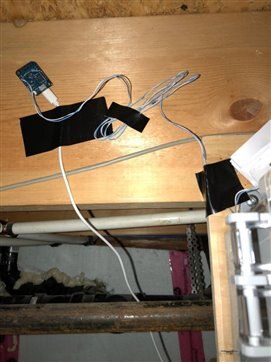
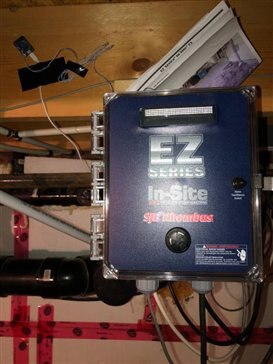
imageimage

And this is how I placed the sensor above the LED on the panel:
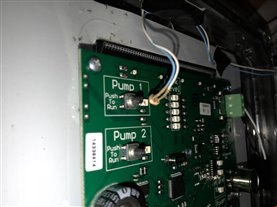
image


I had a WeMos D1 available, so I used that - it's much easier to use than the ESP-01, as it has a micro-USB port on it that I can use to program it, and I can also use it to provide power from a small 5v USB iPhone charger cube.

Instead of a temperature sensor I instead used a light sensor, which I placed near the little red LED "pump on" light on the control panel.

The scripts on the server are also very similar to the temperature one - it logs the readings "on" and "off" into a simple file, and the server adds timestamps.


Because I also wanted to know how long the pump runs each time, the Arduino program counts the number of seconds between the light sensor detecting light and then detecting that the light is off again.

This also gets sent to the server.


To make monitoring more real-time, I added a piece to the script that sends me a text message for each event (using the email-to-text feature my cell provider includes in my package).


I quickly noticed that the pump is always on for about 2:07 (minutes:seconds), give or take 5 seconds. So I added some code for the WeMos to send warning updates to the server if the pump stays on for longer than 5 minutes (I will be reducing that down to 3 minutes soon).


So I've been happily receiving comforting text messages for the last handful of months since that first incident, until this weekend - of course while I was away on a mini-vacation.


This is what I usually see. Very comforting:
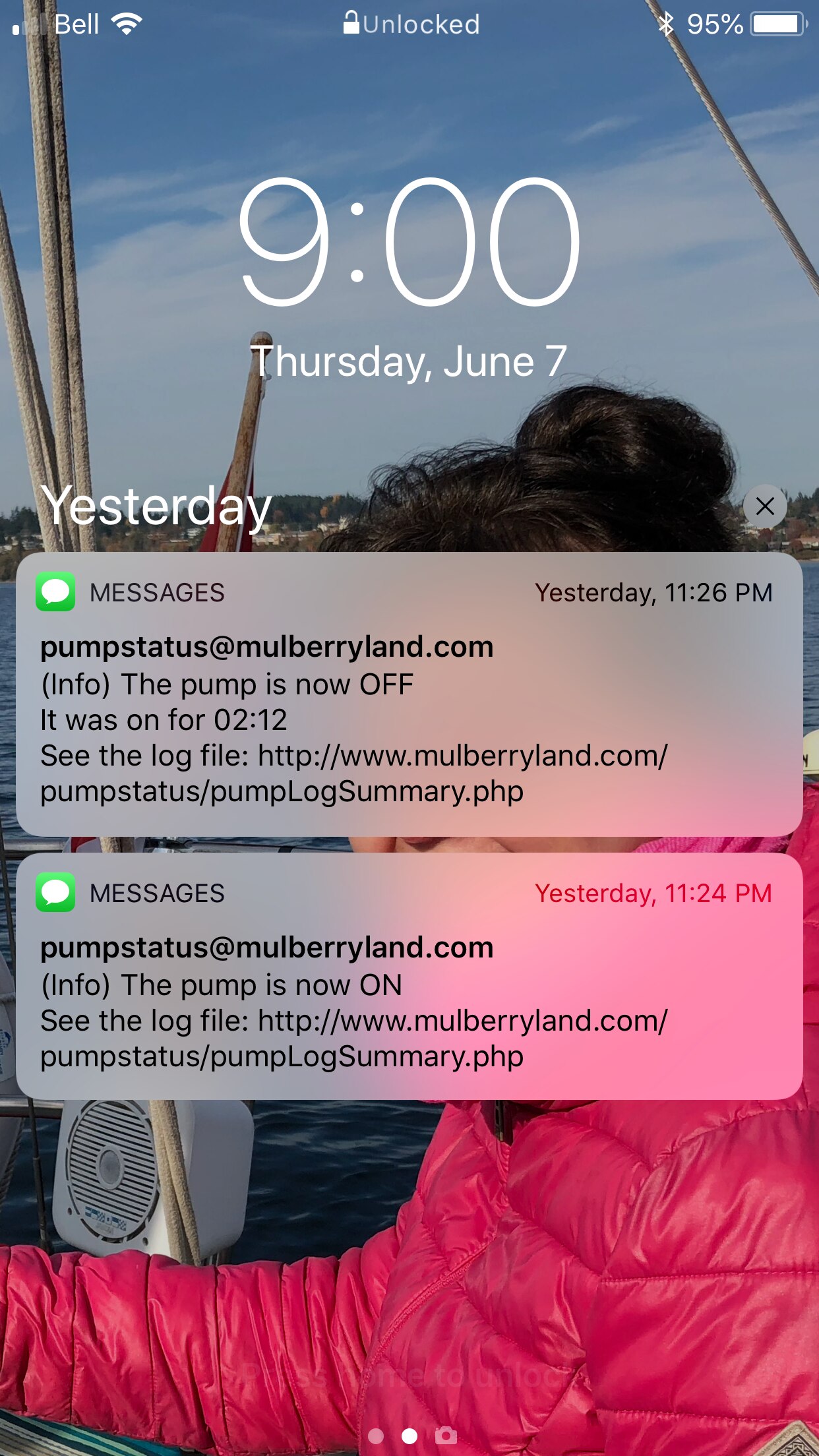
image


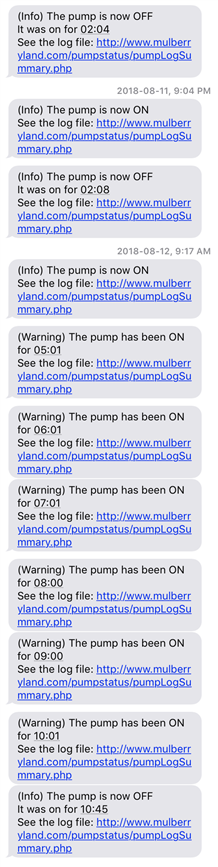
And here is when I knew the pump controller needed attention, not comforting at all! but good to know it works:
image


You'll noticed the top few are 02:04 and 02:08, which is very much along the lines of what I've been getting since I set that up... but then uh-oh!

The pump stayed on for over 10 minutes! EEEP! Luckily it turned off by itself or I would have needed to drive home to deal with it (we were staying overnight on the mountain - about 40 minutes away).


When we got back later that day the pump did a proper run again, but then hiccuped again the next day.


So today we dug it out again (luckily the lid is only a few inches under dirt) - and this time I pulled the sensor out of the tank completely and cleaned it up to where the panel reported it properly as 0.0 inches again. And I raised it up a few more inches just in case the tank gets too much sediment and gums it up again.

Turns out the sensor was reporting the level as 12" when in reality it was down to about 3 or 4".

I'm not very happy with this expensive control panel the plumber installed 4 years ago - it was supposed to be much more reliable, but it turns out to be the opposite! I kinda think this sensor issue caused the previous pump to fail after only 3 years (just after warranty - boo!). The good old fashioned float switches don't care about a bit of goo on them.

If it comes time to replace it, I'll definitely go back to float switches! With my little DIY IoT monitor as a safety backup image

So now we're running some laundry to get the liquid level in the tank up to above the sensor, to make sure that the sensor does report proper numbers and that the pump controller does properly pump out the tank again. The bright side of that is that I don't have to do more shovelling until that part is proven image


So, while it was a lot of effort to clear things up again, we realized that without my little IoT monitor we would not even have known about this issue! It might have caused us yet another premature pump failure from constantly running it dry!


So a definite Win for the DIY tech here!

And my wife no longer makes fun of me receiving text messages from my septic pump image


I'll probably add a redundant low-level float switch, which the control panel has room for, so in the future it at least won't run dry.

The panel tech support guy also suggested I could expand my little DIY device to use a relay to emulate the redundant low-level float! Great idea - seeing as it already counts the minutes I could quite easily have it send the 3 minute warning while at the same time shutting off the pump.


Cheers,

-Nico

  • Sign in to reply

Top Comments

  • jw0752
    jw0752 over 7 years ago +5
    The nice thing about self engineered devices is that you can usually go right to the problem and fix them. The bad thing about self engineered devices is that you may be the only person who can fix them…
  • ntewinkel
    ntewinkel over 7 years ago in reply to jw0752 +4
    Thanks John! As I recall, you had a similar win with your automatic water shut-off and alarm, right? > The bad thing about self engineered devices is that you may be the only person who can fix them. In…
  • ntewinkel
    ntewinkel over 7 years ago in reply to mcb1 +4
    Ours is a sewer lift station - we have city sewer at the edge of the property, but it's higher than the ground level by the house. > Looks like you now need the ability to remotely turn it off as well…
  • ntewinkel
    ntewinkel over 7 years ago in reply to mcb1

    >And I've marked the exact point where the cable will fail.


    Ah! Didn't think of that. And I've seen those bendy things around - I might even have some from old power cords. Wouldn't take much to add one on.

    At least their strain relief is a step up from the basic straight-downward position it would otherwise have when simply zip-tied or clamped, which would require bending up nearly 180 degrees.


    This particular float would not generally move much, as it should only come into play if the tank level gets too low for the pump, but for the multi-daily on/off float it makes sense to add the extra support you pointed out.


    I'm waiting to hear back from SJE - they said my sensor should be replaced and they're sending me a replacement on warranty.


    The tricky part of this setup is that I can't do a visual inspection without making a mess of the walkway there. Otherwise I'd lift the lid occasionally to make sure the sensor's reporting level hasn't shifted.


    Thanks!

    -Nico

    • Cancel
    • Vote Up +1 Vote Down
    • Sign in to reply
    • More
    • Cancel
  • mcb1
    mcb1 over 7 years ago in reply to ntewinkel

    their redundant-low sensor comes with the strain relief and clamp.

    image

    And I've marked the exact point where the cable will fail.


    Since it floats upwards, the point of bending is where it stops being clamped.


    It doesn't have one of those fancy coiled bits of plastic you see like this

    image

    So obviously it will bend where I put the arrow and that means the cable will do 180 deg flex every time.


    While I have no doubt the float itself is fine, the mounting method needs attention.


    So who watching this post has some spare time to model something in 3D ??

    I can do a "MarkCad" to give you and idea of what I was thinking ... but it will be later today (it's 1am here and time for bed)


    Mark

    • Cancel
    • Vote Up +3 Vote Down
    • Sign in to reply
    • More
    • Cancel
  • ntewinkel
    ntewinkel over 7 years ago in reply to mcb1

    >It turned out that the lead broke after years of being flexed at the point where it was attached to the pump.

    Ah! that's really good advice, thank you, and that makes a lot of sense. I had not really thought about that.


    >you'd need a 'curved guide'

    This is something SJE tech support told me this morning too - their redundant-low sensor comes with the strain relief and clamp.


    image

    Here is the link:

    https://www.sjerhombus.com/products/sje-milliampmaster/


    >That suggests to me it's not simply a pressure detector. BUT it sits at the bottom and has a vent higher up, so it must have a very small hole.

    Yes exactly that - it tests the differential pressure. There is a hose that goes up 40" with a tiny tiny vent hole at the top - the top has a little plastic cap that conceals the vent hole pointing downward to ensure it stays clean and dry. That part looked perfectly clean when I checked it.


    Cheers,

    -Nico

    • Cancel
    • Vote Up +2 Vote Down
    • Sign in to reply
    • More
    • Cancel
  • mcb1
    mcb1 over 7 years ago in reply to ntewinkel
    However, a former neighbour (with nearly identical setup) told me his float switches had failed several times in the 4 years they were there.

    I got asked for help from a friend (with the same system as ours) whose pump stopped working.

    It turned out that the lead broke after years of being flexed at the point where it was attached to the pump.


    The lead was simply cable tied onto the pump and since they float each time the liquid level rose, it got flexed at that point.


    If you want to beat that issue, you'd need a 'curved guide' that forced the cable around a gentle radius.

    It would require something to ensure it followed the guide, and someone with a 3D printer could knock up something easily.


    Even when I pulled it out it was still reading a level of 3". It had some surface goo on it, but not in any amount you'd think would cause trouble. Hosing it off gently returned it to 0.0"


    That suggests to me it's not simply a pressure detector. BUT it sits at the bottom and has a vent higher up, so it must have a very small hole.


    Mark

    • Cancel
    • Vote Up +3 Vote Down
    • Sign in to reply
    • More
    • Cancel
  • ntewinkel
    ntewinkel over 7 years ago in reply to mcb1

    >The fact it can be thrown off by debris...

    Right, this was something the installer never told me! He talked me into using this system because "it's so much more reliable and never fails", which I know now is completely untrue. Grrr. And the control panel doesn't add any extra smarts in terms of noticing long run times or any other issues - basically it's just a fancy replacement for 2 float switches (on/off and alarm). The only thing useful it adds is the logging of run times. (and my little add-on doohickey does that in a more useful way).


    The beauty of the float switch is that it doesn't matter if there's debris. However, a former neighbour (with nearly identical setup) told me his float switches had failed several times in the 4 years they were there.

    Our first setup with basic float switches lasted 15 years without us having to touch it, and even then the issue was an air bubble. We should have probably just left it, it likely would have lasted as long as the replacement! (which failed in 3 years).


    >Looking at the manual and other info, it seems the sensor uses pressure to determine the tank level.

    Thanks for looking into that! I did also look at that myself, and I spoke with tech support for quite some time. The sensor was indeed getting clogged a bit, and seemed to be causing a reading of about 7" too high. Even when I pulled it out it was still reading a level of 3". It had some surface goo on it, but not in any amount you'd think would cause trouble. Hosing it off gently returned it to 0.0"


    >You could use a standard water filter to allow the fluid to be filtered

    I had thought about adding something around the sensor, but once I start having to do that much customizing in an attempt to make it reliable I feel that I should just go back to using float switches. I worry that any addition I make might just add a new maintenance issue. Plus the goo on the sensor wouldn't be caught by a roughish filter, and a fine filter would likely clog very quickly.


    >The instruction suggests placement 1 inch above the bottom OR sludge.

    The sensor malfunctioned earlier this year (April or May) while we happened to be outside to notice the pump gurgling sound (and thus my motivation for the IoT monitoring), so at that time I simply raised the sensor another inch or so (after the installer told me about the potential sludge issue). When I pulled it out yesterday I noticed the original installer had put it 1.5" above the bottom, so that should have been enough. I raised it up again, so now it's about 5 or 6" above the bottom.

    That, plus the cleaning, I hope will make it perform well for much longer going forward.


    I kinda think these sensors were designed for effluent systems like your final tank in the septic system, which doesn't get much sludge or debris.


    So my next plan, after the B&B season slows down, is to add a conduit between the tank and the house (the lines are just in the dirt right now) and add the pump's float switch back on - in a pinch this would allow me to do a simple switcheroo in the basement to bypass the controller. It also allows easy pump or float or sensor replacement in the future.


    I will also add a redundant low-level float, to avoid this scenario again - I have a strong feeling that this is what caused our pump to fail last Christmas after only 3 years - the logs showed extended run times. And that seems to be how the C-level sensor fails due to debris.


    And if I can somehow pull it off, I'd like to add my own liquid-level sensor to add to my IoT monitoring setup.


    Thanks!

    -Nico


    • Cancel
    • Vote Up +2 Vote Down
    • Sign in to reply
    • More
    • Cancel
>
element14 Community

element14 is the first online community specifically for engineers. Connect with your peers and get expert answers to your questions.

  • Members
  • Learn
  • Technologies
  • Challenges & Projects
  • Products
  • Store
  • About Us
  • Feedback & Support
  • FAQs
  • Terms of Use
  • Privacy Policy
  • Legal and Copyright Notices
  • Sitemap
  • Cookies

An Avnet Company © 2025 Premier Farnell Limited. All Rights Reserved.

Premier Farnell Ltd, registered in England and Wales (no 00876412), registered office: Farnell House, Forge Lane, Leeds LS12 2NE.

ICP 备案号 10220084.

Follow element14

  • X
  • Facebook
  • linkedin
  • YouTube