element14 Community
element14 Community
    Register Log In
  • Site
  • Search
  • Log In Register
  • Community Hub
    Community Hub
    • What's New on element14
    • Feedback and Support
    • Benefits of Membership
    • Personal Blogs
    • Members Area
    • Achievement Levels
  • Learn
    Learn
    • Ask an Expert
    • eBooks
    • element14 presents
    • Learning Center
    • Tech Spotlight
    • STEM Academy
    • Webinars, Training and Events
    • Learning Groups
  • Technologies
    Technologies
    • 3D Printing
    • FPGA
    • Industrial Automation
    • Internet of Things
    • Power & Energy
    • Sensors
    • Technology Groups
  • Challenges & Projects
    Challenges & Projects
    • Design Challenges
    • element14 presents Projects
    • Project14
    • Arduino Projects
    • Raspberry Pi Projects
    • Project Groups
  • Products
    Products
    • Arduino
    • Avnet & Tria Boards Community
    • Dev Tools
    • Manufacturers
    • Multicomp Pro
    • Product Groups
    • Raspberry Pi
    • RoadTests & Reviews
  • About Us
  • Store
    Store
    • Visit Your Store
    • Choose another store...
      • Europe
      •  Austria (German)
      •  Belgium (Dutch, French)
      •  Bulgaria (Bulgarian)
      •  Czech Republic (Czech)
      •  Denmark (Danish)
      •  Estonia (Estonian)
      •  Finland (Finnish)
      •  France (French)
      •  Germany (German)
      •  Hungary (Hungarian)
      •  Ireland
      •  Israel
      •  Italy (Italian)
      •  Latvia (Latvian)
      •  
      •  Lithuania (Lithuanian)
      •  Netherlands (Dutch)
      •  Norway (Norwegian)
      •  Poland (Polish)
      •  Portugal (Portuguese)
      •  Romania (Romanian)
      •  Russia (Russian)
      •  Slovakia (Slovak)
      •  Slovenia (Slovenian)
      •  Spain (Spanish)
      •  Sweden (Swedish)
      •  Switzerland(German, French)
      •  Turkey (Turkish)
      •  United Kingdom
      • Asia Pacific
      •  Australia
      •  China
      •  Hong Kong
      •  India
      • Japan
      •  Korea (Korean)
      •  Malaysia
      •  New Zealand
      •  Philippines
      •  Singapore
      •  Taiwan
      •  Thailand (Thai)
      • Vietnam
      • Americas
      •  Brazil (Portuguese)
      •  Canada
      •  Mexico (Spanish)
      •  United States
      Can't find the country/region you're looking for? Visit our export site or find a local distributor.
  • Translate
  • Profile
  • Settings
Autodesk EAGLE
  • Products
  • More
Autodesk EAGLE
EAGLE User Support (English) GND pads not connecting to GND polygon?
  • Blog
  • Forum
  • Documents
  • Events
  • Polls
  • Files
  • Members
  • Mentions
  • Sub-Groups
  • Tags
  • More
  • Cancel
  • New
Join Autodesk EAGLE to participate - click to join for free!
Actions
  • Share
  • More
  • Cancel
Forum Thread Details
  • State Verified Answer
  • Replies 9 replies
  • Subscribers 179 subscribers
  • Views 1816 views
  • Users 0 members are here
  • plans
  • polygons
  • gnd
Related

GND pads not connecting to GND polygon?

mastermatic
mastermatic over 9 years ago

Hi, I'm trying to create a 4 layer PCB (TOP + POWER + GND + BOTTOM). I created 2 planes for the VBB and GNDBB using polygons.

My problem is the connection (let's say) beetween a resistor and the PAD of a component (let's call it X component). If try to connect the VBB connection of the resistor to a Via (and the via's name is VBB) the VBB PAD of the X component with appear like the pic below and the airwire that was connecting the resistor to the X component is gone!
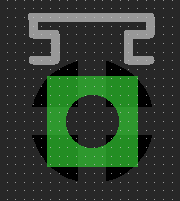
image

But if I try to do the same with a resistor that is connected to a GND pad, the pad stays the same and the airwire is still there, which makes me wonder if the vias are even connecting to the GND plan.


The following are printscreens of the settings I'm currently using.
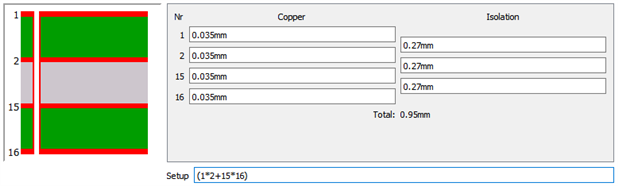
image

image


What am I doing wrong here?

Any help would be highly appreciated!

  • Sign in to reply
  • Cancel
  • autodeskguest
    0 autodeskguest over 9 years ago

    On 31.05.2016 13:11, Nuno Gomes wrote:

    Hi, I'm trying to create a 4 layer PCB (TOP + POWER + GND + BOTTOM). I created 2 planes for the VBB and GNDBB using polygons.

    My problem is the connection (let's say) beetween a resistor and the PAD of a component (let's call it X component). If try to connect the VBB connection of the resistor to a Via (and the via's name is VBB) the VBB PAD of the X component with appear like the pic below and the airwire that was connecting the resistor to the X component is gone!

    But if I try to do the same with a resistor that is connected to a GND pad, the pad stays the same and the airwire is still there, which makes me wonder if the vias are even connecting to the GND plan.


    The following are printscreens of the settings I'm currently using.
     

    What am I doing wrong here?

    Any help would be highly appreciated!


    I'm not sure I understand the question.


    Just make sure the through hole GND pad is surrounded by a polygon named

    GND. A SMD resistor pad needs a via closeby to get to inner layer.

    And remember to do ratsnest.


    • Cancel
    • Vote Up 0 Vote Down
    • Sign in to reply
    • Verify Answer
    • Cancel
  • mastermatic
    0 mastermatic over 9 years ago in reply to autodeskguest

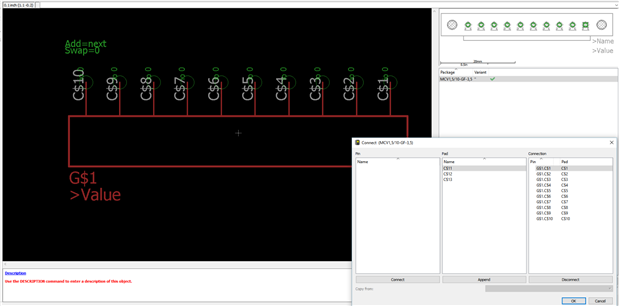
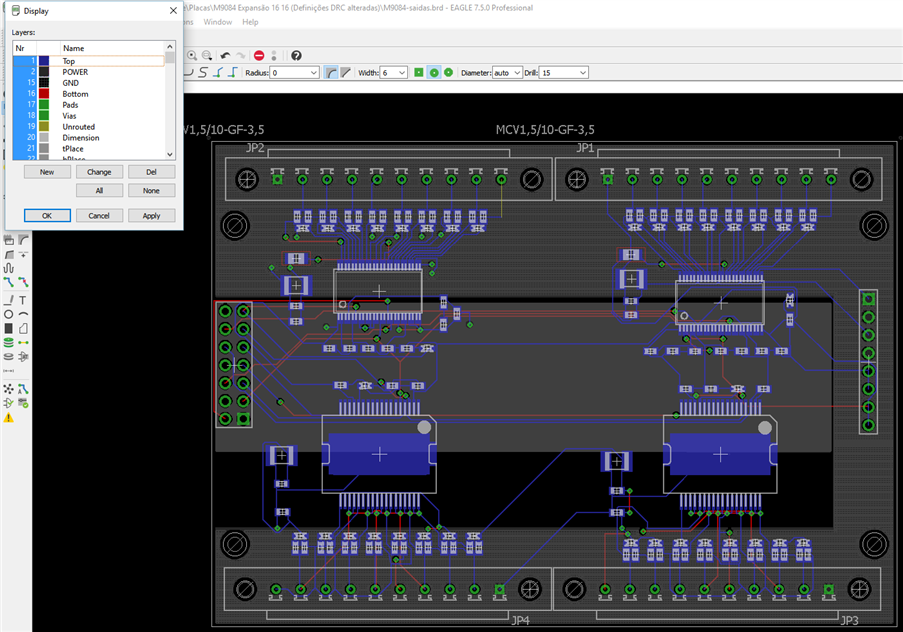
    So, the GND pad on the X component? Like JP2 component on the last picture?

    • Cancel
    • Vote Up 0 Vote Down
    • Sign in to reply
    • Verify Answer
    • Cancel
  • autodeskguest
    0 autodeskguest over 9 years ago in reply to mastermatic

    On 31.05.2016 13:29, Nuno Gomes wrote:

    So, the GND pad on the X component? Like JP2 component on the last picture?


    Are you referring to pin10 of JP2? (assuming pin1 is square) What

    netname does that airwire belonging to? Pin1 of JP2 looks connected to

    GND (assuming hatched grey layer is Layer 15 and polygon named GND)


    You dont seem to have any other polygon on any layer under the connectors.


    Pin1 on JP2 looks a bit funny too. Its appears connected to GND, but

    still got a blue wire.


    • Cancel
    • Vote Up 0 Vote Down
    • Sign in to reply
    • Verify Answer
    • Cancel
  • autodeskguest
    0 autodeskguest over 9 years ago in reply to autodeskguest

    On 31.05.2016 13:35, Morten Leikvoll wrote:

    On 31.05.2016 13:29, Nuno Gomes wrote:

    So, the GND pad on the X component? Like JP2 component on the last

    picture?


    Are you referring to pin10 of JP2? (assuming pin1 is square) What

    netname does that airwire belonging to? Pin1 of JP2 looks connected to

    GND (assuming hatched grey layer is Layer 15 and polygon named GND)


    You dont seem to have any other polygon on any layer under the connectors.


    Pin1 on JP2 looks a bit funny too. Its appears connected to GND, but

    still got a blue wire.


    Ok, maybe the colors are a bit hard to separate.. I see some darker grey

    below the hatched..  I suspect it has a different netname than the airwire.


    Also, I think you need to do better routing on this. My initial reaction

    is that this needs some proper engineering. Like proper decoupling,

    proper heatsinking and proper widths for higher currents here and there.

    Those lower chips looks like power hungry chips.


    • Cancel
    • Vote Up 0 Vote Down
    • Sign in to reply
    • Verify Answer
    • Cancel
  • mastermatic
    0 mastermatic over 9 years ago in reply to autodeskguest

    The pin10 of the JP2 is indeed the GND. This is what the device looks like:

    image

    Yes, the hatched grey layer is layer 15 and the polygon is named GNDBB because there are two tipes of GND plan and two power plans (GND + VDD3.3 & GNDBB + VBB) the GNDBB + VBB are two polygons on top of each other and are the ones closer to the border of the PCB.

    In the last pic of the original question there are indeed two layers on top of each other, not sure if that's the problem.
    I'm not sure about what you "said " Pin1 of JP2 looks connected to GND" because the pin 1 is the POWER (square pad) and it's connected to VBB.

    • Cancel
    • Vote Up 0 Vote Down
    • Sign in to reply
    • Verify Answer
    • Cancel
  • autodeskguest
    0 autodeskguest over 9 years ago in reply to mastermatic

    On 31.05.2016 13:47, Nuno Gomes wrote:

    The pin10 of the JP2 is indeed the GND. This is what the device looks like:

    Yes, the hatched grey layer is layer 15 and the polygon is named GNDBB because there are two tipes of GND plan and two power plans (GND + VDD3.3 & GNDBB + VBB) the GNDBB + VBB are two polygons on top of each other and are the ones closer to the border of the PCB.

    In the last pic of the original question there are indeed two layers on top of each other, not sure if that's the problem.

    I'm not sure about what you "said " Pin1 of JP2 looks connected to GND" because the pin 1 is the POWER (square pad) and it's connected to VBB.


    Pin1 of JP1 just looks funny. Or maybe its the blue wire that goes from

    there to the capacitor. I would expect to get this signal from a via

    down to the polygon instead of routing all the way to the pin.


    Did you check what name the airwire got? Maybe its not connected to what

    you expect. Have a look at the schematic and try moving JP2 around to

    check if its pins are connected to what it looks like.


    • Cancel
    • Vote Up 0 Vote Down
    • Sign in to reply
    • Verify Answer
    • Cancel
  • autodeskguest
    0 autodeskguest over 9 years ago in reply to autodeskguest

    On 31.05.2016 14:15, Morten Leikvoll wrote:

    On 31.05.2016 13:47, Nuno Gomes wrote:

    The pin10 of the JP2 is indeed the GND. This is what the device looks

    like:

    Yes, the hatched grey layer is layer 15 and the polygon is named GNDBB

    because there are two tipes of GND plan and two power plans (GND +

    VDD3.3 & GNDBB + VBB) the GNDBB + VBB are two polygons on top of each

    other and are the ones closer to the border of the PCB.

    In the last pic of the original question there are indeed two layers

    on top of each other, not sure if that's the problem.

    I'm not sure about what you "said " Pin1 of JP2 looks connected to

    GND" because the pin 1 is the POWER (square pad) and it's connected to

    VBB.


    Pin1 of JP1 just looks funny. Or maybe its the blue wire that goes from

    there to the capacitor. I would expect to get this signal from a via

    down to the polygon instead of routing all the way to the pin.


    Did you check what name the airwire got? Maybe its not connected to what

    you expect. Have a look at the schematic and try moving JP2 around to

    check if its pins are connected to what it looks like.


    An alternative way is to click the show button, then the airwire. Both

    the airwire and the polygon should highlite. If not, they are not the

    same net.


    • Cancel
    • Vote Up 0 Vote Down
    • Sign in to reply
    • Verify Answer
    • Cancel
  • mastermatic
    0 mastermatic over 9 years ago in reply to autodeskguest

    About the engineering of the routes I have to say that I only started manually optimizing the JP2 and it's conenctions and everything else you are seeing has been done by autoroute (there's still long way to go image)
    About the pin 1 of JP1 the autoroute did it automatically.
    About that JP2 pin 10 airwire (GNDBB connection) seems like it's gone since I ran ratsnest (dunno why xd)

    And when I click the show button and click the GND routes it also highlights the GND polygon so I think it's done right. What do you think?


    EDIT:

    what do you mean by

    "Like proper decoupling, proper heatsinking..."

    • Cancel
    • Vote Up 0 Vote Down
    • Sign in to reply
    • Verify Answer
    • Cancel
  • autodeskguest
    0 autodeskguest over 9 years ago

    On 31/05/16 12:11, Nuno Gomes wrote:

    I created 2 planes for the VBB and GNDBB using polygons.

    Note----


    ^^^^^

    But if I try to do the same with a resistor that is connected to a GND pad,

    Note----


    ^^^

    the pad stays the same and the airwire is still there, which makes me wonder if the vias are even connecting to the GND plan.


    If your ground plane polygon is named "GNDBB" it will not connect to

    vias named "GND". They need to be the same.


    • Cancel
    • Vote Up 0 Vote Down
    • Sign in to reply
    • Reject Answer
    • Cancel
element14 Community

element14 is the first online community specifically for engineers. Connect with your peers and get expert answers to your questions.

  • Members
  • Learn
  • Technologies
  • Challenges & Projects
  • Products
  • Store
  • About Us
  • Feedback & Support
  • FAQs
  • Terms of Use
  • Privacy Policy
  • Legal and Copyright Notices
  • Sitemap
  • Cookies

An Avnet Company © 2026 Premier Farnell Limited. All Rights Reserved.

Premier Farnell Ltd, registered in England and Wales (no 00876412), registered office: Farnell House, Forge Lane, Leeds LS12 2NE.

ICP 备案号 10220084.

Follow element14

  • X
  • Facebook
  • linkedin
  • YouTube