element14 Community
element14 Community
    Register Log In
  • Site
  • Search
  • Log In Register
  • Community Hub
    Community Hub
    • What's New on element14
    • Feedback and Support
    • Benefits of Membership
    • Personal Blogs
    • Members Area
    • Achievement Levels
  • Learn
    Learn
    • Ask an Expert
    • eBooks
    • element14 presents
    • Learning Center
    • Tech Spotlight
    • STEM Academy
    • Webinars, Training and Events
    • Learning Groups
  • Technologies
    Technologies
    • 3D Printing
    • FPGA
    • Industrial Automation
    • Internet of Things
    • Power & Energy
    • Sensors
    • Technology Groups
  • Challenges & Projects
    Challenges & Projects
    • Design Challenges
    • element14 presents Projects
    • Project14
    • Arduino Projects
    • Raspberry Pi Projects
    • Project Groups
  • Products
    Products
    • Arduino
    • Avnet & Tria Boards Community
    • Dev Tools
    • Manufacturers
    • Multicomp Pro
    • Product Groups
    • Raspberry Pi
    • RoadTests & Reviews
  • About Us
    About the element14 Community
  • Store
    Store
    • Visit Your Store
    • Choose another store...
      • Europe
      •  Austria (German)
      •  Belgium (Dutch, French)
      •  Bulgaria (Bulgarian)
      •  Czech Republic (Czech)
      •  Denmark (Danish)
      •  Estonia (Estonian)
      •  Finland (Finnish)
      •  France (French)
      •  Germany (German)
      •  Hungary (Hungarian)
      •  Ireland
      •  Israel
      •  Italy (Italian)
      •  Latvia (Latvian)
      •  
      •  Lithuania (Lithuanian)
      •  Netherlands (Dutch)
      •  Norway (Norwegian)
      •  Poland (Polish)
      •  Portugal (Portuguese)
      •  Romania (Romanian)
      •  Russia (Russian)
      •  Slovakia (Slovak)
      •  Slovenia (Slovenian)
      •  Spain (Spanish)
      •  Sweden (Swedish)
      •  Switzerland(German, French)
      •  Turkey (Turkish)
      •  United Kingdom
      • Asia Pacific
      •  Australia
      •  China
      •  Hong Kong
      •  India
      •  Japan
      •  Korea (Korean)
      •  Malaysia
      •  New Zealand
      •  Philippines
      •  Singapore
      •  Taiwan
      •  Thailand (Thai)
      •  Vietnam
      • Americas
      •  Brazil (Portuguese)
      •  Canada
      •  Mexico (Spanish)
      •  United States
      Can't find the country/region you're looking for? Visit our export site or find a local distributor.
  • Translate
  • Profile
  • Settings
Autodesk EAGLE
  • Products
  • More
Autodesk EAGLE
Forum Reticon SAD1024 Delay Chip
  • Blog
  • Forum
  • Documents
  • Events
  • Polls
  • Files
  • Members
  • Mentions
  • Sub-Groups
  • Tags
  • More
  • Cancel
  • New
Join Autodesk EAGLE to participate - click to join for free!
Actions
  • Share
  • More
  • Cancel
Forum Thread Details
  • State Verified Answer
  • Replies 39 replies
  • Answers 14 answers
  • Subscribers 203 subscribers
  • Views 13159 views
  • Users 0 members are here
Related

Reticon SAD1024 Delay Chip

Andy Betts
Andy Betts over 8 years ago

Reaching out to the people on this web site.......


I'm after a SAD1024 delay chip, they were manufactured by Reticon and are now discontinued, and have been for around 30 years. I'm hoping someone here may have one lying around....... if so can you get back to me and I'll make you an offer to buy it off you.


As a heads up this is required for a planned pedal build, for the near future, but it all rests on being able to obtain this IC chip.


The data sheet is available to read here


http://www.pmerecords.com/Docs/Archer_SAD-1024_Tech_Data.pdf

  • Sign in to reply
  • Cancel
Parents
  • jw0752
    0 jw0752 over 8 years ago

    Hi Andy,

    I checked and I do not have this chip. Apparently it was sold for a while by Radio Shack under stock number 276-1761. There was some talk on the following link about using a MN3007 as a possible substitute.


    http://music-electronics-forum.com/t23353/


    I see that there are two or three listed on ebay but the sellers know they have little pieces of gold judging by the price tags.


    John

    • Cancel
    • Vote Up +4 Vote Down
    • Sign in to reply
    • Verify Answer
    • Reject Answer
    • Cancel
  • michaelkellett
    0 michaelkellett over 8 years ago in reply to jw0752

    Andy,

    You may know these people:


    Small Bear Electronics


    They have clones of the MN3207 chip.


    Why must you have the SAD1024, can you post the circuit of the thing you want to build. It is possible to make a replacement for the SAD1024 using an ADC, tiny FPGA and DAC - it won't be the same size (on a hobby budget) but would work fine, and offer all sorts of other possibilities.


    MK

    • Cancel
    • Vote Up +1 Vote Down
    • Sign in to reply
    • Verify Answer
    • Reject Answer
    • Cancel
  • Andy Betts
    0 Andy Betts over 8 years ago in reply to michaelkellett

    Hi Michael


    Yeah, I know small bear... US supplier, and expensive to get shipped over to the UK.


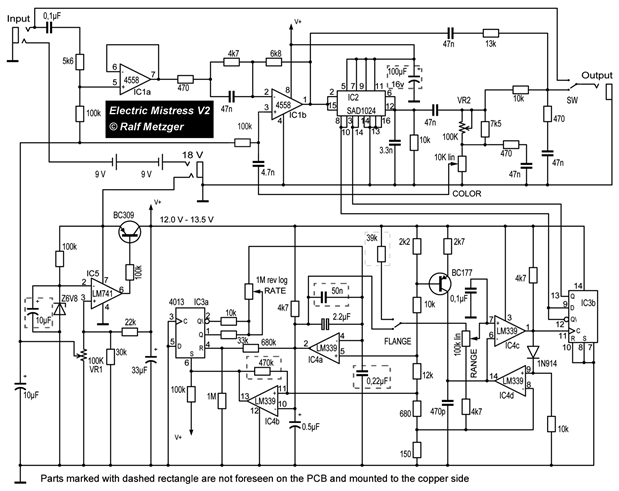
    The circuit is attached


    image


    From what I understand, the SAD1024 is pretty peculiar to this circuit, however if there's a good substitute I'm willing to look into that.


    Original SAD chips are expensive, for that very reason....... They are gold

    • Cancel
    • Vote Up +1 Vote Down
    • Sign in to reply
    • Verify Answer
    • Reject Answer
    • Cancel
  • shabaz
    0 shabaz over 8 years ago in reply to michaelkellett

    Oh I see.. I hadn't realized that is what a flanger did : (

    I guess at some stage it just makes sense to do all this in software on a PC or DSP. I have a friend who works in the sound industry, he uses some fancy gear to generate virtually any sound programmatically, essentially a DSP connected to a PC, and he downloads either instructions or scripts to it. But, at the same time he also uses low-tech too, he will use a mic and record anything interesting and then play with it to make the effect he is seeking.

    Motorola/Freescale had a nice dev-board (probably still available on ebay) which had a DSP (56k series, so quite old : (, enough RAM for echo-style effects, and codec, and I think a serial port for downloading the program to it. It could make a nice universal effects pedal!

    • Cancel
    • Vote Up +1 Vote Down
    • Sign in to reply
    • Verify Answer
    • Cancel
  • michaelkellett
    0 michaelkellett over 8 years ago in reply to shabaz

    The really hard part about exact replication is that the BBD (Bucket Brigade Delay) device varies its sampling rate as the clock changes and the clock in the flangers is swept. This means that data is sampled at one clock speed but then passes into the delay chain and may be sampled at the output at a different rate from that at which it was captured.

    Typical ADC - DSP- DAC chains sample at  a constant rate and will have serious issues if swept sampling is attempted (and only ultra pricey parts can go fast enough). It is possible to achieve the entire effect with constant rate sampling but the DSP will be required to interpolate and resample at both input and output and I would guess that an audio sample rate of 192kHz will be needed to come close to the behavior of the SAD1024. This kind of DSP stuff is possible with DSP chips or FPGA (@ DAB - way out of PSOC league). The development effort in software is significant (if I were quoting a customer I would allow 8 weeks for the FPGA HDL work).


    The other way to do it is to use a non-conventional chain with SAR ADC and ladder type DAC where the sampling is on demand with negligible latency. 16 bit 2MHz parts will be needed to match the SAD1024 dynamic range and speed. The FPGA needs to do very little other than buffer the data (needs 2k bytes of internal RAM so a Lattice ICE40 series part would do - and would keep the power low.


    The problem is that the 16 bit 2MHz ADC and DAC are quite expensive.


    MK

    • Cancel
    • Vote Up +1 Vote Down
    • Sign in to reply
    • Verify Answer
    • Reject Answer
    • Cancel
  • shabaz
    0 shabaz over 8 years ago in reply to jc2048

    Oh I see! Yeah I wasn't sure what specifically the flange sound was, and what it might translate to in requirements, even after scanning briefly through the video (although I am most definitely a fan of the Police!!).

    • Cancel
    • Vote Up +1 Vote Down
    • Sign in to reply
    • Verify Answer
    • Cancel
  • jc2048
    0 jc2048 over 8 years ago in reply to shabaz

    I don't know much about musical stuff, but from that circuit I'd say that the flange effect comes from sweeping the clock up and down in frequency.


    The 470p being charged by the transistor (set up as a current source) and then being reset by the comparators is evidently the actual clock. The period of that clock is determined by the slower triangle waveform generated by IC4a (the 22u integrates up and down depending on the state of the flip-flop IC3a, which flips backwards and forwards in the way that flip-flops like to do).


    Unless you could simulate that I don't think you would have flanging, though you'd be able to do other interesting stuff with it.

    • Cancel
    • Vote Up +1 Vote Down
    • Sign in to reply
    • Verify Answer
    • Reject Answer
    • Cancel
Reply
  • jc2048
    0 jc2048 over 8 years ago in reply to shabaz

    I don't know much about musical stuff, but from that circuit I'd say that the flange effect comes from sweeping the clock up and down in frequency.


    The 470p being charged by the transistor (set up as a current source) and then being reset by the comparators is evidently the actual clock. The period of that clock is determined by the slower triangle waveform generated by IC4a (the 22u integrates up and down depending on the state of the flip-flop IC3a, which flips backwards and forwards in the way that flip-flops like to do).


    Unless you could simulate that I don't think you would have flanging, though you'd be able to do other interesting stuff with it.

    • Cancel
    • Vote Up +1 Vote Down
    • Sign in to reply
    • Verify Answer
    • Reject Answer
    • Cancel
Children
  • shabaz
    0 shabaz over 8 years ago in reply to michaelkellett

    Oh I see.. I hadn't realized that is what a flanger did : (

    I guess at some stage it just makes sense to do all this in software on a PC or DSP. I have a friend who works in the sound industry, he uses some fancy gear to generate virtually any sound programmatically, essentially a DSP connected to a PC, and he downloads either instructions or scripts to it. But, at the same time he also uses low-tech too, he will use a mic and record anything interesting and then play with it to make the effect he is seeking.

    Motorola/Freescale had a nice dev-board (probably still available on ebay) which had a DSP (56k series, so quite old : (, enough RAM for echo-style effects, and codec, and I think a serial port for downloading the program to it. It could make a nice universal effects pedal!

    • Cancel
    • Vote Up +1 Vote Down
    • Sign in to reply
    • Verify Answer
    • Cancel
  • michaelkellett
    0 michaelkellett over 8 years ago in reply to shabaz

    The really hard part about exact replication is that the BBD (Bucket Brigade Delay) device varies its sampling rate as the clock changes and the clock in the flangers is swept. This means that data is sampled at one clock speed but then passes into the delay chain and may be sampled at the output at a different rate from that at which it was captured.

    Typical ADC - DSP- DAC chains sample at  a constant rate and will have serious issues if swept sampling is attempted (and only ultra pricey parts can go fast enough). It is possible to achieve the entire effect with constant rate sampling but the DSP will be required to interpolate and resample at both input and output and I would guess that an audio sample rate of 192kHz will be needed to come close to the behavior of the SAD1024. This kind of DSP stuff is possible with DSP chips or FPGA (@ DAB - way out of PSOC league). The development effort in software is significant (if I were quoting a customer I would allow 8 weeks for the FPGA HDL work).


    The other way to do it is to use a non-conventional chain with SAR ADC and ladder type DAC where the sampling is on demand with negligible latency. 16 bit 2MHz parts will be needed to match the SAD1024 dynamic range and speed. The FPGA needs to do very little other than buffer the data (needs 2k bytes of internal RAM so a Lattice ICE40 series part would do - and would keep the power low.


    The problem is that the 16 bit 2MHz ADC and DAC are quite expensive.


    MK

    • Cancel
    • Vote Up +1 Vote Down
    • Sign in to reply
    • Verify Answer
    • Reject Answer
    • Cancel
  • shabaz
    0 shabaz over 8 years ago in reply to jc2048

    Oh I see! Yeah I wasn't sure what specifically the flange sound was, and what it might translate to in requirements, even after scanning briefly through the video (although I am most definitely a fan of the Police!!).

    • Cancel
    • Vote Up +1 Vote Down
    • Sign in to reply
    • Verify Answer
    • Cancel
element14 Community

element14 is the first online community specifically for engineers. Connect with your peers and get expert answers to your questions.

  • Members
  • Learn
  • Technologies
  • Challenges & Projects
  • Products
  • Store
  • About Us
  • Feedback & Support
  • FAQs
  • Terms of Use
  • Privacy Policy
  • Legal and Copyright Notices
  • Sitemap
  • Cookies

An Avnet Company © 2026 Premier Farnell Limited. All Rights Reserved.

Premier Farnell Ltd, registered in England and Wales (no 00876412), registered office: Farnell House, Forge Lane, Leeds LS12 2NE.

Follow element14

  • X
  • Facebook
  • linkedin
  • YouTube