
element14 Community
element14 Community
    Register Log In
  • Site
  • Search
  • Log In Register
  • Community Hub
    Community Hub
    • What's New on element14
    • Feedback and Support
    • Benefits of Membership
    • Personal Blogs
    • Members Area
    • Achievement Levels
  • Learn
    Learn
    • Ask an Expert
    • eBooks
    • element14 presents
    • Learning Center
    • Tech Spotlight
    • STEM Academy
    • Webinars, Training and Events
    • Learning Groups
  • Technologies
    Technologies
    • 3D Printing
    • FPGA
    • Industrial Automation
    • Internet of Things
    • Power & Energy
    • Sensors
    • Technology Groups
  • Challenges & Projects
    Challenges & Projects
    • Design Challenges
    • element14 presents Projects
    • Project14
    • Arduino Projects
    • Raspberry Pi Projects
    • Project Groups
  • Products
    Products
    • Arduino
    • Avnet & Tria Boards Community
    • Dev Tools
    • Manufacturers
    • Multicomp Pro
    • Product Groups
    • Raspberry Pi
    • RoadTests & Reviews
  • About Us
    About the element14 Community
  • Store
    Store
    • Visit Your Store
    • Choose another store...
      • Europe
      •  Austria (German)
      •  Belgium (Dutch, French)
      •  Bulgaria (Bulgarian)
      •  Czech Republic (Czech)
      •  Denmark (Danish)
      •  Estonia (Estonian)
      •  Finland (Finnish)
      •  France (French)
      •  Germany (German)
      •  Hungary (Hungarian)
      •  Ireland
      •  Israel
      •  Italy (Italian)
      •  Latvia (Latvian)
      •  
      •  Lithuania (Lithuanian)
      •  Netherlands (Dutch)
      •  Norway (Norwegian)
      •  Poland (Polish)
      •  Portugal (Portuguese)
      •  Romania (Romanian)
      •  Russia (Russian)
      •  Slovakia (Slovak)
      •  Slovenia (Slovenian)
      •  Spain (Spanish)
      •  Sweden (Swedish)
      •  Switzerland(German, French)
      •  Turkey (Turkish)
      •  United Kingdom
      • Asia Pacific
      •  Australia
      •  China
      •  Hong Kong
      •  India
      •  Japan
      •  Korea (Korean)
      •  Malaysia
      •  New Zealand
      •  Philippines
      •  Singapore
      •  Taiwan
      •  Thailand (Thai)
      •  Vietnam
      • Americas
      •  Brazil (Portuguese)
      •  Canada
      •  Mexico (Spanish)
      •  United States
      Can't find the country/region you're looking for? Visit our export site or find a local distributor.
  • Translate
  • Profile
  • Settings
Raspberry Pi
  • Products
  • More
Raspberry Pi
Raspberry Pi Forum Interesting "Competitors" for the Raspberry Pi
  • Blog
  • Forum
  • Documents
  • Quiz
  • Events
  • Polls
  • Files
  • Members
  • Mentions
  • Sub-Groups
  • Tags
  • More
  • Cancel
  • New
Join Raspberry Pi to participate - click to join for free!
Featured Articles
Announcing Pi
Technical Specifications
Raspberry Pi FAQs
Win a Pi
Raspberry Pi Wishlist
Actions
  • Share
  • More
  • Cancel
Forum Thread Details
  • Replies 196 replies
  • Subscribers 705 subscribers
  • Views 23610 views
  • Users 0 members are here
  • single_board_computer
  • single_board_computers
  • raspberry_pi
Related

Interesting "Competitors" for the Raspberry Pi

wallarug
wallarug over 13 years ago

It is interesting to see what people are comparing to the "An ARM GNU/Linux box for $25. Take a byte!" to these days.


http://arstechnica.com/information-technology/2012/09/99-raspberry-pi-sized-supercomputer-touted-in-kickstarter-project/

This article is talking about a $99 dollar supercomputer that has 16 cores @ 700MHz each.


http://www.electronicsweekly.com/Articles/28/09/2012/54676/raspberry-pi-gets-a-competitor.htm

This article is about an ARM board, not that different to the Raspberry Pi but with more power and RAM.

  • Sign in to reply
  • Cancel
Parents
  • jamodio
    jamodio over 13 years ago

    The parallela sounds and looks cool but we are talking about a major project that includes sillicon rebake and that probably is 6-12months away from mass production.


    Meanwhile while there are other developments that are not exactly comparable to the R-Pi, they are slowly but steady making progress, like the OLinuXino boards from Olimex. I'm testing both the micro and maxi using the Freescale iMX233 application processor SoC (fully documented by the way,) waiting for the A13 one and they also have under development one using the A10. The iMX233 Maxi uses also the LAN9512 and I didn't find any issues with it yet (and BTW the connectors are properly aligned and it has a nice swtiching power supply, the board is slightly bigger than the R-pi, no HDMI/VGA tough.)


    I also recently got a TI AM335x Starter Kit, you will start to see more stuff based on the AM335x and TI will get more agressive to dettach the OMAP from some applications and put it on boards similar to the R-Pi.


    Still the R-pi continues to be a good idea, unfortunatelly with an associated plan badly executed and with more focus on hype and promotion than really make it a strong and solid "product" with the participation of a community that is eager and able to contribute.


    No schematics, no Gerbers, major concern is "cloning" .... I'd not clone something that is not working properly ...


    -J

    • Cancel
    • Vote Up 0 Vote Down
    • Sign in to reply
    • Cancel
  • Former Member
    Former Member over 13 years ago in reply to jamodio

    At least it looks like Olimex is taking the problems from people using their boards seriously.

    Their Forum is an example of what a forum should be like.


    The supply dip when you connect an usb device is a known fact. It might be hard to notice it on a scope, unless you have a good memory scope and are able to trigger it properly. The issue happens more frequently on the newer boards with the usb polyfuses removed. If you look at the Pi schematics, there aren't much buffer capacitors on the 5V supply rail. (just 1 small capacitor). I guess we get what we payed for.

    It looks like a lot of the Pi usb issues are caused by timing.

    As linux isn't a real time OS, and as stated before that the cpu can become heavy loaded, I doubt they will ever be able to fully fix the issue.

    Besides the usb, there are other dissapointing things. One mentionned already is the fact that X11 isn't hardware accelerated.

    Another one is the poor quality of the analog audio output. A third one is the fact that you need to properly shutdown the system to avoid sd card corruption. This makes it difficult to use the Pi as an embedded solution. A fourth one is the critical power requirement of the board.

    Some of those can be resolved, but all solutions make your cheap solution (not so cheap) anymore.

    I know it's a little off topic, but these points are worth checking when seeking for "Competitors" and might rectify a higher price.

    • Cancel
    • Vote Up 0 Vote Down
    • Sign in to reply
    • Cancel
  • shabaz
    shabaz over 13 years ago in reply to jamodio

    By the way, if you're ordering direct from Olimex to the UK, I'd highly recommend the insured option.

    Problem is, that costs a lot (for me anyway).

    I've never had a problem buying stuff from elsewhere in Europe, US, Asia, but the Olimex one never arrived.

    The local post is always reliable here.

    They never e-mailed a notice of shipment, so when I queried them about it (just to ask shipping company), they replied

    that it's not their responsibility, and left me to chase up with Bulgaria post (and still not being sure of the

    shipment or where it was dispatched from to provide information to Bulgaria Post).

    Since then, I've just purchased my boards elsewhere (e.g. I got a low cost AT91SAM7S blank PCB in a better form factor

    for just a few dollars, and soldered the microcontroller on myself).


    My e-mail to Olimex:

    Hi,


    It's been three weeks, but unfortunately the items still have not arrived. Which

    postal firm was used for the airmail shipping, so I can check with Royal Mail

    if they received it?


    Many thanks,


    Their response from their CEO:

    Hi

    this is Bulgarian post service, as written on our web AIRMAIL is post shipping with no tracking

    usually it takes 1-2 weeks to arrive but sometimes it may take up to 5-6 weeks, this is outside our control and this is why on our web when your order with this shipment there is tickbox


    "I understand that:

    My order will be shipped with non-insured shipping service and Olimex cannot be held responsible for damaged, lost, or stolen packages."

    • Cancel
    • Vote Up 0 Vote Down
    • Sign in to reply
    • Cancel
  • jamodio
    jamodio over 13 years ago in reply to wallarug

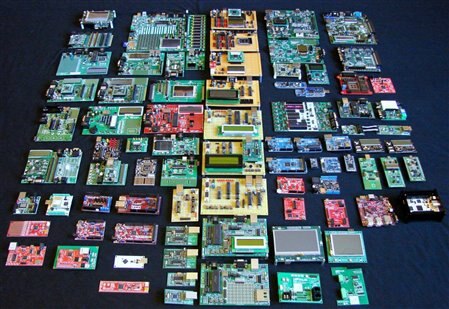
    Thanks, and that's just a very small part of the entire collection of evaluation/development boards, starter kits, etc.


    I think that pariing the R-Pi with an Arduino is a great idea, also with other microcontroller based boards that can run a RTOS for better real time control, it also has the side effect that if you do thing right, thinkering with the I/Os on the Arduinio will limit potential damage on the R-Pi.


    -J

    • Cancel
    • Vote Up 0 Vote Down
    • Sign in to reply
    • Cancel
  • jamodio
    jamodio over 13 years ago in reply to shabaz

    Yup, shipping is a nightmare, particularly to/from some places in Europe, if you want to have tracking or better service it costs much more. I shipped a large number of boards from the US to Europe, Customs are always a pain in the butt, Italy particularly is horrible, UK is efficient but I had some cases where the customer was supposed to be notified to pick up a parcel and they never did, France is also problematic.


    I'll stronlgy suggest you try to get your stuff from a local distributor, Farnell and Cool Components are Olimex's distributors in the UK.


    -J

    • Cancel
    • Vote Up 0 Vote Down
    • Sign in to reply
    • Cancel
  • shabaz
    shabaz over 13 years ago in reply to jamodio

    I agree on that, and there are some nice interfaces (I2C, SPI, asynch serial) for example which allow for compatibility between any interface board and any processor board (Rasp-pi, etc) since the rasp-pi has so few GPIO. TI seem to have some nice motor controllers, I've been looking into the DRV8432 (for an unrelated project), it needs maybe 6 GPIO, but I've yet to assemble up a board with that and a microcontroller. So much to do and so little time as always!

    • Cancel
    • Vote Up 0 Vote Down
    • Sign in to reply
    • Cancel
  • Former Member
    Former Member over 13 years ago in reply to Former Member

    A third one is the fact that you need to properly shutdown the system to avoid sd card corruption.

    That has very little to do with the Pi, the same would be true of linux (or windows) on your desktop/laptop if you just yank the power.


    It's much more down to the trade offs you make by runing a full desktop oriented OS on what's essentially an embedded device.  Or put it another way, there's millions of xDSL routers, wifi AP's, android phones etc. that don't corrupt their flash storage when power unexpectedly goes away and they're mostly running linux too.

    Of course they've been designed with that scenario in mind and have the OS specifically setup to handle it properly.

    • Cancel
    • Vote Up 0 Vote Down
    • Sign in to reply
    • Cancel
  • fustini
    fustini over 13 years ago in reply to jamodio

    You had me drooling on G+ image

    • Cancel
    • Vote Up 0 Vote Down
    • Sign in to reply
    • Cancel
  • GeorgeIoak
    GeorgeIoak over 13 years ago in reply to fustini

    So, from all of our discussion I haven't really seen a viable contender to the RPi considering it's cost and video capabilities. I really like the OMAP boards but they aren't even close to the $35 mark. The TI AM335x looks pretty good and there are some boards starting to come out which could get you close to a $50 mark but I haven't touched one yet so I can't say 1st hand how they perform. TI does do a pretty good job supporting the community though.


    Is there anyway we could collectively rally together and try to fix the RPi or make a strong collective recommendation to The Foundation or is the closed nature of Broadcom too much of a deterent for anyone to jump on board? What if you take the Rev A board and modify it so it includes a plug in header (like the Gumstix) which would allow you to add peripherals that we are in control of (i.e., ethernet, USB hub, LCD??).


    Just thining out loud....

    • Cancel
    • Vote Up 0 Vote Down
    • Sign in to reply
    • Cancel
  • jamodio
    jamodio over 13 years ago in reply to fustini

    LOL Drew,


    I guess you have not seen this one I think I posted somewhere else, and still it does not show "everything"


    image

    -J

    • Cancel
    • Vote Up +2 Vote Down
    • Sign in to reply
    • Cancel
  • jamodio
    jamodio over 13 years ago in reply to GeorgeIoak

    Very unlikely that the RPF will ever listen to any recommendation such that.


    -J

    • Cancel
    • Vote Up 0 Vote Down
    • Sign in to reply
    • Cancel
  • johnbeetem
    johnbeetem over 13 years ago in reply to GeorgeIoak

    George Ioakimedes wrote:


    So, from all of our discussion I haven't really seen a viable contender to the RPi considering it's cost and video capabilities. I really like the OMAP boards but they aren't even close to the $35 mark. The TI AM335x looks pretty good and there are some boards starting to come out which could get you close to a $50 mark but I haven't touched one yet so I can't say 1st hand how they perform. TI does do a pretty good job supporting the community though.


    Is there anyway we could collectively rally together and try to fix the RPi or make a strong collective recommendation to The Foundation or is the closed nature of Broadcom too much of a deterent for anyone to jump on board?

    It's going to be hard for anyone to compete with RasPi, especially when they start shipping Model A at US$25.  Most companies want to make a good profit, which already puts them at a disadvantage against a not-for-profit.  The main thing is volume: if BeagleBone had the same volume as RasPi, they could probably match the price.


    Broadcom has a bad reputation for openness.  Anyone who's tried to design with their parts has found out how difficult it is to get data unless it's a ridiculously common part like an Ethernet PHY.  I really don't think they're going to open up BCM2835 documentation until it becomes blatently obvious that it's costing them business.  The best way for this to happen is for people to choose products with open documentation.  However, this doesn't happen with mobile technology: most people just want a consumption device and couldn't care less whether you can get a tech reference manual.  I don't expect Broadcom to open anything up any time soon.


    Different companies have different traditions regarding open documentation.  This mostly has to do with corporate culture and corporate history.  I have a theory about one company that's particularly good about open documentation.  According to rumor, this company used to publish data sheets before they did the layout of the part.  If enough orders came in, then they'd assign engineers to do the layout, prototype fab, and testing on an exhaustingly short schedule.  This meant (a) you probably didn't want to be a chip designer at this company, and (b) you'd better get samples before designing that company's parts into your product.  In fairness, the hardest part of designing a part is determining its function and target specs, and once you have those doing the layout is straightforward as long as the timing is reasonable.  Also, I don't think that company does this anymore because modern parts take way too long to get from start of layout to samples.


    The point of this story?  I think one big reason that company has such open documentation today is because their data sheets literally sold their products in the past.

    • Cancel
    • Vote Up 0 Vote Down
    • Sign in to reply
    • Cancel
Reply
  • johnbeetem
    johnbeetem over 13 years ago in reply to GeorgeIoak

    George Ioakimedes wrote:


    So, from all of our discussion I haven't really seen a viable contender to the RPi considering it's cost and video capabilities. I really like the OMAP boards but they aren't even close to the $35 mark. The TI AM335x looks pretty good and there are some boards starting to come out which could get you close to a $50 mark but I haven't touched one yet so I can't say 1st hand how they perform. TI does do a pretty good job supporting the community though.


    Is there anyway we could collectively rally together and try to fix the RPi or make a strong collective recommendation to The Foundation or is the closed nature of Broadcom too much of a deterent for anyone to jump on board?

    It's going to be hard for anyone to compete with RasPi, especially when they start shipping Model A at US$25.  Most companies want to make a good profit, which already puts them at a disadvantage against a not-for-profit.  The main thing is volume: if BeagleBone had the same volume as RasPi, they could probably match the price.


    Broadcom has a bad reputation for openness.  Anyone who's tried to design with their parts has found out how difficult it is to get data unless it's a ridiculously common part like an Ethernet PHY.  I really don't think they're going to open up BCM2835 documentation until it becomes blatently obvious that it's costing them business.  The best way for this to happen is for people to choose products with open documentation.  However, this doesn't happen with mobile technology: most people just want a consumption device and couldn't care less whether you can get a tech reference manual.  I don't expect Broadcom to open anything up any time soon.


    Different companies have different traditions regarding open documentation.  This mostly has to do with corporate culture and corporate history.  I have a theory about one company that's particularly good about open documentation.  According to rumor, this company used to publish data sheets before they did the layout of the part.  If enough orders came in, then they'd assign engineers to do the layout, prototype fab, and testing on an exhaustingly short schedule.  This meant (a) you probably didn't want to be a chip designer at this company, and (b) you'd better get samples before designing that company's parts into your product.  In fairness, the hardest part of designing a part is determining its function and target specs, and once you have those doing the layout is straightforward as long as the timing is reasonable.  Also, I don't think that company does this anymore because modern parts take way too long to get from start of layout to samples.


    The point of this story?  I think one big reason that company has such open documentation today is because their data sheets literally sold their products in the past.

    • Cancel
    • Vote Up 0 Vote Down
    • Sign in to reply
    • Cancel
Children
  • jamodio
    jamodio over 13 years ago in reply to johnbeetem

    While it may not be the most important, one of the main reasons that nowadays some companies are so picky about releasing information is becasue they may probably don't own all the IP associated with a product, and some of the SoC type chips are just a collection of IP modules (like the Synoptics USB module) from different vendors that are glued together with some extra stuff and under non disclosure type of relationships.


    Then knowing from where each piece comes from it makes more easy to clone some chips.


    Companies like TI with very long history and tradition in electronics development (besides its acquisitions) has been always a company generating IP, so even if you have a detailed datasheet and reference manual, plus other support documentation, you can develop your products openly but not clone their chip.


    And by cloning I don't mean reverse engineering or copying masks, etc.


    Besides the particular relationship with Broadcom, one of the major issues I see with RPF is the total lack of transparency and accountability for a non-profit organization.


    How much will compromise their confidentiality if Broadcom at least releases the list of pins and what each does, the electrical and timing characteristics of their chip, how come there are not yet schematics for Rev 2, etc, etc.


    And about the subject of the R-pi being intended for educational use, nowadays we live in a connected world, for schools it will be much more easy to implement a wireless network than a wired network, so the model A with a good certified WiFi adapter will work, but alas, if you want to have a keyboard and monitor you are out of USB ports !! then you need an external hub.


    Again, I still believe the R-Pi is a good idea, but with many design issues and shortfalls and with very bad execution compensated by a lot of hype and promotion.


    My .02

    -J

    • Cancel
    • Vote Up 0 Vote Down
    • Sign in to reply
    • Cancel
  • morgaine
    morgaine over 13 years ago in reply to johnbeetem

    John, perhaps the answer is to go non-commercial.  A modular open hardware board could be layed out to enthusiast-level specifications, avoiding the problems of soldering BGA packages by accepting a SoC on a header instead of the BGA device directly.  Separately, we could commission a tiny BGA SoC on a corresponding breakout header to be manufactured for us after a suitable SoC is chosen by community consensus.


    It's certainly doable if the open hardware community wanted to do it.  The cost of the unpopulated boards would be minimal, far undercutting Raspberry Pi.  Admittedly it's not a fair comparison, but unpopulated boards are not a disincentive to most electronics enthusiasts, and I'm sure that companies would spring up selling kits of parts as well as fully assembled boards for profit.


    PS.  We could even ask competing SoC manufacturers to develop their own SoC-on-a-breakout-header for us.  Very little effort and cost for them, and potentially good PR since it constitutes a form of marketing targetted at engineers and enthusiasts, just like normal prototyping boards but even cheaper.


    Morgaine.

    • Cancel
    • Vote Up 0 Vote Down
    • Sign in to reply
    • Cancel
  • GeorgeIoak
    GeorgeIoak over 13 years ago in reply to morgaine

    @Morgaine Well I'm in a unique position to do start such a project, on the funding, design, and manufacturing. I've waited for years now to find a good solution in the market and I had hoped that the RPi would hit most of the requirements but it just didn't happen. I don't think it's reasonable to find a solution that isn't BGA, besides, how many people really are doing any soldering on parts with pin counts more than ~50, and why would they need to?


    Personally I like the OMAP line of parts but all the boards are higher cost than what I want and the BeagleBone doesn't do 1080P and if I was to do anything it doesn't make sense not to support 1080P. Is TI/distribution pricing their boards like standard retail markets so the real cost is sub $50? The last time I spoke with TI the OMAP was still only sold to major OEMs but with recent announcements that might not be the case.

    • Cancel
    • Vote Up 0 Vote Down
    • Sign in to reply
    • Cancel
  • Former Member
    Former Member over 13 years ago in reply to GeorgeIoak

    how many people really are doing any soldering on parts with pin counts more than ~50, and why would they need to?

    Well I certainly do.  It's becoming less of a problem these days as lots of stuff is moving to being connected serially meaning that pin counts are coming down.


    You're right though, until something can challenge the Pi in terms of cost with a roughly equivalent set of features it's kind of pointless. The $25/$35 is some sort of magic number that boards costing many times more really can't compete with, people aren't looking beyong the headline price - it doesn't matter if the more expensive one is somehow 'better'.

    • Cancel
    • Vote Up 0 Vote Down
    • Sign in to reply
    • Cancel
  • Former Member
    Former Member over 13 years ago in reply to morgaine

    Separately, we could commission a tiny BGA SoC on a corresponding breakout header to be manufactured for us after a suitable SoC is chosen by community consensus.

    Not exactly the same, but that's effectively what that Rhombus-tech EOMA thing is trying to do, and as far as I can tell we'll all be old and grey by the time it goes on sale.

    It probably needs another RPF-alike group to actually go produce some and show the ODM's that there's volume/demand similar to the Pi behind it before it'll take off.  There's plenty of other candidate boards - beaglebone for one - that don't seem able to gain the momentum.


    There are even places doing exactly what you describe - producing a module with all the bga stuff on it. One I found recently http://bluetechnix.at/rainbow2006/site/i_mx_family/__core_modules/i-mx31-/387/i-mx31-.aspx but go check out the prices and you see why they don't gain the momentum to challenge the Pi either.

    • Cancel
    • Vote Up +1 Vote Down
    • Sign in to reply
    • Cancel
  • GeorgeIoak
    GeorgeIoak over 13 years ago in reply to Former Member

    My comment about the sodlering of parts was aimed more at the comments made earlier about "needing/wanting" a board that didn't have a BGA. I just don't see that as a requirement even for a hobbist board. Are any of the Arduino users even replacing the processor on those boards? Morgaine's comments about utilizing an add on module for the main CPU is what I'm seeing more and more of with a 200-pin SO-DIMM being rather common. The problem with what I've seen though is that those aren't cheap. Even the Variscite AM335x SO-DIMM board is priced at $39 which seems nice but then you need a baseboard and all the connectors which brings you right back the BeagleBone cost.

    • Cancel
    • Vote Up 0 Vote Down
    • Sign in to reply
    • Cancel
  • morgaine
    morgaine over 13 years ago in reply to GeorgeIoak

    George, it's no different to hobbiest suppliers often providing a semi-populated board containing only the SMT components for the design already placed, in order to support those enthusiasts who like to construct but for whom soldering SMT is difficult.  There are many such people, even today with the wide presence of SMT.


    Likewise, soldering BGA would be problematic for the majority of hardware enthusiasts, so providing the BGA part on a plugin module would play a similar role.  The rest of the board would be constructable by the majority of enthusiasts using their more common building skills, which does not include handling BGA.

    • Cancel
    • Vote Up 0 Vote Down
    • Sign in to reply
    • Cancel
  • morgaine
    morgaine over 13 years ago in reply to Former Member

    selsinork wrote:


    Not exactly the same, but that's effectively what that Rhombus-tech EOMA thing is trying to do, and as far as I can tell we'll all be old and grey by the time it goes on sale.


    Very good point.  I'd forgotten about them, because as you say, the (visible) rate of progress seemed near zero.


    There are even places doing exactly what you describe - producing a module with all the bga stuff on it. One I found recently http://bluetechnix.at/rainbow2006/site/i_mx_family/__core_modules/i-mx31-/387/i-mx31-.aspx but go check out the prices and you see why they don't gain the momentum to challenge the Pi either.


    Two outfits that love making breakout boards (judging by the high rate at which they release them) are Adafruit and Sparkfun, and instead of price gouging they seem to have a business policy of extremely reasonable pricing.  I wonder if they'd be interested in the concept.


    And their respective heads are more than open and willing to be spoken to about ideas, which is wonderful.

    • Cancel
    • Vote Up 0 Vote Down
    • Sign in to reply
    • Cancel
  • GeorgeIoak
    GeorgeIoak over 13 years ago in reply to morgaine

    @Morgaine I agree, Adafruit and Sparkfun (and maybe Pololu) have done well. I think Limor might be more advanced and open to this idea and with the amount of exposure she draws could really help. She is heavily invloved the RPi though so to a certain extent this might be seen somewhat as a conflict of interest.


    Right now we don't have anything to propose. Should we form a group that investigates and creates a solution? Mounting the main processor on a plug in board could be a good way to go to gain more overall support but understand that this adds to the cost and trying to "compete" with RPi the first thing looked at is going to be cost. I think if you're able to come in at around a $50 mark you could generate a lot of interest. Like I said before, I am more than willing to help in more ways than one. There are already quite a few projects on Kickstarter that are nothing more than different modules, and they are getting quite a bit of attention. If something like this evolved and was ready to launch, a Kickstarter project could be a good way to help get it going and my tag line would be that money is needed for HDMI licensing, FCC testing, etc. All those big ticket up front costs that many people don't seem to factor into the bottom line.

    • Cancel
    • Vote Up 0 Vote Down
    • Sign in to reply
    • Cancel
  • Former Member
    Former Member over 13 years ago in reply to GeorgeIoak

    I think if you're able to come in at around a $50 mark you could generate a lot of interest.

    http://cubieboard.org/ supposedly going to be $49 plus shipping etc. So that's your competition. 


    Realistically, today, an A10 board of some description is probably the best all-round SoC to base a design on. Notice that Olimex, CubieBoard, Rhombus-Tech and others are all choosing it.


    Also as it uses the off-the-shelf from Arm  Mali GPU and there's already an effort to produce OSS drivers it's likely to be a better bet than the bcm2835 GPU. It doesn't matter that it's slower than the broadcom device as there's no drivers for the broadcom anyway..

    • Cancel
    • Vote Up 0 Vote Down
    • Sign in to reply
    • Cancel
element14 Community

element14 is the first online community specifically for engineers. Connect with your peers and get expert answers to your questions.

  • Members
  • Learn
  • Technologies
  • Challenges & Projects
  • Products
  • Store
  • About Us
  • Feedback & Support
  • FAQs
  • Terms of Use
  • Privacy Policy
  • Legal and Copyright Notices
  • Sitemap
  • Cookies

An Avnet Company © 2026 Premier Farnell Limited. All Rights Reserved.

Premier Farnell Ltd, registered in England and Wales (no 00876412), registered office: Farnell House, Forge Lane, Leeds LS12 2NE.

ICP 备案号 10220084.

Follow element14

  • X
  • Facebook
  • linkedin
  • YouTube