element14 Community
element14 Community
    Register Log In
  • Site
  • Search
  • Log In Register
  • Community Hub
    Community Hub
    • What's New on element14
    • Feedback and Support
    • Benefits of Membership
    • Personal Blogs
    • Members Area
    • Achievement Levels
  • Learn
    Learn
    • Ask an Expert
    • eBooks
    • element14 presents
    • Learning Center
    • Tech Spotlight
    • STEM Academy
    • Webinars, Training and Events
    • Learning Groups
  • Technologies
    Technologies
    • 3D Printing
    • FPGA
    • Industrial Automation
    • Internet of Things
    • Power & Energy
    • Sensors
    • Technology Groups
  • Challenges & Projects
    Challenges & Projects
    • Design Challenges
    • element14 presents Projects
    • Project14
    • Arduino Projects
    • Raspberry Pi Projects
    • Project Groups
  • Products
    Products
    • Arduino
    • Avnet & Tria Boards Community
    • Dev Tools
    • Manufacturers
    • Multicomp Pro
    • Product Groups
    • Raspberry Pi
    • RoadTests & Reviews
  • About Us
    About the element14 Community
  • Store
    Store
    • Visit Your Store
    • Choose another store...
      • Europe
      •  Austria (German)
      •  Belgium (Dutch, French)
      •  Bulgaria (Bulgarian)
      •  Czech Republic (Czech)
      •  Denmark (Danish)
      •  Estonia (Estonian)
      •  Finland (Finnish)
      •  France (French)
      •  Germany (German)
      •  Hungary (Hungarian)
      •  Ireland
      •  Israel
      •  Italy (Italian)
      •  Latvia (Latvian)
      •  
      •  Lithuania (Lithuanian)
      •  Netherlands (Dutch)
      •  Norway (Norwegian)
      •  Poland (Polish)
      •  Portugal (Portuguese)
      •  Romania (Romanian)
      •  Russia (Russian)
      •  Slovakia (Slovak)
      •  Slovenia (Slovenian)
      •  Spain (Spanish)
      •  Sweden (Swedish)
      •  Switzerland(German, French)
      •  Turkey (Turkish)
      •  United Kingdom
      • Asia Pacific
      •  Australia
      •  China
      •  Hong Kong
      •  India
      •  Japan
      •  Korea (Korean)
      •  Malaysia
      •  New Zealand
      •  Philippines
      •  Singapore
      •  Taiwan
      •  Thailand (Thai)
      •  Vietnam
      • Americas
      •  Brazil (Portuguese)
      •  Canada
      •  Mexico (Spanish)
      •  United States
      Can't find the country/region you're looking for? Visit our export site or find a local distributor.
  • Translate
  • Profile
  • Settings
Raspberry Pi
  • Products
  • More
Raspberry Pi
Raspberry Pi Forum Interesting "Competitors" for the Raspberry Pi
  • Blog
  • Forum
  • Documents
  • Quiz
  • Events
  • Polls
  • Files
  • Members
  • Mentions
  • Sub-Groups
  • Tags
  • More
  • Cancel
  • New
Join Raspberry Pi to participate - click to join for free!
Featured Articles
Announcing Pi
Technical Specifications
Raspberry Pi FAQs
Win a Pi
Raspberry Pi Wishlist
Actions
  • Share
  • More
  • Cancel
Forum Thread Details
  • Replies 196 replies
  • Subscribers 705 subscribers
  • Views 23610 views
  • Users 0 members are here
  • single_board_computer
  • single_board_computers
  • raspberry_pi
Related

Interesting "Competitors" for the Raspberry Pi

wallarug
wallarug over 13 years ago

It is interesting to see what people are comparing to the "An ARM GNU/Linux box for $25. Take a byte!" to these days.


http://arstechnica.com/information-technology/2012/09/99-raspberry-pi-sized-supercomputer-touted-in-kickstarter-project/

This article is talking about a $99 dollar supercomputer that has 16 cores @ 700MHz each.


http://www.electronicsweekly.com/Articles/28/09/2012/54676/raspberry-pi-gets-a-competitor.htm

This article is about an ARM board, not that different to the Raspberry Pi but with more power and RAM.

  • Sign in to reply
  • Cancel
Parents
  • jamodio
    jamodio over 13 years ago

    The parallela sounds and looks cool but we are talking about a major project that includes sillicon rebake and that probably is 6-12months away from mass production.


    Meanwhile while there are other developments that are not exactly comparable to the R-Pi, they are slowly but steady making progress, like the OLinuXino boards from Olimex. I'm testing both the micro and maxi using the Freescale iMX233 application processor SoC (fully documented by the way,) waiting for the A13 one and they also have under development one using the A10. The iMX233 Maxi uses also the LAN9512 and I didn't find any issues with it yet (and BTW the connectors are properly aligned and it has a nice swtiching power supply, the board is slightly bigger than the R-pi, no HDMI/VGA tough.)


    I also recently got a TI AM335x Starter Kit, you will start to see more stuff based on the AM335x and TI will get more agressive to dettach the OMAP from some applications and put it on boards similar to the R-Pi.


    Still the R-pi continues to be a good idea, unfortunatelly with an associated plan badly executed and with more focus on hype and promotion than really make it a strong and solid "product" with the participation of a community that is eager and able to contribute.


    No schematics, no Gerbers, major concern is "cloning" .... I'd not clone something that is not working properly ...


    -J

    • Cancel
    • Vote Up 0 Vote Down
    • Sign in to reply
    • Cancel
  • Former Member
    Former Member over 13 years ago in reply to jamodio

    At least it looks like Olimex is taking the problems from people using their boards seriously.

    Their Forum is an example of what a forum should be like.


    The supply dip when you connect an usb device is a known fact. It might be hard to notice it on a scope, unless you have a good memory scope and are able to trigger it properly. The issue happens more frequently on the newer boards with the usb polyfuses removed. If you look at the Pi schematics, there aren't much buffer capacitors on the 5V supply rail. (just 1 small capacitor). I guess we get what we payed for.

    It looks like a lot of the Pi usb issues are caused by timing.

    As linux isn't a real time OS, and as stated before that the cpu can become heavy loaded, I doubt they will ever be able to fully fix the issue.

    Besides the usb, there are other dissapointing things. One mentionned already is the fact that X11 isn't hardware accelerated.

    Another one is the poor quality of the analog audio output. A third one is the fact that you need to properly shutdown the system to avoid sd card corruption. This makes it difficult to use the Pi as an embedded solution. A fourth one is the critical power requirement of the board.

    Some of those can be resolved, but all solutions make your cheap solution (not so cheap) anymore.

    I know it's a little off topic, but these points are worth checking when seeking for "Competitors" and might rectify a higher price.

    • Cancel
    • Vote Up 0 Vote Down
    • Sign in to reply
    • Cancel
  • jamodio
    jamodio over 13 years ago in reply to wallarug

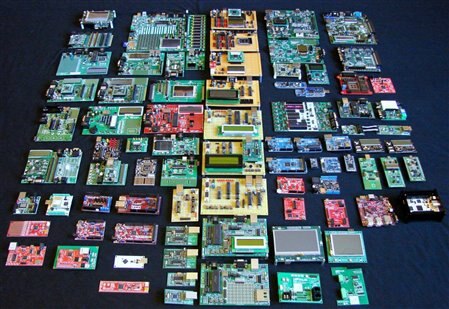
    Thanks, and that's just a very small part of the entire collection of evaluation/development boards, starter kits, etc.


    I think that pariing the R-Pi with an Arduino is a great idea, also with other microcontroller based boards that can run a RTOS for better real time control, it also has the side effect that if you do thing right, thinkering with the I/Os on the Arduinio will limit potential damage on the R-Pi.


    -J

    • Cancel
    • Vote Up 0 Vote Down
    • Sign in to reply
    • Cancel
  • jamodio
    jamodio over 13 years ago in reply to shabaz

    Yup, shipping is a nightmare, particularly to/from some places in Europe, if you want to have tracking or better service it costs much more. I shipped a large number of boards from the US to Europe, Customs are always a pain in the butt, Italy particularly is horrible, UK is efficient but I had some cases where the customer was supposed to be notified to pick up a parcel and they never did, France is also problematic.


    I'll stronlgy suggest you try to get your stuff from a local distributor, Farnell and Cool Components are Olimex's distributors in the UK.


    -J

    • Cancel
    • Vote Up 0 Vote Down
    • Sign in to reply
    • Cancel
  • shabaz
    shabaz over 13 years ago in reply to jamodio

    I agree on that, and there are some nice interfaces (I2C, SPI, asynch serial) for example which allow for compatibility between any interface board and any processor board (Rasp-pi, etc) since the rasp-pi has so few GPIO. TI seem to have some nice motor controllers, I've been looking into the DRV8432 (for an unrelated project), it needs maybe 6 GPIO, but I've yet to assemble up a board with that and a microcontroller. So much to do and so little time as always!

    • Cancel
    • Vote Up 0 Vote Down
    • Sign in to reply
    • Cancel
  • Former Member
    Former Member over 13 years ago in reply to Former Member

    A third one is the fact that you need to properly shutdown the system to avoid sd card corruption.

    That has very little to do with the Pi, the same would be true of linux (or windows) on your desktop/laptop if you just yank the power.


    It's much more down to the trade offs you make by runing a full desktop oriented OS on what's essentially an embedded device.  Or put it another way, there's millions of xDSL routers, wifi AP's, android phones etc. that don't corrupt their flash storage when power unexpectedly goes away and they're mostly running linux too.

    Of course they've been designed with that scenario in mind and have the OS specifically setup to handle it properly.

    • Cancel
    • Vote Up 0 Vote Down
    • Sign in to reply
    • Cancel
  • fustini
    fustini over 13 years ago in reply to jamodio

    You had me drooling on G+ image

    • Cancel
    • Vote Up 0 Vote Down
    • Sign in to reply
    • Cancel
  • GeorgeIoak
    GeorgeIoak over 13 years ago in reply to fustini

    So, from all of our discussion I haven't really seen a viable contender to the RPi considering it's cost and video capabilities. I really like the OMAP boards but they aren't even close to the $35 mark. The TI AM335x looks pretty good and there are some boards starting to come out which could get you close to a $50 mark but I haven't touched one yet so I can't say 1st hand how they perform. TI does do a pretty good job supporting the community though.


    Is there anyway we could collectively rally together and try to fix the RPi or make a strong collective recommendation to The Foundation or is the closed nature of Broadcom too much of a deterent for anyone to jump on board? What if you take the Rev A board and modify it so it includes a plug in header (like the Gumstix) which would allow you to add peripherals that we are in control of (i.e., ethernet, USB hub, LCD??).


    Just thining out loud....

    • Cancel
    • Vote Up 0 Vote Down
    • Sign in to reply
    • Cancel
  • jamodio
    jamodio over 13 years ago in reply to fustini

    LOL Drew,


    I guess you have not seen this one I think I posted somewhere else, and still it does not show "everything"


    image

    -J

    • Cancel
    • Vote Up +2 Vote Down
    • Sign in to reply
    • Cancel
  • jamodio
    jamodio over 13 years ago in reply to GeorgeIoak

    Very unlikely that the RPF will ever listen to any recommendation such that.


    -J

    • Cancel
    • Vote Up 0 Vote Down
    • Sign in to reply
    • Cancel
  • johnbeetem
    johnbeetem over 13 years ago in reply to GeorgeIoak

    George Ioakimedes wrote:


    So, from all of our discussion I haven't really seen a viable contender to the RPi considering it's cost and video capabilities. I really like the OMAP boards but they aren't even close to the $35 mark. The TI AM335x looks pretty good and there are some boards starting to come out which could get you close to a $50 mark but I haven't touched one yet so I can't say 1st hand how they perform. TI does do a pretty good job supporting the community though.


    Is there anyway we could collectively rally together and try to fix the RPi or make a strong collective recommendation to The Foundation or is the closed nature of Broadcom too much of a deterent for anyone to jump on board?

    It's going to be hard for anyone to compete with RasPi, especially when they start shipping Model A at US$25.  Most companies want to make a good profit, which already puts them at a disadvantage against a not-for-profit.  The main thing is volume: if BeagleBone had the same volume as RasPi, they could probably match the price.


    Broadcom has a bad reputation for openness.  Anyone who's tried to design with their parts has found out how difficult it is to get data unless it's a ridiculously common part like an Ethernet PHY.  I really don't think they're going to open up BCM2835 documentation until it becomes blatently obvious that it's costing them business.  The best way for this to happen is for people to choose products with open documentation.  However, this doesn't happen with mobile technology: most people just want a consumption device and couldn't care less whether you can get a tech reference manual.  I don't expect Broadcom to open anything up any time soon.


    Different companies have different traditions regarding open documentation.  This mostly has to do with corporate culture and corporate history.  I have a theory about one company that's particularly good about open documentation.  According to rumor, this company used to publish data sheets before they did the layout of the part.  If enough orders came in, then they'd assign engineers to do the layout, prototype fab, and testing on an exhaustingly short schedule.  This meant (a) you probably didn't want to be a chip designer at this company, and (b) you'd better get samples before designing that company's parts into your product.  In fairness, the hardest part of designing a part is determining its function and target specs, and once you have those doing the layout is straightforward as long as the timing is reasonable.  Also, I don't think that company does this anymore because modern parts take way too long to get from start of layout to samples.


    The point of this story?  I think one big reason that company has such open documentation today is because their data sheets literally sold their products in the past.

    • Cancel
    • Vote Up 0 Vote Down
    • Sign in to reply
    • Cancel
  • jamodio
    jamodio over 13 years ago in reply to johnbeetem

    While it may not be the most important, one of the main reasons that nowadays some companies are so picky about releasing information is becasue they may probably don't own all the IP associated with a product, and some of the SoC type chips are just a collection of IP modules (like the Synoptics USB module) from different vendors that are glued together with some extra stuff and under non disclosure type of relationships.


    Then knowing from where each piece comes from it makes more easy to clone some chips.


    Companies like TI with very long history and tradition in electronics development (besides its acquisitions) has been always a company generating IP, so even if you have a detailed datasheet and reference manual, plus other support documentation, you can develop your products openly but not clone their chip.


    And by cloning I don't mean reverse engineering or copying masks, etc.


    Besides the particular relationship with Broadcom, one of the major issues I see with RPF is the total lack of transparency and accountability for a non-profit organization.


    How much will compromise their confidentiality if Broadcom at least releases the list of pins and what each does, the electrical and timing characteristics of their chip, how come there are not yet schematics for Rev 2, etc, etc.


    And about the subject of the R-pi being intended for educational use, nowadays we live in a connected world, for schools it will be much more easy to implement a wireless network than a wired network, so the model A with a good certified WiFi adapter will work, but alas, if you want to have a keyboard and monitor you are out of USB ports !! then you need an external hub.


    Again, I still believe the R-Pi is a good idea, but with many design issues and shortfalls and with very bad execution compensated by a lot of hype and promotion.


    My .02

    -J

    • Cancel
    • Vote Up 0 Vote Down
    • Sign in to reply
    • Cancel
Reply
  • jamodio
    jamodio over 13 years ago in reply to johnbeetem

    While it may not be the most important, one of the main reasons that nowadays some companies are so picky about releasing information is becasue they may probably don't own all the IP associated with a product, and some of the SoC type chips are just a collection of IP modules (like the Synoptics USB module) from different vendors that are glued together with some extra stuff and under non disclosure type of relationships.


    Then knowing from where each piece comes from it makes more easy to clone some chips.


    Companies like TI with very long history and tradition in electronics development (besides its acquisitions) has been always a company generating IP, so even if you have a detailed datasheet and reference manual, plus other support documentation, you can develop your products openly but not clone their chip.


    And by cloning I don't mean reverse engineering or copying masks, etc.


    Besides the particular relationship with Broadcom, one of the major issues I see with RPF is the total lack of transparency and accountability for a non-profit organization.


    How much will compromise their confidentiality if Broadcom at least releases the list of pins and what each does, the electrical and timing characteristics of their chip, how come there are not yet schematics for Rev 2, etc, etc.


    And about the subject of the R-pi being intended for educational use, nowadays we live in a connected world, for schools it will be much more easy to implement a wireless network than a wired network, so the model A with a good certified WiFi adapter will work, but alas, if you want to have a keyboard and monitor you are out of USB ports !! then you need an external hub.


    Again, I still believe the R-Pi is a good idea, but with many design issues and shortfalls and with very bad execution compensated by a lot of hype and promotion.


    My .02

    -J

    • Cancel
    • Vote Up 0 Vote Down
    • Sign in to reply
    • Cancel
Children
No Data
element14 Community

element14 is the first online community specifically for engineers. Connect with your peers and get expert answers to your questions.

  • Members
  • Learn
  • Technologies
  • Challenges & Projects
  • Products
  • Store
  • About Us
  • Feedback & Support
  • FAQs
  • Terms of Use
  • Privacy Policy
  • Legal and Copyright Notices
  • Sitemap
  • Cookies

An Avnet Company © 2026 Premier Farnell Limited. All Rights Reserved.

Premier Farnell Ltd, registered in England and Wales (no 00876412), registered office: Farnell House, Forge Lane, Leeds LS12 2NE.

ICP 备案号 10220084.

Follow element14

  • X
  • Facebook
  • linkedin
  • YouTube