element14 Community
element14 Community
    Register Log In
  • Site
  • Search
  • Log In Register
  • Community Hub
    Community Hub
    • What's New on element14
    • Feedback and Support
    • Benefits of Membership
    • Personal Blogs
    • Members Area
    • Achievement Levels
  • Learn
    Learn
    • Ask an Expert
    • eBooks
    • element14 presents
    • Learning Center
    • Tech Spotlight
    • STEM Academy
    • Webinars, Training and Events
    • Learning Groups
  • Technologies
    Technologies
    • 3D Printing
    • FPGA
    • Industrial Automation
    • Internet of Things
    • Power & Energy
    • Sensors
    • Technology Groups
  • Challenges & Projects
    Challenges & Projects
    • Design Challenges
    • element14 presents Projects
    • Project14
    • Arduino Projects
    • Raspberry Pi Projects
    • Project Groups
  • Products
    Products
    • Arduino
    • Avnet & Tria Boards Community
    • Dev Tools
    • Manufacturers
    • Multicomp Pro
    • Product Groups
    • Raspberry Pi
    • RoadTests & Reviews
  • About Us
  • Store
    Store
    • Visit Your Store
    • Choose another store...
      • Europe
      •  Austria (German)
      •  Belgium (Dutch, French)
      •  Bulgaria (Bulgarian)
      •  Czech Republic (Czech)
      •  Denmark (Danish)
      •  Estonia (Estonian)
      •  Finland (Finnish)
      •  France (French)
      •  Germany (German)
      •  Hungary (Hungarian)
      •  Ireland
      •  Israel
      •  Italy (Italian)
      •  Latvia (Latvian)
      •  
      •  Lithuania (Lithuanian)
      •  Netherlands (Dutch)
      •  Norway (Norwegian)
      •  Poland (Polish)
      •  Portugal (Portuguese)
      •  Romania (Romanian)
      •  Russia (Russian)
      •  Slovakia (Slovak)
      •  Slovenia (Slovenian)
      •  Spain (Spanish)
      •  Sweden (Swedish)
      •  Switzerland(German, French)
      •  Turkey (Turkish)
      •  United Kingdom
      • Asia Pacific
      •  Australia
      •  China
      •  Hong Kong
      •  India
      • Japan
      •  Korea (Korean)
      •  Malaysia
      •  New Zealand
      •  Philippines
      •  Singapore
      •  Taiwan
      •  Thailand (Thai)
      • Vietnam
      • Americas
      •  Brazil (Portuguese)
      •  Canada
      •  Mexico (Spanish)
      •  United States
      Can't find the country/region you're looking for? Visit our export site or find a local distributor.
  • Translate
  • Profile
  • Settings
Raspberry Pi
  • Products
  • More
Raspberry Pi
Raspberry Pi Forum FCC Certification ...
  • Blog
  • Forum
  • Documents
  • Quiz
  • Events
  • Polls
  • Files
  • Members
  • Mentions
  • Sub-Groups
  • Tags
  • More
  • Cancel
  • New
Join Raspberry Pi to participate - click to join for free!
Featured Articles
Announcing Pi
Technical Specifications
Raspberry Pi FAQs
Win a Pi
Raspberry Pi Wishlist
Actions
  • Share
  • More
  • Cancel
Forum Thread Details
  • Replies 90 replies
  • Subscribers 679 subscribers
  • Views 11163 views
  • Users 0 members are here
  • raspberry_pi
Related

FCC Certification ...

jamodio
jamodio over 12 years ago

Hi There,


anybody knows where I can find the FCC Part 15 Test report and certification documents for the Raspberry Pi Model A and B ?


Thanks & Regards

Jorge

  • Sign in to reply
  • Cancel
Parents
  • morgaine
    morgaine over 12 years ago

    I note that Farnell UK declares very strong policy statements, which include:


    Statement of Quality Policy (part) [my highlighting]


    All employees will be appropriately trained so they understand fully the importance of meeting customer as well as statutory and regulatory requirements. All training will be recorded.

    Top management support will be given at all levels of the business to ensure that sufficient resource is available to realise customer expectations, to ensure legal compliance and to see that the requirements of any relevant national or international standards are satisfied.


    That sounds very professional, and it doesn't leave much room for misinterpretation.


    So why is there so much difficulty in locating and supplying the relevant certifications that were obtained by Raspberry Pi?  Or does the above Statement of Quality Policy apply only to Farnell UK?

    • Cancel
    • Vote Up 0 Vote Down
    • Sign in to reply
    • Cancel
  • Former Member
    Former Member over 12 years ago in reply to morgaine

    I note that Farnell UK declares very strong policy statements, which include:


    Statement of Quality Policy (part) [my highlighting]


    All employees will be appropriately trained so they understand fully the importance of meeting customer as well as statutory and regulatory requirements. All training will be recorded.


    Top management support will be given at all levels of the business to ensure that sufficient resource is available to realise customer expectations, to ensure legal compliance and to see that the requirements of any relevant national or international standards are satisfied.

    I decided to see if any of the Newark support folks on live chat have any such training

    on FCC regulatory requirements.  Here's the relevant excerpt:


    me:  What are you basing your opinion on? Have you been trained at all on FCC rules?

    agent:  No I have not you may contact the FCC directly or you may contact the Raspberry PI foundation.

    agent:  I have sent you a link for that before.

    me:  Is there someone else I can chat with that has some training on FCC rules?

    agent:  We are not trained on FCC rules I apologize.

    me:  Is there someone else I can chat with that has some training on FCC rules?

    agent:  No I am sorry we do not have anyone that is trained on that in our department.

    • Cancel
    • Vote Up 0 Vote Down
    • Sign in to reply
    • Cancel
  • morgaine
    morgaine over 12 years ago in reply to morgaine

    That FCC document that coder27 linked, "UNDERSTANDING THE FCC REGULATIONS FOR COMPUTERS AND OTHER DIGITAL DEVICES", is certainly explicit:


    On pages 8-9, FCC writes:


    What is the difference between a Class A and Class B digital device?

    If a digital device will be sold to anyone who is likely to use it in a residential
    environment then it is a Class B digital device. When determining whether a particular
    device should be classified as Class A or Class B, the Commission normally considers
    the following three questions, in this order:

        Is the marketing of the device restricted in such a manner that it is not sold to residential users?

    If a digital device is sold or offered for sale to any residential users (including
    commercial or industrial companies that could employ the equipment in a residential
    environment) then it is a Class B digital device regardless of its price or application.
    Marketing through a general retail outlet or by mail order to the general public with a
    simple disclaimer, such as "For Business Use Only," is not sufficient to qualify as
    Class A. Instead, all marketing (advertising, sale and distribution) must be restricted
    by the marketer to users in a commercial, industrial, or business environment.

        Does the application for which the device is designed generally preclude operation in residential areas?

    For example, mainframe computer systems have generally been considered Class A
    digital devices because it is highly unlikely that they would be used in residential
    environments.

        Is the price of the device high enough that there is little likelihood that it would be used in a residential environment, including a home business?

    The merits of classifying a digital device as Class A based on its price are reviewed on
    a case-by-case basis. This is because, for example, the price threshold for an I/O card
    will be different than the price threshold for a computer system configuration.


    Portable computers, because they are designed to be used anywhere, are considered
    Class B devices regardless of their price or restrictions placed on marketing. Only in
    those cases where the designed application precludes the possibility of operation in a
    residential environment may portable computers be qualified as Class A devices.


    What happens if one sells or imports non-compliant digital devices?

    As explained earlier, the form of authorization that is required for a digital device
    depends on how the device will be marketed. The FCC rules are designed to control
    the marketing of digital devices and, to a lesser extent, their use. If someone purchases
    a non-compliant digital device, uses it, causes interference to authorized radio
    communications, and is the subject of an FCC interference investigation, the user will
    be told to stop operating the device until the interference problem is corrected.
    However, the person (or company) that sold this non-compliant digital device to the
    user has violated the FCC marketing rules in Part 2 as well as federal law and may be
    subject to an enforcement action by the Commission's Field Operations Bureau that
    could result in one or more of the following:

    -- forfeiture of all non-compliant equipment
    -- $100,000/$200,000 criminal penalty for an individual/organization
    -- a criminal fine totalling twice the gross gain obtained from sales of the non-compliant equipment
    -- an administrative fine totalling $10,000/day per violation.

    It is the act of selling or leasing, offering to sell or lease, or importing a digital device
    that has not gone through the appropriate FCC equipment authorization procedure that
    is a violation of the Commission's rules and federal law.


    Yikes!


    If I understand the above correctly, product classification into class A or B is not a vendor option.  A product falls into one class or another depending on who is expected to buy it, and the duty then falls upon the vendor to obtain the appropriate certification, otherwise apparently it's in violation of FCC rules and federal law.  Is there any other way of understanding the above FCC statements?


    NOTES and REFERENCES.

    • Link to FCC OET (Office of Engineering and Technology) Rules and Regulations page.
    • The FCC OET  publishes the e-CFR (Electronic Code of Federal Regulations), and at the time of writing declares "e-CFR Data is current as of August 22, 2013".  The relevant item here is Title 47 (Telecommunication).
    • OET e-CFR Title 47 Part 15 (RADIO FREQUENCY DEVICES) Subpart A (General) section 15.3 (Definitions) maintains the definition of Class A and B devices that was described in the OET Bulletin 62 document that we examined above.
    • Cancel
    • Vote Up 0 Vote Down
    • Sign in to reply
    • Cancel
  • Former Member
    Former Member over 12 years ago in reply to morgaine

    I think you unintentionally removed the emphasis on "any" and "portable computers".

    • Cancel
    • Vote Up 0 Vote Down
    • Sign in to reply
    • Cancel
  • jamodio
    jamodio over 12 years ago in reply to morgaine

    Morgaine Dinova wrote:


    That seems totally clear.  The Pi board in question (which revision?) was Class A certified only.  That was in April 2012 and things may have changed since then, but at least there can be no doubt about that specific Model B.


    This Raspberry Pi Safety Data Sheet is probably the one mentioned by Gary.  Note that it's dated 19th April 2012.


    Then they should have no problem telling who, how, when, what, where made the tests and post publically as the Beaglebone guys did, the test reports.


    There is no tops secret or trade information on those reports, just a detail of what test have been performed and if the device passed or failed the test.

    • Cancel
    • Vote Up 0 Vote Down
    • Sign in to reply
    • Cancel
  • morgaine
    morgaine over 12 years ago in reply to Former Member

    Thanks for the headsup.  All emphases in the original were lost because I imported those paragraphs via a text file to avoid direct pasting into the forum editor, since that causes all kinds of literary fireworks.  I'd better go back and reinsert them manually, since it's an official document.


    DONE,  I've put the missing emphases back.  I see why you mentioned it --- the paragraph about Portable computers is very specific:

    Portable computers, because they are designed to be used anywhere, are considered
    Class B devices regardless of their price or restrictions placed on marketing. Only in
    those cases where the designed application precludes the possibility of operation in a
    residential environment may portable computers be qualified as Class A devices.

    • Cancel
    • Vote Up 0 Vote Down
    • Sign in to reply
    • Cancel
  • morgaine
    morgaine over 12 years ago in reply to morgaine

    Based on the above FCC document, the situation doesn't look too good, to put it mildly.


    There's not much that can be done on the weekend, but perhaps good advice for Monday morning at Element14 is to begin the first steps towards Class B certification.  If that requires Pi board redesign, so be it, the result will be a better board.

    • Cancel
    • Vote Up 0 Vote Down
    • Sign in to reply
    • Cancel
  • Former Member
    Former Member over 12 years ago in reply to morgaine

    If I understand the above correctly, product classification into class A or B is not a vendor option.  A product falls into one class or another depending on who is expected to buy it, and the duty then falls upon the vendor to obtain the appropriate certification, otherwise apparently it's in violation of FCC rules and federal law.  Is there any other way of understanding the above FCC statements?


    Yes, good point.  That's my understanding as well.

    I don't see any other way of reading it.  I think it directly contradicts Gary's claim that

    The board underwent EMC testing which enables one to discern if it should be classed A or B.

    http://www.element14.com/community/community/legislation/europe/other/blog/2012/04/24/rp-i-class-a-and-b


    and you will notice that my comment pointing this out was not answered.

    http://www.element14.com/community/community/legislation/europe/other/blog/2012/04/24/rp-i-class-a-and-b#comment-13534

    • Cancel
    • Vote Up 0 Vote Down
    • Sign in to reply
    • Cancel
  • jamodio
    jamodio over 12 years ago in reply to Former Member

    School year is starting right now on this side of the pond, recommendation already went out, budget and curriculum is closed.

    • Cancel
    • Vote Up 0 Vote Down
    • Sign in to reply
    • Cancel
  • Former Member
    Former Member over 12 years ago in reply to morgaine

    If that requires Pi board redesign, so be it, the result will be a better board.


    Back in May 2012, Eben said there was already PCB-level work going on to meet Class B standards.

    Starting at 17:35

    http://www.youtube.com/watch?v=WIf4Fk2252A


    So the question was when are the boxed ones for kids going to be available?

    Most of our distribution partners have boxing plans afoot.

    I've seen some CAM models they look pretty cute.

    I guess the kid's thing's got two things associated with it.

    One of them is a Class B FCC pass, so a consumer FCC pass.

    It's really pretty important I think not to start to ship millions of these

    into schools before we have the FCC pass,

    so we'll be doing that.

    There's PCB level work going on at the moment to accomplish that

    and, yeah, lets say summertime.

    • Cancel
    • Vote Up 0 Vote Down
    • Sign in to reply
    • Cancel
  • morgaine
    morgaine over 12 years ago in reply to Former Member

    It doesn't take 14 months to redesign a small board and a box, so a reasonable conclusion is that the PCB work Eben described as ongoing in May 2012 was put on hold.


    Pi board redesign is Pete Lomas' bailiwick, I think.  I wonder if there are any clues as to why the work was stopped in the articles he's written.

    • Cancel
    • Vote Up 0 Vote Down
    • Sign in to reply
    • Cancel
  • Former Member
    Former Member over 12 years ago in reply to morgaine
    It doesn't take 14 months to redesign a small board and a box, so a reasonable conclusion is that the PCB work Eben described as ongoing in May 2012 was put on hold.


    So maybe it's all Jamodio's fault for finding the LAN chip power bug, which may have accelerated plans for rev 2.0, pushing Class B compliance back to rev 3.0.  Then maybe 3.0 was delayed by the camera module.  Who knows?  The emphasis these days seems to be on industrial applications, so that may have shifted the focus away from homes and schools.  A recent Eben intervew says:

    Gareth Jones tells me that the Raspberry Pi is being considered as a processor for controlling industrial processes, with a division of Sony in San Jose interested in using the computer for a project they’re developing.

    http://www.makeuseof.com/tag/raspberry-pi-featureinterview/


    The interview says they will soon be producing up to 12,000 boards per day, and I doubt they are expecting schools to be a large fraction of that demand anytime soon.

    • Cancel
    • Vote Up 0 Vote Down
    • Sign in to reply
    • Cancel
Reply
  • Former Member
    Former Member over 12 years ago in reply to morgaine
    It doesn't take 14 months to redesign a small board and a box, so a reasonable conclusion is that the PCB work Eben described as ongoing in May 2012 was put on hold.


    So maybe it's all Jamodio's fault for finding the LAN chip power bug, which may have accelerated plans for rev 2.0, pushing Class B compliance back to rev 3.0.  Then maybe 3.0 was delayed by the camera module.  Who knows?  The emphasis these days seems to be on industrial applications, so that may have shifted the focus away from homes and schools.  A recent Eben intervew says:

    Gareth Jones tells me that the Raspberry Pi is being considered as a processor for controlling industrial processes, with a division of Sony in San Jose interested in using the computer for a project they’re developing.

    http://www.makeuseof.com/tag/raspberry-pi-featureinterview/


    The interview says they will soon be producing up to 12,000 boards per day, and I doubt they are expecting schools to be a large fraction of that demand anytime soon.

    • Cancel
    • Vote Up 0 Vote Down
    • Sign in to reply
    • Cancel
Children
  • morgaine
    morgaine over 12 years ago in reply to Former Member

    I've added FCC reference links confirming currency of the Class A and B definitions to my long post #16 above.

    • Cancel
    • Vote Up 0 Vote Down
    • Sign in to reply
    • Cancel
  • Former Member
    Former Member over 12 years ago in reply to morgaine

    During the whole conversation, I did not see any mention of the new rev of the boards.

    The conversation seemed to cover the original design, and ignore the changes made in the latest release.

    Maybe this one passed all the test, but we do not have documentation.


    Just my two cents.


    AC9GH

    • Cancel
    • Vote Up 0 Vote Down
    • Sign in to reply
    • Cancel
  • morgaine
    morgaine over 12 years ago in reply to Former Member

    Yes, that's clearly a very relevent issue, since certification of one revision of a board may not carry over to another revision.  What's more, Pi Models A and B are very different electronically despite using the same PCB.


    So, quite separate from the issue of Class B certification for what is clearly a device in residential use, there is also the matter of whether the revisions of both models sold today are actually covered by a current FCC certification even for Class A.  Newer revisions can usually be expected to behave better than old ones (as I think you were hinting), but this of course needs to be verified.  I assume that a test certificate details the exact board revision being tested, so Element14 can (presumably) verify the validity of existing certifications immediately without room for doubt just by checking revision numbers.


    I suspect that there are clear rules for when a certification can be carried over to a new revision and when not.  Has anyone found the relevant FCC guidelines?

    • Cancel
    • Vote Up 0 Vote Down
    • Sign in to reply
    • Cancel
  • Former Member
    Former Member over 12 years ago in reply to morgaine

    I suspect that there are clear rules for when a certification can be carried over to a new revision and when not.  Has anyone found the relevant FCC guidelines?


    See p. 10 of the previously cited OET Bulletin 62 under the heading

    What changes can be made to an FCC-authorized device without requiring a new FCC

    authorization?

    http://transition.fcc.gov/Bureaus/Engineering_Technology/Documents/bulletins/oet62/oet62rev.pdf

    • Cancel
    • Vote Up 0 Vote Down
    • Sign in to reply
    • Cancel
  • morgaine
    morgaine over 12 years ago in reply to Former Member

    If my reading of p.13 is correct, then "For certified equipment (personal computers and their peripherals)", with the proviso that clock circuitry is unchanged (because that could entirely change RF characteristics), if there is no increase in RF emissions, then no new certification is required.  Again stressing that this is only if my reading is correct. then because this equipment is only certified rather than verified, it is up to the certifier to declare that there has been no increase in RF emissions, rather than it needing to be verified.  It seems to work on trust.


    It wouldn't surprise me if my reading of this is incorrect, since such an approach seems open to abuse --- comments welcome.  That said, I would not expect any  engineering professional in the Pi ecosystem to abuse such regulations, so it doesn't seem to be relevant here.


    In other words, it seems to me that if Pi development engineers find that "a change does not affect, or reduces the radio frequency emissions from the device" (the FCC's words) then it's entirely proper to consider the previous certification to continue to apply.  Needless to say, this "Class I permissive change" would have to appear on the certification, or an ammendment to it.  Just saying nothing is asking for trouble.

    • Cancel
    • Vote Up 0 Vote Down
    • Sign in to reply
    • Cancel
  • mcb1
    mcb1 over 12 years ago in reply to morgaine

    Morgaine


    Without diving in FCC, if you certify something, you have tested that it meets the necessary requirement/laws and that testing will record the conditions under which it met those requirement/laws.

    If the manufacturer continues with the method, then any subsequent items will still meet that certification.


    Verify is to check it still meets the requirement/law and could be random sampling (espcially if its close) or when something has been changed.


    I believe there were issues with the HDMI during inital testing, hence it was reduced slightly to meet the necessary emissions, and tested under those settings.


    I do note that once again NZ and Australia have been singled out.

    AUSTRALIA AND NEW ZEALAND CLASS A EMISSIONS COMPLIANCE STATEMENT

    Warning: This is a Class A product. In a domestic environment this product may cause radio interference in which case the user may be required to take adequate measures.

    Mark

    • Cancel
    • Vote Up 0 Vote Down
    • Sign in to reply
    • Cancel
  • jamodio
    jamodio over 12 years ago in reply to morgaine

    Yes Model A and B require different emissions tests given that Model A does not include the 25MHz crystal and ethernet PHY, a very well known source of common mode noise and EMI.


    -J

    • Cancel
    • Vote Up 0 Vote Down
    • Sign in to reply
    • Cancel
  • jamodio
    jamodio over 12 years ago in reply to mcb1

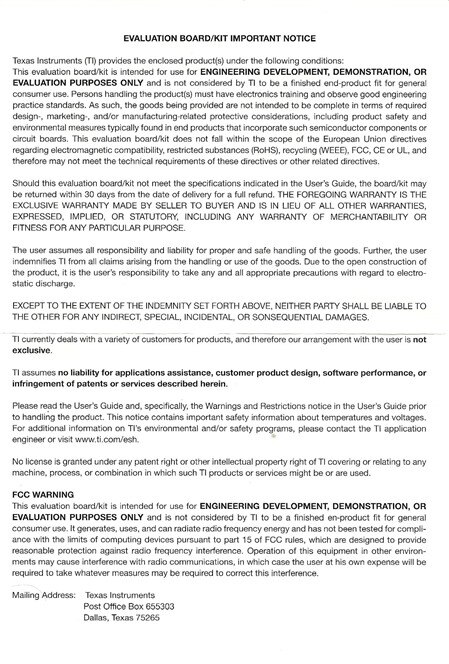
    Let me share as an example what accompanies the Texas Instruments LaunchPad Evaluation Kit ...

    image

    The problem with RPF and Rpi is that the initial plan for it was to be an evaluation board, that way they were able to circumvent the certification requirements, but instead of sticking with the original plan of creating a limited number of boards for testing and development they got blinded by ambition after seeing the demand generated by so much hype and buzz.


    Then it was too late to circumvent the tests when you start calling it a "computer" or a "box" and obviously the number of boards produced.


    After making a deal with Farnell and RS, they had to step in and at least perform the hazardous materials tests, I remember seeing a picture of one guy from RS holding one of the early RPi boards on the Fischer material analyser, results of those tests have never been made public.


    I remember that there was an issue with the signal levels on HDMI that complicated the first pass of the emissions tests, but afaik minimal changes have been done to the pcb layout between 1.0 and 2.0 to address any other issues, and what Pete Lomas said about sharing what other issues have been found never materialized.


    Will RPF ever make all this information public ? Who knows, but if Farnell/element14 have assumed the responsibility of manufacturing and selling the boards, they SHOULD be now the ones to make the information available publicly.


    There is nothing wrong about been transparent and open, if it is not certified or certification can't be met, it is not the end of the world, at least we know what we are dealing with and know what to say to the end user.


    My .02

    • Cancel
    • Vote Up 0 Vote Down
    • Sign in to reply
    • Cancel
  • Former Member
    Former Member over 12 years ago in reply to jamodio

    There is a discussion of development kits here:

    http://www.element14.com/community/community/legislation/europe/rohs/blog/2012/09/28/development-kits-in-scope-of-the-rohs-recast

    • Cancel
    • Vote Up 0 Vote Down
    • Sign in to reply
    • Cancel
  • Former Member
    Former Member over 12 years ago in reply to Former Member

    During the whole conversation, I did not see any mention of the new rev of the boards.

    The conversation seemed to cover the original design, and ignore the changes made in the latest release.

    Maybe this one passed all the test, but we do not have documentation.


    Eben was asked if the Rev 2 board would be tested for FCC Class B emissions,

    and he said:

    Not on this version. This will have to wait for the “educational release” board.

    http://www.raspberrypi.org/archives/1929#comment-31756

    • Cancel
    • Vote Up 0 Vote Down
    • Sign in to reply
    • Cancel
element14 Community

element14 is the first online community specifically for engineers. Connect with your peers and get expert answers to your questions.

  • Members
  • Learn
  • Technologies
  • Challenges & Projects
  • Products
  • Store
  • About Us
  • Feedback & Support
  • FAQs
  • Terms of Use
  • Privacy Policy
  • Legal and Copyright Notices
  • Sitemap
  • Cookies

An Avnet Company © 2025 Premier Farnell Limited. All Rights Reserved.

Premier Farnell Ltd, registered in England and Wales (no 00876412), registered office: Farnell House, Forge Lane, Leeds LS12 2NE.

ICP 备案号 10220084.

Follow element14

  • X
  • Facebook
  • linkedin
  • YouTube