element14 Community
element14 Community
    Register Log In
  • Site
  • Search
  • Log In Register
  • Community Hub
    Community Hub
    • What's New on element14
    • Feedback and Support
    • Benefits of Membership
    • Personal Blogs
    • Members Area
    • Achievement Levels
  • Learn
    Learn
    • Ask an Expert
    • eBooks
    • element14 presents
    • Learning Center
    • Tech Spotlight
    • STEM Academy
    • Webinars, Training and Events
    • Learning Groups
  • Technologies
    Technologies
    • 3D Printing
    • FPGA
    • Industrial Automation
    • Internet of Things
    • Power & Energy
    • Sensors
    • Technology Groups
  • Challenges & Projects
    Challenges & Projects
    • Design Challenges
    • element14 presents Projects
    • Project14
    • Arduino Projects
    • Raspberry Pi Projects
    • Project Groups
  • Products
    Products
    • Arduino
    • Avnet & Tria Boards Community
    • Dev Tools
    • Manufacturers
    • Multicomp Pro
    • Product Groups
    • Raspberry Pi
    • RoadTests & Reviews
  • About Us
  • Store
    Store
    • Visit Your Store
    • Choose another store...
      • Europe
      •  Austria (German)
      •  Belgium (Dutch, French)
      •  Bulgaria (Bulgarian)
      •  Czech Republic (Czech)
      •  Denmark (Danish)
      •  Estonia (Estonian)
      •  Finland (Finnish)
      •  France (French)
      •  Germany (German)
      •  Hungary (Hungarian)
      •  Ireland
      •  Israel
      •  Italy (Italian)
      •  Latvia (Latvian)
      •  
      •  Lithuania (Lithuanian)
      •  Netherlands (Dutch)
      •  Norway (Norwegian)
      •  Poland (Polish)
      •  Portugal (Portuguese)
      •  Romania (Romanian)
      •  Russia (Russian)
      •  Slovakia (Slovak)
      •  Slovenia (Slovenian)
      •  Spain (Spanish)
      •  Sweden (Swedish)
      •  Switzerland(German, French)
      •  Turkey (Turkish)
      •  United Kingdom
      • Asia Pacific
      •  Australia
      •  China
      •  Hong Kong
      •  India
      • Japan
      •  Korea (Korean)
      •  Malaysia
      •  New Zealand
      •  Philippines
      •  Singapore
      •  Taiwan
      •  Thailand (Thai)
      • Vietnam
      • Americas
      •  Brazil (Portuguese)
      •  Canada
      •  Mexico (Spanish)
      •  United States
      Can't find the country/region you're looking for? Visit our export site or find a local distributor.
  • Translate
  • Profile
  • Settings
Raspberry Pi
  • Products
  • More
Raspberry Pi
Raspberry Pi Forum FCC Certification ...
  • Blog
  • Forum
  • Documents
  • Quiz
  • Events
  • Polls
  • Files
  • Members
  • Mentions
  • Sub-Groups
  • Tags
  • More
  • Cancel
  • New
Join Raspberry Pi to participate - click to join for free!
Featured Articles
Announcing Pi
Technical Specifications
Raspberry Pi FAQs
Win a Pi
Raspberry Pi Wishlist
Actions
  • Share
  • More
  • Cancel
Forum Thread Details
  • Replies 90 replies
  • Subscribers 679 subscribers
  • Views 11159 views
  • Users 0 members are here
  • raspberry_pi
Related

FCC Certification ...

jamodio
jamodio over 12 years ago

Hi There,


anybody knows where I can find the FCC Part 15 Test report and certification documents for the Raspberry Pi Model A and B ?


Thanks & Regards

Jorge

  • Sign in to reply
  • Cancel
Parents
  • morgaine
    morgaine over 12 years ago

    I note that Farnell UK declares very strong policy statements, which include:


    Statement of Quality Policy (part) [my highlighting]


    All employees will be appropriately trained so they understand fully the importance of meeting customer as well as statutory and regulatory requirements. All training will be recorded.

    Top management support will be given at all levels of the business to ensure that sufficient resource is available to realise customer expectations, to ensure legal compliance and to see that the requirements of any relevant national or international standards are satisfied.


    That sounds very professional, and it doesn't leave much room for misinterpretation.


    So why is there so much difficulty in locating and supplying the relevant certifications that were obtained by Raspberry Pi?  Or does the above Statement of Quality Policy apply only to Farnell UK?

    • Cancel
    • Vote Up 0 Vote Down
    • Sign in to reply
    • Cancel
  • Former Member
    Former Member over 12 years ago in reply to morgaine

    I note that Farnell UK declares very strong policy statements, which include:


    Statement of Quality Policy (part) [my highlighting]


    All employees will be appropriately trained so they understand fully the importance of meeting customer as well as statutory and regulatory requirements. All training will be recorded.


    Top management support will be given at all levels of the business to ensure that sufficient resource is available to realise customer expectations, to ensure legal compliance and to see that the requirements of any relevant national or international standards are satisfied.

    I decided to see if any of the Newark support folks on live chat have any such training

    on FCC regulatory requirements.  Here's the relevant excerpt:


    me:  What are you basing your opinion on? Have you been trained at all on FCC rules?

    agent:  No I have not you may contact the FCC directly or you may contact the Raspberry PI foundation.

    agent:  I have sent you a link for that before.

    me:  Is there someone else I can chat with that has some training on FCC rules?

    agent:  We are not trained on FCC rules I apologize.

    me:  Is there someone else I can chat with that has some training on FCC rules?

    agent:  No I am sorry we do not have anyone that is trained on that in our department.

    • Cancel
    • Vote Up 0 Vote Down
    • Sign in to reply
    • Cancel
  • morgaine
    morgaine over 12 years ago in reply to morgaine

    Based on the above FCC document, the situation doesn't look too good, to put it mildly.


    There's not much that can be done on the weekend, but perhaps good advice for Monday morning at Element14 is to begin the first steps towards Class B certification.  If that requires Pi board redesign, so be it, the result will be a better board.

    • Cancel
    • Vote Up 0 Vote Down
    • Sign in to reply
    • Cancel
  • Former Member
    Former Member over 12 years ago in reply to morgaine

    If I understand the above correctly, product classification into class A or B is not a vendor option.  A product falls into one class or another depending on who is expected to buy it, and the duty then falls upon the vendor to obtain the appropriate certification, otherwise apparently it's in violation of FCC rules and federal law.  Is there any other way of understanding the above FCC statements?


    Yes, good point.  That's my understanding as well.

    I don't see any other way of reading it.  I think it directly contradicts Gary's claim that

    The board underwent EMC testing which enables one to discern if it should be classed A or B.

    http://www.element14.com/community/community/legislation/europe/other/blog/2012/04/24/rp-i-class-a-and-b


    and you will notice that my comment pointing this out was not answered.

    http://www.element14.com/community/community/legislation/europe/other/blog/2012/04/24/rp-i-class-a-and-b#comment-13534

    • Cancel
    • Vote Up 0 Vote Down
    • Sign in to reply
    • Cancel
  • jamodio
    jamodio over 12 years ago in reply to Former Member

    School year is starting right now on this side of the pond, recommendation already went out, budget and curriculum is closed.

    • Cancel
    • Vote Up 0 Vote Down
    • Sign in to reply
    • Cancel
  • Former Member
    Former Member over 12 years ago in reply to morgaine

    If that requires Pi board redesign, so be it, the result will be a better board.


    Back in May 2012, Eben said there was already PCB-level work going on to meet Class B standards.

    Starting at 17:35

    http://www.youtube.com/watch?v=WIf4Fk2252A


    So the question was when are the boxed ones for kids going to be available?

    Most of our distribution partners have boxing plans afoot.

    I've seen some CAM models they look pretty cute.

    I guess the kid's thing's got two things associated with it.

    One of them is a Class B FCC pass, so a consumer FCC pass.

    It's really pretty important I think not to start to ship millions of these

    into schools before we have the FCC pass,

    so we'll be doing that.

    There's PCB level work going on at the moment to accomplish that

    and, yeah, lets say summertime.

    • Cancel
    • Vote Up 0 Vote Down
    • Sign in to reply
    • Cancel
  • morgaine
    morgaine over 12 years ago in reply to Former Member

    It doesn't take 14 months to redesign a small board and a box, so a reasonable conclusion is that the PCB work Eben described as ongoing in May 2012 was put on hold.


    Pi board redesign is Pete Lomas' bailiwick, I think.  I wonder if there are any clues as to why the work was stopped in the articles he's written.

    • Cancel
    • Vote Up 0 Vote Down
    • Sign in to reply
    • Cancel
  • Former Member
    Former Member over 12 years ago in reply to morgaine
    It doesn't take 14 months to redesign a small board and a box, so a reasonable conclusion is that the PCB work Eben described as ongoing in May 2012 was put on hold.


    So maybe it's all Jamodio's fault for finding the LAN chip power bug, which may have accelerated plans for rev 2.0, pushing Class B compliance back to rev 3.0.  Then maybe 3.0 was delayed by the camera module.  Who knows?  The emphasis these days seems to be on industrial applications, so that may have shifted the focus away from homes and schools.  A recent Eben intervew says:

    Gareth Jones tells me that the Raspberry Pi is being considered as a processor for controlling industrial processes, with a division of Sony in San Jose interested in using the computer for a project they’re developing.

    http://www.makeuseof.com/tag/raspberry-pi-featureinterview/


    The interview says they will soon be producing up to 12,000 boards per day, and I doubt they are expecting schools to be a large fraction of that demand anytime soon.

    • Cancel
    • Vote Up 0 Vote Down
    • Sign in to reply
    • Cancel
  • morgaine
    morgaine over 12 years ago in reply to Former Member

    I've added FCC reference links confirming currency of the Class A and B definitions to my long post #16 above.

    • Cancel
    • Vote Up 0 Vote Down
    • Sign in to reply
    • Cancel
  • Former Member
    Former Member over 12 years ago in reply to morgaine

    During the whole conversation, I did not see any mention of the new rev of the boards.

    The conversation seemed to cover the original design, and ignore the changes made in the latest release.

    Maybe this one passed all the test, but we do not have documentation.


    Just my two cents.


    AC9GH

    • Cancel
    • Vote Up 0 Vote Down
    • Sign in to reply
    • Cancel
  • morgaine
    morgaine over 12 years ago in reply to Former Member

    Yes, that's clearly a very relevent issue, since certification of one revision of a board may not carry over to another revision.  What's more, Pi Models A and B are very different electronically despite using the same PCB.


    So, quite separate from the issue of Class B certification for what is clearly a device in residential use, there is also the matter of whether the revisions of both models sold today are actually covered by a current FCC certification even for Class A.  Newer revisions can usually be expected to behave better than old ones (as I think you were hinting), but this of course needs to be verified.  I assume that a test certificate details the exact board revision being tested, so Element14 can (presumably) verify the validity of existing certifications immediately without room for doubt just by checking revision numbers.


    I suspect that there are clear rules for when a certification can be carried over to a new revision and when not.  Has anyone found the relevant FCC guidelines?

    • Cancel
    • Vote Up 0 Vote Down
    • Sign in to reply
    • Cancel
  • Former Member
    Former Member over 12 years ago in reply to morgaine

    I suspect that there are clear rules for when a certification can be carried over to a new revision and when not.  Has anyone found the relevant FCC guidelines?


    See p. 10 of the previously cited OET Bulletin 62 under the heading

    What changes can be made to an FCC-authorized device without requiring a new FCC

    authorization?

    http://transition.fcc.gov/Bureaus/Engineering_Technology/Documents/bulletins/oet62/oet62rev.pdf

    • Cancel
    • Vote Up 0 Vote Down
    • Sign in to reply
    • Cancel
Reply
  • Former Member
    Former Member over 12 years ago in reply to morgaine

    I suspect that there are clear rules for when a certification can be carried over to a new revision and when not.  Has anyone found the relevant FCC guidelines?


    See p. 10 of the previously cited OET Bulletin 62 under the heading

    What changes can be made to an FCC-authorized device without requiring a new FCC

    authorization?

    http://transition.fcc.gov/Bureaus/Engineering_Technology/Documents/bulletins/oet62/oet62rev.pdf

    • Cancel
    • Vote Up 0 Vote Down
    • Sign in to reply
    • Cancel
Children
  • morgaine
    morgaine over 12 years ago in reply to Former Member

    If my reading of p.13 is correct, then "For certified equipment (personal computers and their peripherals)", with the proviso that clock circuitry is unchanged (because that could entirely change RF characteristics), if there is no increase in RF emissions, then no new certification is required.  Again stressing that this is only if my reading is correct. then because this equipment is only certified rather than verified, it is up to the certifier to declare that there has been no increase in RF emissions, rather than it needing to be verified.  It seems to work on trust.


    It wouldn't surprise me if my reading of this is incorrect, since such an approach seems open to abuse --- comments welcome.  That said, I would not expect any  engineering professional in the Pi ecosystem to abuse such regulations, so it doesn't seem to be relevant here.


    In other words, it seems to me that if Pi development engineers find that "a change does not affect, or reduces the radio frequency emissions from the device" (the FCC's words) then it's entirely proper to consider the previous certification to continue to apply.  Needless to say, this "Class I permissive change" would have to appear on the certification, or an ammendment to it.  Just saying nothing is asking for trouble.

    • Cancel
    • Vote Up 0 Vote Down
    • Sign in to reply
    • Cancel
  • mcb1
    mcb1 over 12 years ago in reply to morgaine

    Morgaine


    Without diving in FCC, if you certify something, you have tested that it meets the necessary requirement/laws and that testing will record the conditions under which it met those requirement/laws.

    If the manufacturer continues with the method, then any subsequent items will still meet that certification.


    Verify is to check it still meets the requirement/law and could be random sampling (espcially if its close) or when something has been changed.


    I believe there were issues with the HDMI during inital testing, hence it was reduced slightly to meet the necessary emissions, and tested under those settings.


    I do note that once again NZ and Australia have been singled out.

    AUSTRALIA AND NEW ZEALAND CLASS A EMISSIONS COMPLIANCE STATEMENT

    Warning: This is a Class A product. In a domestic environment this product may cause radio interference in which case the user may be required to take adequate measures.

    Mark

    • Cancel
    • Vote Up 0 Vote Down
    • Sign in to reply
    • Cancel
  • jamodio
    jamodio over 12 years ago in reply to mcb1

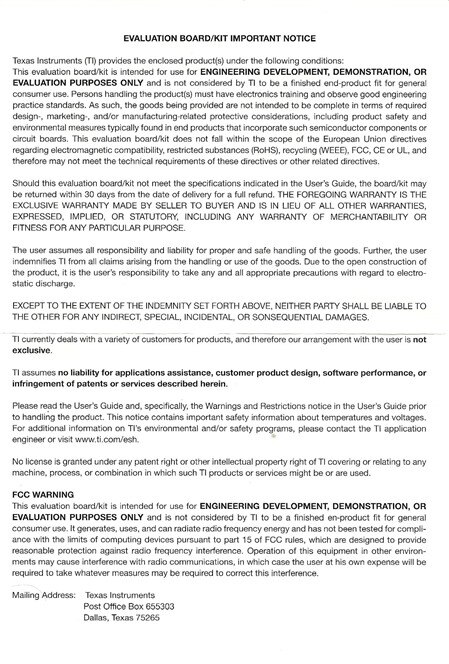
    Let me share as an example what accompanies the Texas Instruments LaunchPad Evaluation Kit ...

    image

    The problem with RPF and Rpi is that the initial plan for it was to be an evaluation board, that way they were able to circumvent the certification requirements, but instead of sticking with the original plan of creating a limited number of boards for testing and development they got blinded by ambition after seeing the demand generated by so much hype and buzz.


    Then it was too late to circumvent the tests when you start calling it a "computer" or a "box" and obviously the number of boards produced.


    After making a deal with Farnell and RS, they had to step in and at least perform the hazardous materials tests, I remember seeing a picture of one guy from RS holding one of the early RPi boards on the Fischer material analyser, results of those tests have never been made public.


    I remember that there was an issue with the signal levels on HDMI that complicated the first pass of the emissions tests, but afaik minimal changes have been done to the pcb layout between 1.0 and 2.0 to address any other issues, and what Pete Lomas said about sharing what other issues have been found never materialized.


    Will RPF ever make all this information public ? Who knows, but if Farnell/element14 have assumed the responsibility of manufacturing and selling the boards, they SHOULD be now the ones to make the information available publicly.


    There is nothing wrong about been transparent and open, if it is not certified or certification can't be met, it is not the end of the world, at least we know what we are dealing with and know what to say to the end user.


    My .02

    • Cancel
    • Vote Up 0 Vote Down
    • Sign in to reply
    • Cancel
  • Former Member
    Former Member over 12 years ago in reply to jamodio

    There is a discussion of development kits here:

    http://www.element14.com/community/community/legislation/europe/rohs/blog/2012/09/28/development-kits-in-scope-of-the-rohs-recast

    • Cancel
    • Vote Up 0 Vote Down
    • Sign in to reply
    • Cancel
  • morgaine
    morgaine over 12 years ago in reply to jamodio

    It's striking that FCC makes no distinction at all based on intended use of a board at design or manufacturing time.  All that matters is to whom the vendor markets or sells the board, and the likelihood of its use in a domestic environment.  This is very sensible if you think about it, because a board that was not designed for domestic use but is then sold to residential users as if it had been so designed represents a liability to society, with potentially damaging consequences of many kinds.  This is especially true if large numbers are sold.


    In effect, non-compliance with consumer standards (whether that non-compliance is declared or not) cannot be invoked as a defence nor waiver when marketing a board into the consumer segment, because non-compliance would entail violation of FCC regulations and federal law.  Therefore the only option is not marketing a non-compliant board into that segment in the first place.


    The US tends not to be associated with consumer protection laws quite as much as the EU, but in this case FCC regulation is clearly very strong.  This isn't necessarily about protecting consumers of course --- unintentional radiators as covered in Part 15 can affect everyone, including hospitals and the military.  I wouldn't be surprised if that is why the penalties are so severe.

    • Cancel
    • Vote Up 0 Vote Down
    • Sign in to reply
    • Cancel
  • morgaine
    morgaine over 12 years ago in reply to morgaine

    Element14 has written about "dev kits" being considered finished products in the EU.  What seems to be appreciated somewhat less is that the FCC has effectively the same rules, but just differing in language.


    Whereas the EU refers to "finished products" (bare boards are considered finished when they merely require plugging in), the FCC doesn't bother with such finessing and instead simply classifies digital devices based on marketting and sales:  if they are marketted and sold for use in a residential environment, then they are Class B devices, and require Class B certification before they can be marketed or sold at all.  No ifs or buts, and the FCC's published penalties for violation are harsh.


    Since the EU employs the same A/B classification for commercial/residential uses and in addition defines ready-to-operate boards as finished products, in practice there is no distinct category for so-called "dev kits" in EU nor FCC regulations.  If marketed or sold into a residential environment, they are captured by the Class B certification requirement on both side of the Atlantic.


    This makes me wonder why certification of "dev kits" is a discrete topic of discussion at all.  It appears to be wishful thinking, since such a distinction doesn't seem to exist in EU/US legislation.  (It might exist in other jurisdictions though.)

    • Cancel
    • Vote Up 0 Vote Down
    • Sign in to reply
    • Cancel
  • Former Member
    Former Member over 12 years ago in reply to morgaine
    and the FCC's published penalties for violation are harsh


    Amazon raised some eyebrows by taking pre-orders last Sept for its latest Kindle,

    prior to FCC approval. but FCC declined to comment.

    http://www.reuters.com/article/2012/09/08/amazon-fcc-idUSL2E8K80EB20120908


    But they say it's very unusual for a company to announce major new products without first getting the sign-off from the agency.


    "I can't think of an instance where a device has been offered by a U.S. carrier or an independent retailer that has not had FCC approval yet," said John Jackson, a wireless analyst at CCS Insight.


    An FCC spokesman declined to comment.


    The 4G Kindle Fire tablets are a crucial part of Amazon's attempt to challenge Apple Inc's iPad at the premium end of the booming tablet market.


    The lack of FCC approval at this stage is likely a result of Amazon's lack of experience with wireless hardware, according to Charles Golvin, a wireless analyst at Forrester Research.


    Lazarus said Apple Inc, Motorola, now owned by Google, Samsung and Microsoft have never had such issues.


    "These companies have dedicated staff whose job it is to ensure FCC compliance and they do their job very well," Lazarus added.


    Sprint Nextel, a leading wireless carrier, does not release phones for pre-order unless they have already been FCC approved.


    "In the vast majority of cases, we will not accept a phone into our formal lab process that has not already received FCC approval," said Sprint spokeswoman Michelle Leff Mermelstein.


    A spokeswoman for AT&T, which is providing the 4G data plan for the new Kindle Fire wireless tablets, declined to comment.

    • Cancel
    • Vote Up 0 Vote Down
    • Sign in to reply
    • Cancel
  • morgaine
    morgaine over 12 years ago in reply to Former Member

    coder27 wrote:

    Lazarus said Apple Inc, Motorola, now owned by Google, Samsung and Microsoft have never had such issues.


    "These companies have dedicated staff whose job it is to ensure FCC compliance and they do their job very well," Lazarus added.


    Sprint Nextel, a leading wireless carrier, does not release phones for pre-order unless they have already been FCC approved.


    "In the vast majority of cases, we will not accept a phone into our formal lab process that has not already received FCC approval," said Sprint spokeswoman Michelle Leff Mermelstein.


    Well how difficult can it be?  If your job spec says "Keep us FCC-compliant", all you have to do is to read the damn FCC documentation, advise your company accordingly, and give hell to your suppliers until their products comply.  Damn it, I'd love such a cushie job!  (Parden the "damn"s, but they're warranted in this case.)


    How to fail on such a simple task is hard to imagine.  Maybe by trying really really really hard?  The FCC goes out of its way to write short and friendly documents about certification, easily understandable by anyone.  It's hard to pin the blame on them.

    • Cancel
    • Vote Up 0 Vote Down
    • Sign in to reply
    • Cancel
  • jamodio
    jamodio over 12 years ago in reply to morgaine

    Well, if RPF manage to redesign the Rpi to run on batteries and with a clock speed of 1.7MHz they will be excluded ...


    -J

    • Cancel
    • Vote Up 0 Vote Down
    • Sign in to reply
    • Cancel
  • Former Member
    Former Member over 12 years ago in reply to morgaine

    Well how difficult can it be?  If your job spec says "Keep us FCC-compliant", all you have to do is to read the damn FCC documentation, advise your company accordingly, and give hell to your suppliers until their products comply.  Damn it, I'd love such a cushie job!  (Parden the "damn"s, but they're warranted in this case.)

    Anyone who is concerned that there may have been some FCC or EC noncompliance

    is welcomed and encouraged to provide feedback in order to get that resolved:

    We welcome, and continue to actively encourage, open feedback and consultation on this policy from any interested parties via email to swebb@premierfarnell.com.

    http://www.premierfarnell.com/sustainability/our-sustainability-policy


    OUR VISION

    Our vision is to become the world’s most sustainable provider of products and services to Electronic Design Engineers by 2020

    We focus on the following areas:

    Principles

    We seek to be known for our exceptional ethical standards and compliance, and for the way that we treat our stakeholders.

    Our Group-wide Code of Ethics requires compliance with laws and regulations in the countries in which we operate.

    The senior manager of our business units in each country is required quarterly to identify any non-compliance with the laws and regulations of the country in which that business unit operates and any breaches of the Group’s Code of Ethics of which the manager is aware.

    The Internal Audit function reports any instances of non-compliance that it identifies to the Audit Committee.    ...

    • Cancel
    • Vote Up 0 Vote Down
    • Sign in to reply
    • Cancel
element14 Community

element14 is the first online community specifically for engineers. Connect with your peers and get expert answers to your questions.

  • Members
  • Learn
  • Technologies
  • Challenges & Projects
  • Products
  • Store
  • About Us
  • Feedback & Support
  • FAQs
  • Terms of Use
  • Privacy Policy
  • Legal and Copyright Notices
  • Sitemap
  • Cookies

An Avnet Company © 2025 Premier Farnell Limited. All Rights Reserved.

Premier Farnell Ltd, registered in England and Wales (no 00876412), registered office: Farnell House, Forge Lane, Leeds LS12 2NE.

ICP 备案号 10220084.

Follow element14

  • X
  • Facebook
  • linkedin
  • YouTube