element14 Community
element14 Community
    Register Log In
  • Site
  • Search
  • Log In Register
  • Community Hub
    Community Hub
    • What's New on element14
    • Feedback and Support
    • Benefits of Membership
    • Personal Blogs
    • Members Area
    • Achievement Levels
  • Learn
    Learn
    • Ask an Expert
    • eBooks
    • element14 presents
    • Learning Center
    • Tech Spotlight
    • STEM Academy
    • Webinars, Training and Events
    • Learning Groups
  • Technologies
    Technologies
    • 3D Printing
    • FPGA
    • Industrial Automation
    • Internet of Things
    • Power & Energy
    • Sensors
    • Technology Groups
  • Challenges & Projects
    Challenges & Projects
    • Design Challenges
    • element14 presents Projects
    • Project14
    • Arduino Projects
    • Raspberry Pi Projects
    • Project Groups
  • Products
    Products
    • Arduino
    • Avnet & Tria Boards Community
    • Dev Tools
    • Manufacturers
    • Multicomp Pro
    • Product Groups
    • Raspberry Pi
    • RoadTests & Reviews
  • About Us
  • Store
    Store
    • Visit Your Store
    • Choose another store...
      • Europe
      •  Austria (German)
      •  Belgium (Dutch, French)
      •  Bulgaria (Bulgarian)
      •  Czech Republic (Czech)
      •  Denmark (Danish)
      •  Estonia (Estonian)
      •  Finland (Finnish)
      •  France (French)
      •  Germany (German)
      •  Hungary (Hungarian)
      •  Ireland
      •  Israel
      •  Italy (Italian)
      •  Latvia (Latvian)
      •  
      •  Lithuania (Lithuanian)
      •  Netherlands (Dutch)
      •  Norway (Norwegian)
      •  Poland (Polish)
      •  Portugal (Portuguese)
      •  Romania (Romanian)
      •  Russia (Russian)
      •  Slovakia (Slovak)
      •  Slovenia (Slovenian)
      •  Spain (Spanish)
      •  Sweden (Swedish)
      •  Switzerland(German, French)
      •  Turkey (Turkish)
      •  United Kingdom
      • Asia Pacific
      •  Australia
      •  China
      •  Hong Kong
      •  India
      • Japan
      •  Korea (Korean)
      •  Malaysia
      •  New Zealand
      •  Philippines
      •  Singapore
      •  Taiwan
      •  Thailand (Thai)
      • Vietnam
      • Americas
      •  Brazil (Portuguese)
      •  Canada
      •  Mexico (Spanish)
      •  United States
      Can't find the country/region you're looking for? Visit our export site or find a local distributor.
  • Translate
  • Profile
  • Settings
Raspberry Pi
  • Products
  • More
Raspberry Pi
Documents Setting up Bluetooth on the Raspberry Pi 3
  • Blog
  • Forum
  • Documents
  • Quiz
  • Events
  • Polls
  • Files
  • Members
  • Mentions
  • Sub-Groups
  • Tags
  • More
  • Cancel
  • New
Join Raspberry Pi to participate - click to join for free!
Actions
  • Share
  • More
  • Cancel
Engagement
  • Author Author: cstanton
  • Date Created: 16 Mar 2016 1:01 AM Date Created
  • Last Updated Last Updated: 10 May 2021 7:23 PM
  • Views 15585 views
  • Likes 18 likes
  • Comments 61 comments
Related
Recommended

Setting up Bluetooth on the Raspberry Pi 3

Wireless at Last!


Now that it has been a few weeks since the release of the Raspberry Pi 3Raspberry Pi 3, support for the WiFi and Bluetooth chip has settled and you can use it with Raspbian. Support with Windows 10 IoT Core will be available in the early days via the Insider Program before it is pushed through to the full release.


As usual, with Raspbian ensure that you have your distribution up to date, with this guide we will be using Raspbian Jessie, at present it is still the ARMv7 32bit kernel. Connect your Raspberry Pi to the internet either via WiFi or Ethernet and run the following commands:


sudo apt-get update

sudo apt-get upgrade -y

sudo apt-get dist-upgrade -y

sudo rpi-update


Installing the Software


From a console terminal, either from within your desktop environment, which at the time of writing the window manager is still LXDE. This will ensure your system is up to date.


Now you have a few options, you can install the following package:


sudo apt-get install pi-bluetooth


Which should install what you need to use the bluetooth portion of the chip, this installs the following packages which you can, if you want, install instead of pi-bluetooth:


sudo apt-get install bluez bluez-firmware


As the chip requires a firmware blob to work along with the driver. Bluez also installs a suite of tools. These will work from the console terminal. Should you wish to manage your bluetooth devices from your X environment, aka your windows manager, aka your desktop then you can install the following package:


sudo apt-get install blueman


After installing the software and drivers, reboot your Raspberry Pi. Unless you know otherwise, to load the driver for the adapter.


Terminal / Console


Bluez comes with a tool called 'bluetoothctl' which you can run from the console terminal, typing 'man bluetoothctl' does not give you a great deal of detail, so you have to type 'help' from within the software:

pi@raspberrypi:~ $ bluetoothctl

[bluetooth]# help

Available commands:

  list                       List available controllers

  show [ctrl]                Controller information

  select <ctrl>              Select default controller

  devices                    List available devices

  paired-devices             List paired devices

  power <on/off>             Set controller power

  pairable <on/off>          Set controller pairable mode

  discoverable <on/off>      Set controller discoverable mode

  agent <on/off/capability>  Enable/disable agent with given capability

  default-agent              Set agent as the default one

  scan <on/off>              Scan for devices

  info <dev>                 Device information

  pair <dev>                 Pair with device

  trust <dev>                Trust device

  untrust <dev>              Untrust device

  block <dev>                Block device

  unblock <dev>              Unblock device

  remove <dev>               Remove device

  connect <dev>              Connect device

  disconnect <dev>           Disconnect device

  version                    Display version

  quit                       Quit program


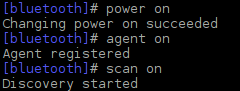
Now we are in bluetoothctl we can run the commands, first lets make sure that bluetooth is on, running and discovering devices:
 

image

With the commands 'power on', 'agent on' and 'scan on'. Though we likely only need 'power on' and 'scan on'.


image

image

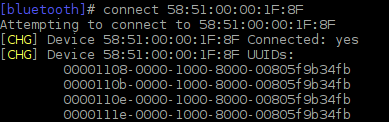
Devices! and while the software is running we will see devices appear, change, delete, etc. We can then connect to a device using its MAC address. Basically, we are talking to the devices directly at the hardware layer, usually on your typical WiFi or Ethernet network this is done transparently to you and we only work with IP addresses. However with Bluetooth at this point, no.
 

image

We can also then pair and trust the device and do all the fun features of Bluetooth, provided these are successful.


GUI

Some consider the blueman package and software to be unstable, though the sources saying so are a bit dated by now and it may be somewhat more stable.

 

image


When you have the blueman package installed, you should have a nice Bluetooth icon in your system tray. If you left-click with a mouse connected to your Raspberry Pi you should get a menu with all of the, hopefully, self explanatory options for you to play with, which for some reason I could not capture with scrot/imagemagick, so you get a nice photograph:


image


Yum, pixelated (it was an old Dell monitor). If we want to scan for devices, similarly to using the 'scan' command for bluetoothctl then we select 'Devices' on the menu:


image

And from here we can see what is available in the vicinity, you may be surprised at suddenly finding your neighbours smart television or phone, you will find out how thin your walls really are. It can be more fun in the office at work.


However, let us select "setup a new device":


{gallery} Add New Device

image

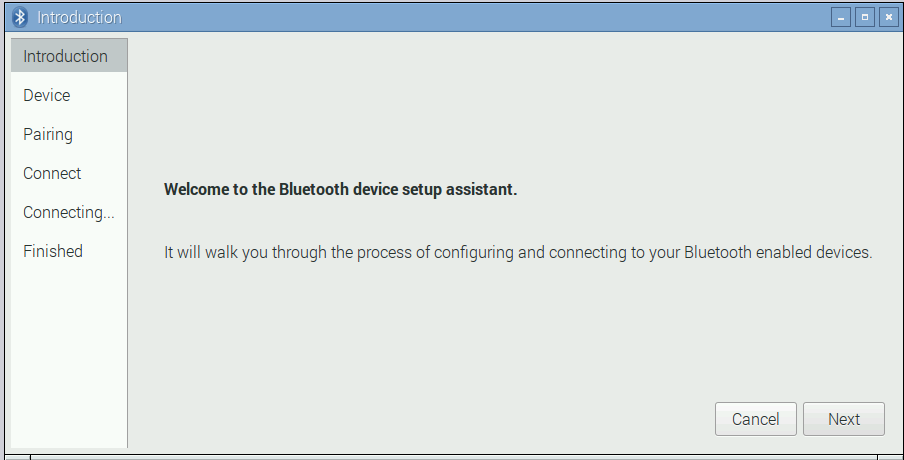
Add New Devices: Introduction

image

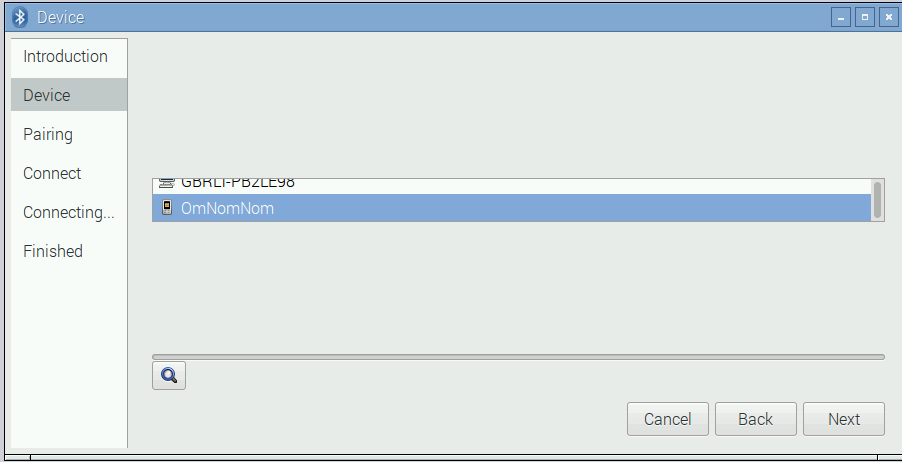
Add New Device: Choose the Device to Connect to

image

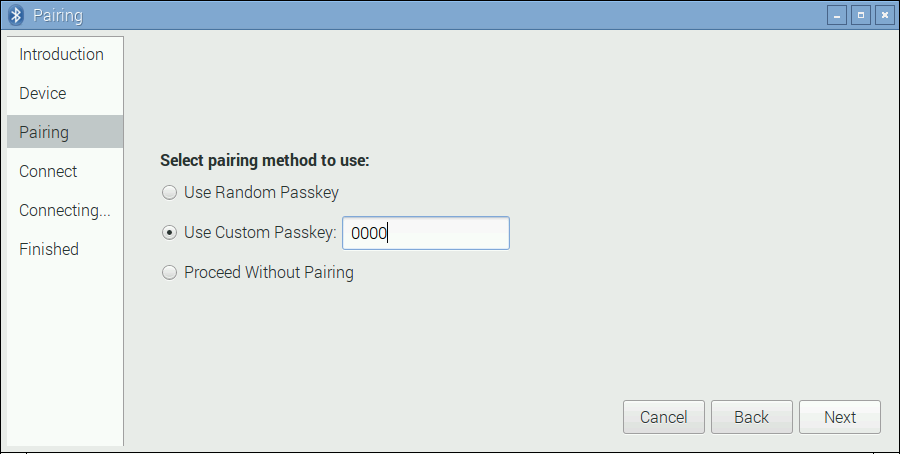
Add New Device: Choose a pairing code


However, what I discovered is that the passkey method is practically deprecated or ignored, it may be applicable for older Bluetooth software or devices, but these days you will get a prompt appear (and for myself, then hide) on Raspbian, next to the icon for blueman, there will be a message, and in this message it will display a message like:


This device wants to pair with this machine, with this code xxxxxxxx, do you want to permit or deny?


This likely happens with new devices such as smart phones and televisions, as a security measure that you are physically holding or looking at the device in question. Of course you then 'permit' on either the device or Raspbian and the two will be paired. Allowing you to then setup drivers for your Bluetooth device functionality, to use it as a modem, in the case of a phone, share its internet access or simply send files to and from it. Potentially, you can even use it as an audio device!


Attaching to devices such as headsets tends to be easier, and usually does not use a pairing code. A standard is usually four zeroes (0000) with most consumer devices.


Have you setup your Raspberry Pi 3 with Bluetooth?

Perhaps speakers, or even the Panasonic Grid Eye sensor boardPanasonic Grid Eye sensor board? (yes, it has bluetooth). I am not sure what I will do with mine, but after I backed the Bluetooth Audio Link I may use it with some speakers, or perhaps add the functionality to remote control a Plex Server.

  • bluetooth
  • ble
  • raspberry pi 3 bluetooth
  • ble 4.0
  • bluetooth low energy 4.0
  • ble 4.1
  • raspberry_pi
  • bluetooth_4.1
  • raspberry pi
  • bluetooth 4
  • bluetooth 4.1
  • raspberry_pi_space
  • raspberry_pi_3_bluetooth
  • bluetooth 4.0
  • bluetooth low energy
  • raspberry pi 3
  • ble_4.1
  • Share
  • History
  • More
  • Cancel
  • Sign in to reply

Top Comments

  • shabaz
    shabaz over 9 years ago +3
    Nice! I just tried it - worked a treat with my keyboard following your instructions. The update/upgrade part is super important, I tried it first without that (I was curious lol). After the upgrade, I…
  • shabaz
    shabaz over 9 years ago +2
    Also, cool smartphone name ; )
  • bwelsby
    bwelsby over 9 years ago in reply to cstanton +2
    Christopher Stanton wrote: So just for clarification, you're pairing more than one device at once to the Raspberry Pi? Yep and playing music from one device through the RPi to the other BTW another cause…
  • Former Member
    Former Member over 9 years ago in reply to Former Member

    Have you seen this?  How to get Wi-Fi and Bluetooth working on Raspberry Pi 3 | TechRadar

    • Cancel
    • Vote Up 0 Vote Down
    • Sign in to reply
    • More
    • Cancel
  • Former Member
    Former Member over 9 years ago

    Hello,

    I just purchased a Raspberry pi 3 and for the past few days I've been trying to figure out the Bluetooth feature of it. I managed to pair my phone (android) and laptop (win7) with it. I can send files from the pi to both of them but i cannot seem to find anywhere a tutorial about sending files (any files)  to the Rpi. I know there are a lot of methods to send files across but i was just wondering if the Bluetooth of the pi is capable of doing this sort of thing. One last thing i should mention is that I am a complete beginner soo .... yeah. Please help or at least point me into the right direction.

    • Cancel
    • Vote Up 0 Vote Down
    • Sign in to reply
    • More
    • Cancel
  • Former Member
    Former Member over 9 years ago in reply to Former Member

    I don't think that the Pi or the Linux bluetooth software is an issue for making client connections to a speaker.  Pairing always seems to work fine.  But, a successful connection seems to require a specific order of states and events - at least, with some speakers. 


    For example, my wife's Macbook Air connection to a portable bluetooth speaker always requires an exact sequence of steps to succeed (ditto for my laptop running Linux Mint):

    1. No bluetooth audio clients are trying to talk to the bluetooth speaker (E.g. a browser running YouTube), either from her laptop or from one of the other computers.
    2. The speaker is powered on and in bluetooth mode (as opposed to 9mm cabled mode if that is an option).
    3. The Mac bluetooth icon indicates that the Mac is currently connected via bluetooth to the speaker.  If not true, make the connection now.
    4. Start up the bluetooth client (E.g. a browser running YouTube).


    It seems to be a state-machine issue on the speaker-side (bluetooth audio server).  If steps 1-3 are not completed, step 4 fails consistently.  When I execute steps 1-2-3-4 in order, connection and subsequent usage succeeds 100% of the time.

    • Cancel
    • Vote Up +1 Vote Down
    • Sign in to reply
    • More
    • Cancel
  • shabaz
    shabaz over 9 years ago in reply to rubz

    Hi Rube,


    Can you repeat all the steps (it won't harm anything by repeating them), but this time copy-and-paste the output into a response, so that the output at each stage can be observed?

    • Cancel
    • Vote Up 0 Vote Down
    • Sign in to reply
    • More
    • Cancel
  • rubz
    rubz over 9 years ago in reply to clem57

    Hi Clem,


    Could you tell me how to get the complete log?


    Thanks

    • Cancel
    • Vote Up 0 Vote Down
    • Sign in to reply
    • More
    • Cancel
  • rubz
    rubz over 9 years ago in reply to shabaz

    Hi Shabaz,


    I'm still a noob on this but I'm sure it's not working from the command line either.

    I tried


    bluetoothctl

    power on


    and it says no adapter found.

    Please let me know if I'm doing this right.


    Thanks

    • Cancel
    • Vote Up 0 Vote Down
    • Sign in to reply
    • More
    • Cancel
  • clem57
    clem57 over 9 years ago in reply to rubz

    Please post the device(s) you tried along with a complete log. Sometimes more than one message holds the clues. For sure the software is not as mature as needed. Also to be fair this is a general discussion and not a I have a problem discussion. Posting a question would get better help/attention. Just saying.

    Clem

    • Cancel
    • Vote Up 0 Vote Down
    • Sign in to reply
    • More
    • Cancel
  • shabaz
    shabaz over 9 years ago in reply to rubz

    Hi Rube,


    Does it work without the GUI?

    I didn't try the GUI, but can confirm it works from the command line using the instructions in this blog post.


    Some devices have a few idiosyncrasies but people are reporting their findings and how they got devices functioning here in the comments over time.

    • Cancel
    • Vote Up 0 Vote Down
    • Sign in to reply
    • More
    • Cancel
  • rubz
    rubz over 9 years ago

    Hi, I've recently purchased the pi 3 and have been trying to get bluetooth working but I keep getting this message.


    Failed to apply network settings

    org.freedesktop.Dbus.Error.Spawn.ExecFailed: Failed to execute program org.blueman.Mechanism:Success


    You might not be able to connect bluetooth network via this machine


    I have followed the instructions above and checked other forums but can't find how to fix this.

    Running on Debian OS.


    Any help would be much appreciated.


    Thanks.

    Rube

    • Cancel
    • Vote Up 0 Vote Down
    • Sign in to reply
    • More
    • Cancel
  • fvan
    fvan over 9 years ago

    Was having issue with my new JBL Go speaker:


    pi@raspberrypi:~ $ bluetoothctl -a

    [bluetooth]# scan on

    Discovery started

    [CHG] Controller B8:27:EB:81:F8:41 Discovering: yes

    [NEW] Device 40:EF:4C:4F:7E:DF JBL GO

    [bluetooth]# pair 40:EF:4C:4F:7E:DF

    Attempting to pair with 40:EF:4C:4F:7E:DF

    [CHG] Device 40:EF:4C:4F:7E:DF Connected: yes

    [CHG] Device 40:EF:4C:4F:7E:DF UUIDs:

      00001108-0000-1000-8000-00805f9b34fb

      0000110b-0000-1000-8000-00805f9b34fb

      0000110c-0000-1000-8000-00805f9b34fb

      0000110e-0000-1000-8000-00805f9b34fb

      0000111e-0000-1000-8000-00805f9b34fb

    [CHG] Device 40:EF:4C:4F:7E:DF Paired: yes

    Pairing successful

    [CHG] Device 40:EF:4C:4F:7E:DF Connected: no

    [bluetooth]# connect 40:EF:4C:4F:7E:DF

    Attempting to connect to 40:EF:4C:4F:7E:DF

    Failed to connect: org.bluez.Error.Failed


    No matter what I did, I would keep getting that error. To test the speaker, I paired it with my phone, that worked. Tried again on Pi3:


    [bluetooth]# connect 40:EF:4C:4F:7E:DF

    Attempting to connect to 40:EF:4C:4F:7E:DF

    [CHG] Device 40:EF:4C:4F:7E:DF Connected: yes

    Connection successful


    Not sure why it would only work after pairing with another device, but it's working now image

    • Cancel
    • Vote Up +1 Vote Down
    • Sign in to reply
    • More
    • Cancel
<>
element14 Community

element14 is the first online community specifically for engineers. Connect with your peers and get expert answers to your questions.

  • Members
  • Learn
  • Technologies
  • Challenges & Projects
  • Products
  • Store
  • About Us
  • Feedback & Support
  • FAQs
  • Terms of Use
  • Privacy Policy
  • Legal and Copyright Notices
  • Sitemap
  • Cookies

An Avnet Company © 2026 Premier Farnell Limited. All Rights Reserved.

Premier Farnell Ltd, registered in England and Wales (no 00876412), registered office: Farnell House, Forge Lane, Leeds LS12 2NE.

ICP 备案号 10220084.

Follow element14

  • X
  • Facebook
  • linkedin
  • YouTube