element14 Community
element14 Community
    Register Log In
  • Site
  • Search
  • Log In Register
  • Community Hub
    Community Hub
    • What's New on element14
    • Feedback and Support
    • Benefits of Membership
    • Personal Blogs
    • Members Area
    • Achievement Levels
  • Learn
    Learn
    • Ask an Expert
    • eBooks
    • element14 presents
    • Learning Center
    • Tech Spotlight
    • STEM Academy
    • Webinars, Training and Events
    • Learning Groups
  • Technologies
    Technologies
    • 3D Printing
    • FPGA
    • Industrial Automation
    • Internet of Things
    • Power & Energy
    • Sensors
    • Technology Groups
  • Challenges & Projects
    Challenges & Projects
    • Design Challenges
    • element14 presents Projects
    • Project14
    • Arduino Projects
    • Raspberry Pi Projects
    • Project Groups
  • Products
    Products
    • Arduino
    • Avnet & Tria Boards Community
    • Dev Tools
    • Manufacturers
    • Multicomp Pro
    • Product Groups
    • Raspberry Pi
    • RoadTests & Reviews
  • About Us
  • Store
    Store
    • Visit Your Store
    • Choose another store...
      • Europe
      •  Austria (German)
      •  Belgium (Dutch, French)
      •  Bulgaria (Bulgarian)
      •  Czech Republic (Czech)
      •  Denmark (Danish)
      •  Estonia (Estonian)
      •  Finland (Finnish)
      •  France (French)
      •  Germany (German)
      •  Hungary (Hungarian)
      •  Ireland
      •  Israel
      •  Italy (Italian)
      •  Latvia (Latvian)
      •  
      •  Lithuania (Lithuanian)
      •  Netherlands (Dutch)
      •  Norway (Norwegian)
      •  Poland (Polish)
      •  Portugal (Portuguese)
      •  Romania (Romanian)
      •  Russia (Russian)
      •  Slovakia (Slovak)
      •  Slovenia (Slovenian)
      •  Spain (Spanish)
      •  Sweden (Swedish)
      •  Switzerland(German, French)
      •  Turkey (Turkish)
      •  United Kingdom
      • Asia Pacific
      •  Australia
      •  China
      •  Hong Kong
      •  India
      • Japan
      •  Korea (Korean)
      •  Malaysia
      •  New Zealand
      •  Philippines
      •  Singapore
      •  Taiwan
      •  Thailand (Thai)
      • Vietnam
      • Americas
      •  Brazil (Portuguese)
      •  Canada
      •  Mexico (Spanish)
      •  United States
      Can't find the country/region you're looking for? Visit our export site or find a local distributor.
  • Translate
  • Profile
  • Settings
Embedded and Microcontrollers
  • Technologies
  • More
Embedded and Microcontrollers
Blog switch up to 5V and 8 mA with MSPM0 Open Drain IO
  • Blog
  • Forum
  • Documents
  • Quiz
  • Polls
  • Files
  • Members
  • Mentions
  • Sub-Groups
  • Tags
  • More
  • Cancel
  • New
Join Embedded and Microcontrollers to participate - click to join for free!
  • Share
  • More
  • Cancel
Group Actions
  • Group RSS
  • More
  • Cancel
Engagement
  • Author Author: Jan Cumps
  • Date Created: 18 Nov 2025 7:46 PM Date Created
  • Views 202 views
  • Likes 7 likes
  • Comments 12 comments
  • MSPM0L1105
  • MSPM0
  • easyL1105
  • arm cortex-m
  • arm
Related
Recommended

switch up to 5V and 8 mA with MSPM0 Open Drain IO

Jan Cumps
Jan Cumps
18 Nov 2025

The Texas Instruments MSPM0 microcontroller has a few open drain GPIOs. TI calls them ODIO. These are 5V tolerant, and can switch up to ( see jc2048  comment below) +-8 mA. The main purpose is to support multi-level IO. 
They can do general low side switching too. That's what I'm checking out in this post. I use a ODIO to blinky an LED.

image
image: EasyL1105 controling an LED with open drain IO

The standard GPIOs can source 3.3V, 6 mA (with caveats). Can be used to modestly blink efficient LEDs. But if you want to control a small LCD's backlight, this 5V, 8 mA capability can save a few components.

From TI's documentation:

image

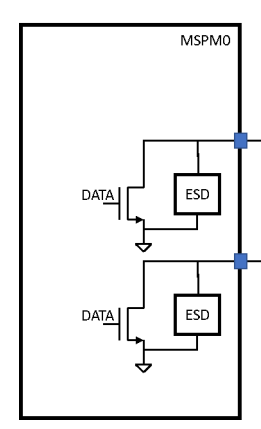
"... the open drain IO only implement a low-side NMOS driver and no high-side PMOS driver. The 5V-tolerant
open drain IO are fail-safe and may have a voltage present even if VDD is not supplied"

"ODIO can be used to implement communication with a 5V device."

image
source: MSPM0 L-Series MCUs Hardware Development Guide and MSPM0L110x Mixed-Signal Microcontrollers datasheet

What does this project do?

It's the blinky. TI calls it gpio_toggle_output. It blinks an LED every second. The only change I made, is to define open drain pin PA0 as the LED pin. The code is just a simple loop that toggles the pin, then delays half a second.

But what it actually allows you to do, is test that the MSPM0 ODIOs are capable to switch a 5V powered load.

Hardware resources

LED1 PA0 Led with 330R resistor in series
Powered by 5V

The circuit is simple. A red LED with a 330 Ohm resistor in series. When PA0's gate is driven high, the current in this circuit, and through PA0's channel, will be around 10  7 mA.

I used the 5V of my EasyL1105 kit. If you use a LaunchPad: they have a 5V supply too.

image

Testing

Program the MSPM0LL05 with the attached CCS project code. If you have a debugger, you can do this from CCS. I've also provided a .hex firmware that can be used with shabaz ' bootloader utility.

Code highlights

In SysConfig, PA0 is set up as an open drain output.:
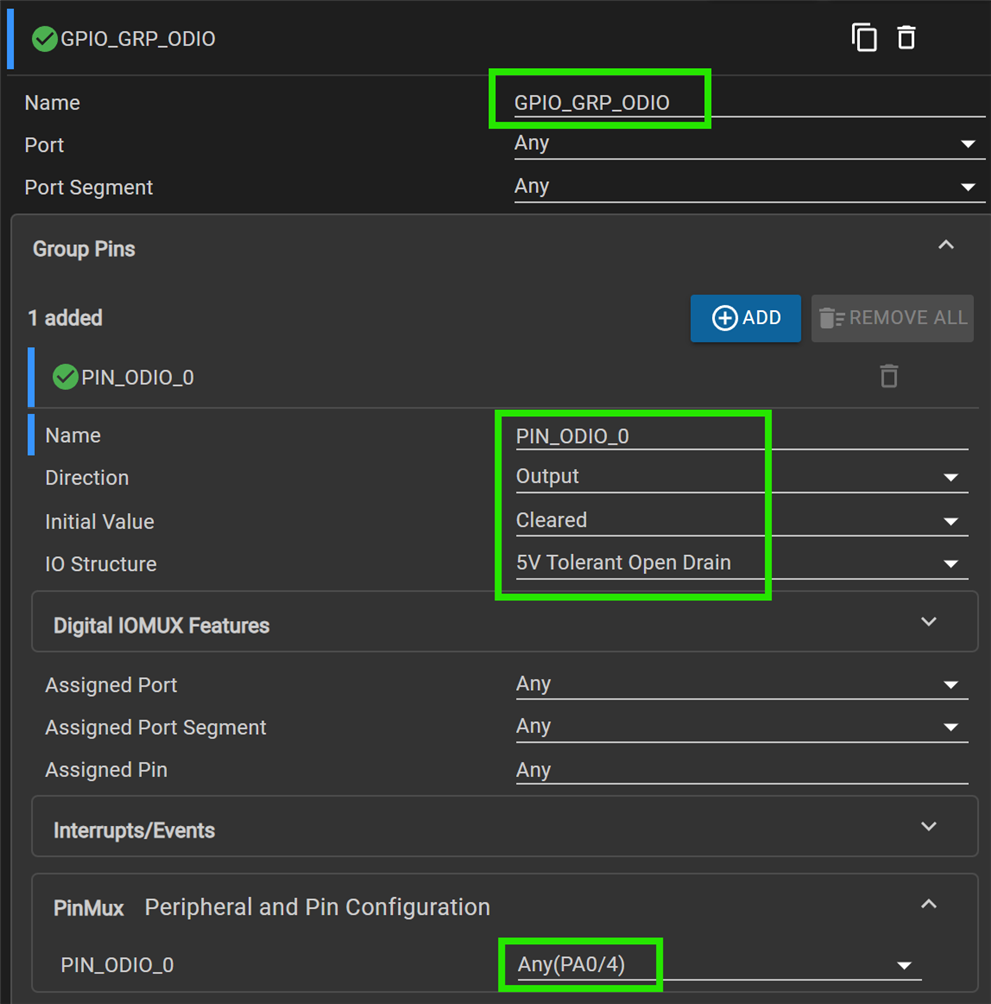
image

The code is extremely simple:

/* This results in approximately 0.5s of delay assuming 32MHz CPU_CLK */
#define DELAY (16000000)

int main(void)
{
    SYSCFG_DL_init();

    while (1) {
        delay_cycles(DELAY);
        DL_GPIO_togglePins(GPIO_GRP_ODIO_PORT,
            GPIO_GRP_ODIO_PIN_ODIO_0_PIN);
    }
}

What's next? PA0 can be driven from a PWM peripheral. That allows you to dim a small LCD's backlight without external transistors.

Have fun!

ccs project adapted to EasyL1105 (with bootloader compatible .hex firmware): EasyL1105_odio_sink_20251118.zip

Related posts

  • Sign in to reply
Parents
  • DAB
    DAB 23 days ago

    Nice post Jan.

    • Cancel
    • Vote Up 0 Vote Down
    • Sign in to reply
    • More
    • Cancel
Comment
  • DAB
    DAB 23 days ago

    Nice post Jan.

    • Cancel
    • Vote Up 0 Vote Down
    • Sign in to reply
    • More
    • Cancel
Children
No Data
element14 Community

element14 is the first online community specifically for engineers. Connect with your peers and get expert answers to your questions.

  • Members
  • Learn
  • Technologies
  • Challenges & Projects
  • Products
  • Store
  • About Us
  • Feedback & Support
  • FAQs
  • Terms of Use
  • Privacy Policy
  • Legal and Copyright Notices
  • Sitemap
  • Cookies

An Avnet Company © 2025 Premier Farnell Limited. All Rights Reserved.

Premier Farnell Ltd, registered in England and Wales (no 00876412), registered office: Farnell House, Forge Lane, Leeds LS12 2NE.

ICP 备案号 10220084.

Follow element14

  • X
  • Facebook
  • linkedin
  • YouTube