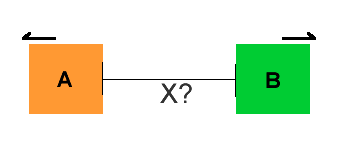
Alberto,
Ultrasonic? I never thought of that. Do you have any experience with such devices?
Cabe
What are the dimensions of the blocks? Let's say 3 inch cubes.
What are the max/min distances between the blocks? 4 inches.
What accuracy do you require? I would like it to be accurate to 0.01 inches. Or 10 thousandths.
Are you trying to detect a fixed or variable distance? I would like to detect fixed distances.
Can wires be attached to both blocks, and/or between the blocks? Yes.
How fast are the blocks moving? 50 inches per minute.
describe the environment that this is to work in -- temp, humidity, air quality, etc. Think light industrial but sheltered.
How much money do you want to spend? I would like it to be around $20 US dollars or less.
Thanks, NoSho.
Cabe
Hi Cabe,
yes I have experience in developing US system.
some years ago I developed an Electronic Parking System, it works just like a bat sense.
Hi Cabe,
Do you think RF transformer with low coupling could be a solution?
Just like RFID system, the power received, is proportional to the coils coupling.
What do you think about this!
In an ideal situation Ultrasonic might be perfect. However, what if it is in a noisy industrial environment? Is there a way to isolate the signal?
Also, please post some links to the Ultrasonic emitter/detectors you've used.
Thanks.
Cabe
Alberto,
I often don't get my RFID tollway device detected when I pass through the booths. So, I worry about the accuracy of such a device in measuring distance. But I like where your head is at.
I will have to research this a little more.
Cabe
Hi Cabe,
I know, RFID system got some troubles when the distance is more than a meter.
This is depending by the great difference between the coil of the reader (usually a big coil), and the coil of the transponder (usually tiny coils).
But if we try to think to put coils on the two blocks, and we will consider the system just like a power transformer, I believe that after some test and measurement, we can have a real proportionality
between received power and the distance of the two coils.
Alberto.
Something about US system.
In the 1994 we developed a US system for FIAT car alarm system, the goal was to detect any movments inside the car, when the car was parked.
So we built up a small 44KHz transmitter, using analog components, and also an analog receiver able to detect signal phase variations.
In the 2004 I worked in another company and we developed an electronic parking system with US technology. We always used discrete devices for TX and Rx, then a uP able to measure the delay between the transmitted signal and the received signal.
Alberto.
Beem breaker perhaps
It would take some doing to get .25% accuracy with ultrasound. You have to fight 3 different problems:
1. Speed of sound changes with temperature (very roughly .1% every degree F), you could correct for that with a temperature sensor, so it's not too bad.
2. Speed of sound changes with humidity (bone dry to saturated might be about .5% difference (again very roughly) in a warm environment, again, humidity sensor could take care of that.
3. Speed of sound changes with gas composition, measuring that would be tricky, but it's not a huge factor, but can be noticable.
Also note if your environment is windy you'll have to go with two transducers instead of reflections to correct for it.
Ultrasound is great for getting a good idea of distance, but getting serious accuracy out of it takes some work.