element14 Community
element14 Community
    Register Log In
  • Site
  • Search
  • Log In Register
  • Community Hub
    Community Hub
    • What's New on element14
    • Feedback and Support
    • Benefits of Membership
    • Personal Blogs
    • Members Area
    • Achievement Levels
  • Learn
    Learn
    • Ask an Expert
    • eBooks
    • element14 presents
    • Learning Center
    • Tech Spotlight
    • STEM Academy
    • Webinars, Training and Events
    • Learning Groups
  • Technologies
    Technologies
    • 3D Printing
    • FPGA
    • Industrial Automation
    • Internet of Things
    • Power & Energy
    • Sensors
    • Technology Groups
  • Challenges & Projects
    Challenges & Projects
    • Design Challenges
    • element14 presents Projects
    • Project14
    • Arduino Projects
    • Raspberry Pi Projects
    • Project Groups
  • Products
    Products
    • Arduino
    • Avnet & Tria Boards Community
    • Dev Tools
    • Manufacturers
    • Multicomp Pro
    • Product Groups
    • Raspberry Pi
    • RoadTests & Reviews
  • About Us
    About the element14 Community
  • Store
    Store
    • Visit Your Store
    • Choose another store...
      • Europe
      •  Austria (German)
      •  Belgium (Dutch, French)
      •  Bulgaria (Bulgarian)
      •  Czech Republic (Czech)
      •  Denmark (Danish)
      •  Estonia (Estonian)
      •  Finland (Finnish)
      •  France (French)
      •  Germany (German)
      •  Hungary (Hungarian)
      •  Ireland
      •  Israel
      •  Italy (Italian)
      •  Latvia (Latvian)
      •  
      •  Lithuania (Lithuanian)
      •  Netherlands (Dutch)
      •  Norway (Norwegian)
      •  Poland (Polish)
      •  Portugal (Portuguese)
      •  Romania (Romanian)
      •  Russia (Russian)
      •  Slovakia (Slovak)
      •  Slovenia (Slovenian)
      •  Spain (Spanish)
      •  Sweden (Swedish)
      •  Switzerland(German, French)
      •  Turkey (Turkish)
      •  United Kingdom
      • Asia Pacific
      •  Australia
      •  China
      •  Hong Kong
      •  India
      •  Japan
      •  Korea (Korean)
      •  Malaysia
      •  New Zealand
      •  Philippines
      •  Singapore
      •  Taiwan
      •  Thailand (Thai)
      •  Vietnam
      • Americas
      •  Brazil (Portuguese)
      •  Canada
      •  Mexico (Spanish)
      •  United States
      Can't find the country/region you're looking for? Visit our export site or find a local distributor.
  • Translate
  • Profile
  • Settings
Experts, Learning and Guidance
  • Technologies
  • More
Experts, Learning and Guidance
Ask an Expert Forum Design a Non-Contact RPM meter
  • Blog
  • Forum
  • Documents
  • Leaderboard
  • Files
  • Members
  • Mentions
  • Sub-Groups
  • Tags
  • More
  • Cancel
  • New
Join Experts, Learning and Guidance to participate - click to join for free!
Actions
  • Share
  • More
  • Cancel
Forum Thread Details
  • State Suggested Answer
  • Replies 5 replies
  • Answers 2 answers
  • Subscribers 336 subscribers
  • Views 112 views
  • Users 0 members are here
Related
See a helpful answer?

Be sure to click 'more' and select 'suggest as answer'!

If you're the thread creator, be sure to click 'more' then 'Verify as Answer'!

Design a Non-Contact RPM meter

Humaninsane
Humaninsane 17 hours ago

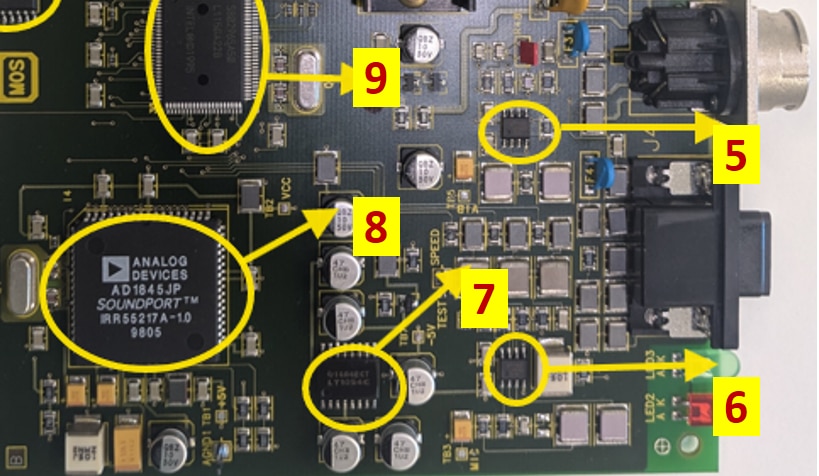
I am currently reverse-engineering a non-contact RPM sensor module that uses a Bosch knock sensor (

Knock Sensors (0261231046) - Knock Sensors - Bosch Auto Parts)

and a Condenser MIC output as the input. The knock sensor and MIC signal is fed into 2 separate op-amp

LMC66x CMOS Dual Operational Amplifiers datasheet (Rev. D)

, and the op-amp output goes to a CODEC 

AD1845 , DigChip http://www.digchip.com

for processing.

My goal is to understand the op-amp circuitry and determine the appropriate configuration needed to condition the knock sensor and MIC signal before feeding it to the CODEC. I am a bit confused about where to start and what concepts I should study regarding op-amp. and there is a charge pump as well, 

LT1054 Switched-Capacitor Voltage Converters With Regulators datasheet (Rev. G)

Could anyone guide me on:

How to analyze the existing op-amp circuit?
What op-amp configurations are commonly used for piezoelectric sensors such as knock sensors?
What topics should I study to better understand this signal-conditioning stage?
How can I determine the expected signal levels and bandwidth requirements before the CODEC input?

The ultimate task is to redesign this board while maintaining identical functionality and output behavior as the existing device, so understanding the analog front-end is critical.

Any suggestions on the right approach, reference materials, or debugging techniques would be greatly appreciated.

AI is confusing with too much data. Not getting a clear path.image
  • Sign in to reply
  • Cancel

Top Replies

  • michaelkellett
    michaelkellett 14 hours ago in reply to Humaninsane +4 suggested
    From your picture of the pcb it's an old design. So my next question is - why do you want to copy it ? Pretty much all the parts are old (starting with the now obsolete AD1845). I'm sure that whatever…
  • geralds
    geralds 14 hours ago +1 suggested
    Sorry to tell you: you cannot rework this schematic as well we cannot. AD1845 Datasheet and Product Info | Analog Devices The CODEC is obsolete. 1. you need the values of all components 2. the ADC…
Parents
  • colporteur
    0 colporteur 6 hours ago

    Are you willing to share your experience level?

    The OP amp knowledge pool can be fairly deep and trust me this site has some pretty good deep end divers. Providing some back ground on your experience level will help tailor responses.

    I did a term paper on OP amps some forty five years ago for my college course. The same program had a vacuum course. My OP amp knowledge is in the shallow end of the pool. 

    • Cancel
    • Vote Up 0 Vote Down
    • Sign in to reply
    • Verify Answer
    • Cancel
Reply
  • colporteur
    0 colporteur 6 hours ago

    Are you willing to share your experience level?

    The OP amp knowledge pool can be fairly deep and trust me this site has some pretty good deep end divers. Providing some back ground on your experience level will help tailor responses.

    I did a term paper on OP amps some forty five years ago for my college course. The same program had a vacuum course. My OP amp knowledge is in the shallow end of the pool. 

    • Cancel
    • Vote Up 0 Vote Down
    • Sign in to reply
    • Verify Answer
    • Cancel
Children
No Data
element14 Community

element14 is the first online community specifically for engineers. Connect with your peers and get expert answers to your questions.

  • Members
  • Learn
  • Technologies
  • Challenges & Projects
  • Products
  • Store
  • About Us
  • Feedback & Support
  • FAQs
  • Terms of Use
  • Privacy Policy
  • Legal and Copyright Notices
  • Sitemap
  • Cookies

An Avnet Company © 2026 Premier Farnell Limited. All Rights Reserved.

Premier Farnell Ltd, registered in England and Wales (no 00876412), registered office: Farnell House, Forge Lane, Leeds LS12 2NE.

Follow element14

  • X
  • Facebook
  • linkedin
  • YouTube