element14 Community
element14 Community
    Register Log In
  • Site
  • Search
  • Log In Register
  • Community Hub
    Community Hub
    • What's New on element14
    • Feedback and Support
    • Benefits of Membership
    • Personal Blogs
    • Members Area
    • Achievement Levels
  • Learn
    Learn
    • Ask an Expert
    • eBooks
    • element14 presents
    • Learning Center
    • Tech Spotlight
    • STEM Academy
    • Webinars, Training and Events
    • Learning Groups
  • Technologies
    Technologies
    • 3D Printing
    • FPGA
    • Industrial Automation
    • Internet of Things
    • Power & Energy
    • Sensors
    • Technology Groups
  • Challenges & Projects
    Challenges & Projects
    • Design Challenges
    • element14 presents Projects
    • Project14
    • Arduino Projects
    • Raspberry Pi Projects
    • Project Groups
  • Products
    Products
    • Arduino
    • Avnet & Tria Boards Community
    • Dev Tools
    • Manufacturers
    • Multicomp Pro
    • Product Groups
    • Raspberry Pi
    • RoadTests & Reviews
  • About Us
  • Store
    Store
    • Visit Your Store
    • Choose another store...
      • Europe
      •  Austria (German)
      •  Belgium (Dutch, French)
      •  Bulgaria (Bulgarian)
      •  Czech Republic (Czech)
      •  Denmark (Danish)
      •  Estonia (Estonian)
      •  Finland (Finnish)
      •  France (French)
      •  Germany (German)
      •  Hungary (Hungarian)
      •  Ireland
      •  Israel
      •  Italy (Italian)
      •  Latvia (Latvian)
      •  
      •  Lithuania (Lithuanian)
      •  Netherlands (Dutch)
      •  Norway (Norwegian)
      •  Poland (Polish)
      •  Portugal (Portuguese)
      •  Romania (Romanian)
      •  Russia (Russian)
      •  Slovakia (Slovak)
      •  Slovenia (Slovenian)
      •  Spain (Spanish)
      •  Sweden (Swedish)
      •  Switzerland(German, French)
      •  Turkey (Turkish)
      •  United Kingdom
      • Asia Pacific
      •  Australia
      •  China
      •  Hong Kong
      •  India
      •  Korea (Korean)
      •  Malaysia
      •  New Zealand
      •  Philippines
      •  Singapore
      •  Taiwan
      •  Thailand (Thai)
      • Americas
      •  Brazil (Portuguese)
      •  Canada
      •  Mexico (Spanish)
      •  United States
      Can't find the country/region you're looking for? Visit our export site or find a local distributor.
  • Translate
  • Profile
  • Settings
FPGA
  • Technologies
  • More
FPGA
Forum Open Source development at Altera
  • Blog
  • Forum
  • Documents
  • Quiz
  • Events
  • Polls
  • Files
  • Members
  • Mentions
  • Sub-Groups
  • Tags
  • More
  • Cancel
  • New
Join FPGA to participate - click to join for free!
Actions
  • Share
  • More
  • Cancel
Forum Thread Details
  • Replies 6 replies
  • Subscribers 558 subscribers
  • Views 1471 views
  • Users 0 members are here
  • open_source
  • altera
  • linux
Related

Open Source development at Altera

fustini
fustini over 9 years ago

FYI - I watched this interesting talk recently by Altera engineer Dinh Nguyen at Embedded Linux Conference Europe 2015:


Upstreaming in a Downstream Environment


You don't have permission to edit metadata of this video.
Edit media
x
image
Upload Preview
image

Altera has been, for the most part, a closed-source company with little, if any, contributions to any open-source projects. So when Altera decided that they needed to upstream everything possible for supporting the Altera SoCFPGA platform, most people in the company did not really understand what that really meant. From IT infrastructure, to all levels of management, Dinh had to educate that upstreaming with community involvement was the way to go for this platform. That it will yield benefits in the future. This also involved members of Dinh's own development team, who have never contributed before, to start contributing. And to also get into the mindset of upstream first. For example, the Linux support for Altera's SoCFPGA platform is mostly upstreamed, so Dinh's team can move to the latest Linux kernel within 1-2 hours of a kernel release. While our U-Boot support has been lacking,


PDF Slides:

https://events.linuxfoundation.org/sites/events/files/slides/2015_ELCE_Dinh_Nguyen_v5_16_9.pdf


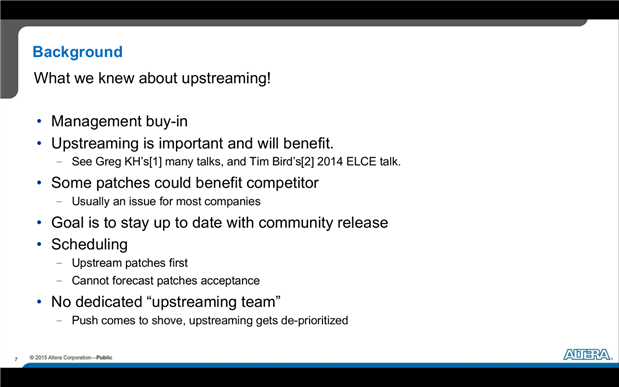
A couple slides I thought were interesting:
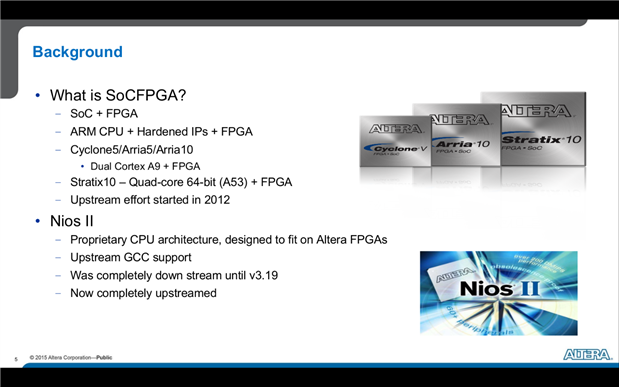
image

image

image

image

  • Sign in to reply
  • Cancel

Top Replies

  • fustini
    fustini over 9 years ago in reply to johnbeetem +1
    He mentions that open source Altera design tools might be possible in the future. It does sound like Open Source ideals are starting to spread through the company... so I guess that gives a little hope…
  • Former Member
    Former Member over 9 years ago in reply to fustini +1
    Interesting - thanks for sharing, fustini . The open sourcing of FPGA bitstreams, etc. seems to have Altera and Xilinx caught in a little (see: massive, high-stakes) game of chicken. Something's gotta…
  • johnbeetem
    johnbeetem over 9 years ago

    Does he say anything about opening Altera FPGA bitstreams?  From the slides, it only looks like Altera is open-sourcing CPU stuff.

    • Cancel
    • Vote Up 0 Vote Down
    • Sign in to reply
    • Cancel
  • fustini
    fustini over 9 years ago in reply to johnbeetem

    He mentions that open source Altera design tools might be possible in the future.  It does sound like Open Source ideals are starting to spread through the company... so I guess that gives a little hope.

    • Cancel
    • Vote Up +1 Vote Down
    • Sign in to reply
    • Cancel
  • Former Member
    Former Member over 9 years ago in reply to fustini

    Interesting - thanks for sharing, fustini. The open sourcing of FPGA bitstreams, etc. seems to have Altera and Xilinx caught in a little (see: massive, high-stakes) game of chicken. Something's gotta eventually give...

    • Cancel
    • Vote Up +1 Vote Down
    • Sign in to reply
    • Cancel
  • michaelkellett
    michaelkellett over 9 years ago in reply to Former Member

    I don't see any great pressure - the effort to write open source mapping/fitting tools for the X and A parts would be huge and experience from GCC and other such things (like GPU video support) suggests that not much will happen unless actually supported by the IP holder (X or A in this case).

    Both X and A are largely software companies (ie the software to support the FPGAs is a huge chunk of their R&D spend) and they both seek competitive advantage from owning it.


    What might change the picture is the emergence of a new FPGA maker without the resources to do all their own tools but so far they all seem to go and license from Synplicity -  which they do because there is no viable open source alternative. So it's all a bit chicken and eggish - if you've invested a huge load of cash into tools you don't want to give them away, and you can't establish a new chip without using tools with a huge investment in them.


    I'm not really all that bothered if I could use open source tools with X and A - where they (open source tools) would help is opening up competition to X and A - which of course they are both well aware of which is why they don't open up their bit streams.


    Lattice are the underdog in all this and their interest in tiny FPGAs may give them a different attitude - but I can't see the open source ICE40 effort (which Lattice don't appear to be trying to stop) making a big impact in the short term.


    MK

    • Cancel
    • Vote Up 0 Vote Down
    • Sign in to reply
    • Cancel
  • johnbeetem
    johnbeetem over 9 years ago in reply to michaelkellett

    Michael Kellett wrote:


    Both X and A are largely software companies (ie the software to support the FPGAs is a huge chunk of their R&D spend) and they both seek competitive advantage from owning it.

    I don't have insider knowledge of any FPGA companies, but my opinion is that X and A are primarily silicon companies and they don't make money unless they sell that silicon.  They have to develop and maintain FPGA software to sell that silicon, but it's pure overhead.  If they didn't have to develop and maintain that software, the silicon would be a lot more profitable.


    Compare this to a typical microcontroller company.  They don't have to write their own software -- they can give away a free GNU tool-chain or let customers license software from ARM.  The microcontroller companies can concentrate on silicon and adding clever peripherals to distinguish their parts from competitors.  They don't have to re-invent the wheel like the FPGA vendors all need to do since they can't use a shared open-source tool base.


    IMO FPGA companies try to spend as little resource as possible on software, and I believe this is clear from looking at that software.  Basically, what FPGA vendors want is to be an alternative to ASICs.  The software serves that purpose.  It's designed for FPGA professionals who know what they're doing, with a steep learning curve for new users.  The software is slow for complex designs, which is not a big issue if you're competing with large ASICs but which is impractical for reconfigurable computing.  Reconfigurable computing doesn't sell a lot of silicon, so it's understandable that FPGA vendors wouldn't want to spend software resources on it.  If the software were open-source, reconfigurable computing researchers could create their own software and languages that would be better suited to the task.


    Here's another consideration: I don't know if this applies to any of the FPGA vendors, but one thing I've seen in medium to large companies is what I call the "business area one" phenomenon.  Basically, the part of the company that brings in the most revenue calls the shots and makes sure "business area one" gets an outsize share of resources, starving other parts of the company that could be helping the company as a whole become more successful.  For an FPGA vendor, silicon is clearly "business area one" and software is an overhead.  If there are limited resources, who is going to get "first dibs"?


    JMO/YMMV

    • Cancel
    • Vote Up 0 Vote Down
    • Sign in to reply
    • Cancel
  • Former Member
    Former Member over 9 years ago in reply to johnbeetem

    michaelkellett, to your point, existing players face a lot of pressure from their existing/established customers - see: defense & aerospace - (in addition to wanting to protect their IP) to continue to keep things closed. I definitely agree that at some point we'll see a bit of a shift as FPGAs make their way deeper into the maker/education space (assuming that ends up being a substantial enough source of revenue), perhaps starting with older, otherwise-unsupported architectures.


    johnbeetem, the FPGA vendors actually expend a ton of resources on software development (and when it isn't practical to build it, they just buy it - e.g. Vivado, HLS, etc.). But it's definitely true that the revenue from development tools is a drop in the bucket. You may have event seen the recent announcement that Xilinx made their High Level Synthesis tool completely free for select devices - which is pretty amazing honestly.


    Pretty exciting stuff. Hopefully FPGAs are finally ready for primetime! image

    • Cancel
    • Vote Up 0 Vote Down
    • Sign in to reply
    • Cancel
element14 Community

element14 is the first online community specifically for engineers. Connect with your peers and get expert answers to your questions.

  • Members
  • Learn
  • Technologies
  • Challenges & Projects
  • Products
  • Store
  • About Us
  • Feedback & Support
  • FAQs
  • Terms of Use
  • Privacy Policy
  • Legal and Copyright Notices
  • Sitemap
  • Cookies

An Avnet Company © 2025 Premier Farnell Limited. All Rights Reserved.

Premier Farnell Ltd, registered in England and Wales (no 00876412), registered office: Farnell House, Forge Lane, Leeds LS12 2NE.

ICP 备案号 10220084.

Follow element14

  • X
  • Facebook
  • linkedin
  • YouTube