element14 Community
element14 Community
    Register Log In
  • Site
  • Search
  • Log In Register
  • Community Hub
    Community Hub
    • What's New on element14
    • Feedback and Support
    • Benefits of Membership
    • Personal Blogs
    • Members Area
    • Achievement Levels
  • Learn
    Learn
    • Ask an Expert
    • eBooks
    • element14 presents
    • Learning Center
    • Tech Spotlight
    • STEM Academy
    • Webinars, Training and Events
    • Learning Groups
  • Technologies
    Technologies
    • 3D Printing
    • FPGA
    • Industrial Automation
    • Internet of Things
    • Power & Energy
    • Sensors
    • Technology Groups
  • Challenges & Projects
    Challenges & Projects
    • Design Challenges
    • element14 presents Projects
    • Project14
    • Arduino Projects
    • Raspberry Pi Projects
    • Project Groups
  • Products
    Products
    • Arduino
    • Avnet & Tria Boards Community
    • Dev Tools
    • Manufacturers
    • Multicomp Pro
    • Product Groups
    • Raspberry Pi
    • RoadTests & Reviews
  • About Us
    About the element14 Community
  • Store
    Store
    • Visit Your Store
    • Choose another store...
      • Europe
      •  Austria (German)
      •  Belgium (Dutch, French)
      •  Bulgaria (Bulgarian)
      •  Czech Republic (Czech)
      •  Denmark (Danish)
      •  Estonia (Estonian)
      •  Finland (Finnish)
      •  France (French)
      •  Germany (German)
      •  Hungary (Hungarian)
      •  Ireland
      •  Israel
      •  Italy (Italian)
      •  Latvia (Latvian)
      •  
      •  Lithuania (Lithuanian)
      •  Netherlands (Dutch)
      •  Norway (Norwegian)
      •  Poland (Polish)
      •  Portugal (Portuguese)
      •  Romania (Romanian)
      •  Russia (Russian)
      •  Slovakia (Slovak)
      •  Slovenia (Slovenian)
      •  Spain (Spanish)
      •  Sweden (Swedish)
      •  Switzerland(German, French)
      •  Turkey (Turkish)
      •  United Kingdom
      • Asia Pacific
      •  Australia
      •  China
      •  Hong Kong
      •  India
      •  Japan
      •  Korea (Korean)
      •  Malaysia
      •  New Zealand
      •  Philippines
      •  Singapore
      •  Taiwan
      •  Thailand (Thai)
      •  Vietnam
      • Americas
      •  Brazil (Portuguese)
      •  Canada
      •  Mexico (Spanish)
      •  United States
      Can't find the country/region you're looking for? Visit our export site or find a local distributor.
  • Translate
  • Profile
  • Settings
FPGA
  • Technologies
  • More
FPGA
Forum 基于Verilog HDL设计实现的乘法器性能研究
  • Blog
  • Forum
  • Documents
  • Quiz
  • Events
  • Polls
  • Files
  • Members
  • Mentions
  • Sub-Groups
  • Tags
  • More
  • Cancel
  • New
Join FPGA to participate - click to join for free!
Actions
  • Share
  • More
  • Cancel
Forum Thread Details
  • Replies 0 replies
  • Subscribers 570 subscribers
  • Views 2127 views
  • Users 0 members are here
  • 资源占用率
  • 时序仿真
  • 乘法器
Related

基于Verilog HDL设计实现的乘法器性能研究

Flush
Flush over 15 years ago

1 引言

     Verilog HDL是当今最为流行的一种硬件描述语言,完整的Verilog HDL足以对最复杂的芯片和完整的电子系统进行描述[1]。本文采用Verilog HDL语言来设计实现4-2和5-2混合压缩器构成的乘法器的设计,并与另外实现的两种乘法器从速度,面积和硬件资源占用率等方面进行了性能比较,得出用这种改进压缩器要比两位阵列乘法器和传统的4-2压缩器构成的乘法器速度提高了10%,硬件资源占用减少了2%。

2 两位阵列乘法器

阵列乘法器基于移位与求和算法。两位阵列乘法器是对乘数以2bit进行判断,这样可以在部分积的数目上比一位判断阵列乘法器减少1倍;另外,阵列乘法器结构比较规范,利于布局布线,但是阵列乘法器存在进位问题,运算速度比较慢,所需时钟周期长,时延大。以下是两位判断的乘法器的Verilog HDL语言部分程序:

module imult _radix_2(prod,ready,multiplicand,multiplier,start,clk);

      ……

        case ( {product[1:0]} )

          2'd0: pp = {2'b0, product[31:16] };

          2'd1: pp = {2'b0, product[31:16] } + multiplicandX_1;

          2'd2: pp = {2'b0, product[31:16] } + multiplicandX_2;

          2'd3: pp = {2'b0, product[31:16] } + multiplicandX_3;

        ……  

3  改进Booth编码乘法器

       阵列乘法器虽然占用相对较少的硬件面积,可是运算速度非常慢,不能满足高速运算的要求。为了得到高速的乘法器,可以从两个方面来提高乘法器的计算速度:减少部分积数目;提高部分积压缩速度。通常减少部分积数目采用二阶的Booth编码实现;可用4-2压缩器构成的Wallace树来提高部分积求和速度。本文采用4-2压缩器和5-2压缩器的混合Wallace树来进一步提高求和速度。www.51kaifa.com

       改进Booth算法通过对二进制补码数据重新编码,压缩PP(部分积)数目,以提高运算速度。其中,压缩率取决于编码方法,如果采用三位编码,可压缩1/2的PP,再对所得的n/2个部分积进行求和运算。在电路实现中还可采用混合握手协议和管道传输方式,可以降低电路的功耗,仅占Amulet3i乘法器的每次运算的能量消耗的50%【2】,另外,也可以采用混合逻辑乘法器设计【3】。Booth算法电路图在文献[4]中有具体介绍。

3.1  4-2压缩器

        4-2压缩器使用2个CSA(Carry-save Adders保留进位加法器),将5个数据(4个实际数据和一个进位)相加产生3个数(Sun, Carry和Cout)。4-2压缩器结构图如图1所示【4】。
image

图1 由2个CSA构成的4-2压缩器

        4-2压缩器是进行部分积压缩最常用到的部件,与全加器相比,具有电路简单、连线规则的优点.传统4-2压缩器输入与输出的逻辑关系表达式[8]为:

image

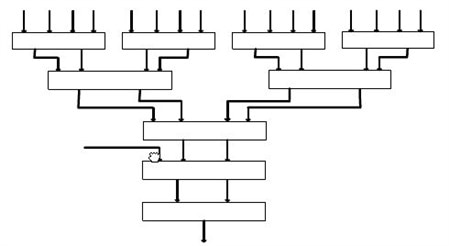
表达式中:In1~In4为部分积输入信号;Cin为邻近压缩器进位输入;Sum为伪和;Carry和Cout为进位输出,其权值相同。由图及表达式知,输出进位与输入进位式相互独立的,即输出并不由输入产生,这样就能保证部分积同时且独立地相加。4-2压缩器对部分积进行压缩的图如图2【5】所示:
image

图2  4-2压缩器组结构图

       由4-2压缩器进行部分积压缩的Booth乘法器的Verilog HDL描述部分程序如下:

module Booth_radix_4(prod,ready,multiplicand,multiplier,start,clk);

     …… 

      dug dug0(PP0,mult[2:0]);

            ……

count count1(clock,sum0,carry0,PP0,PP1,PP2,PP3,cout0,cin0);

     count count2(clock,sum1,carry1,PP4,PP5,PP6,PP7,cout1,cout0);

      ……

     count count3(clock,sum,carry,sum0,carry0,sum1,carry1,cout,cin0);www.51kaifa.com

       ……

3.2    4-2和5-2混合压缩器

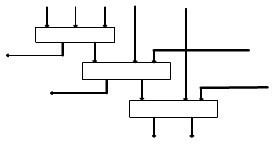
4-2压缩器在很大程度上减少了部分积的求和速度,但是它有一个缺点是Sum(伪和信号)比Carry(进位信号)的产生速度慢,因此,进位信号必须等待伪和信号的产生,这样又造成了压缩速度的降低和功耗的增加.可以用异或门和2-1数据选择器对电路进行变换【6】,这种结构能同时产生伪和信号和进位信号,并且关键路径的延迟也只有全加器的1.5倍【8】。为进一步压缩部分积的求和级数,加快压缩速度,本文同时采用了4-2压缩器和5-2压缩器混合逻辑设计。5-2压缩器的结构图如图3【7】所示,
image

5-2压缩器有7个输入In1~In5(权值相同),3个进位输出(权值相同)和一个伪和(权值比进位输出低一位),这种结构的压缩器结构规整,且仅有6个异或门的延迟。文献[8]中给出了5-2压缩器的输入与输出的逻辑关系表达式。整个压缩器结构图如图4所示:

image

图4  本文采用的整个压缩器结构

       由4-2和5-2混合压缩器实现的改进Booth乘法器的Verilog HDL描述部分程序如下:

module Booth_radix_5(prod,ready,multiplicand,multiplier,start,clk);

     …… 

      dug dug0(PP0,mult[2:0]);

      dug dug1(PP1,mult[4:2]);

      ……

count count1(clock,sum0,carry0,PP0,PP1,PP2,PP3,cout0,cin0);

           ……

      sum sum1(clock,sum,carry,In16,sum0,carry0,sum1,carry1,cout,cin0,cin1);

       ……

4逻辑仿真及性能比较

      本文在Xilinx ISE和Quartus II两种集成开发环境下, 对以上3种结构的乘法器进行了编译、综合、适配、时序仿真以及功率分析,其中输入信号的字宽为32bit。有仿真工具Xilinx ISE和Quartus II进行的仿真结果报告文件,很容易做出对这3种乘法器的性能比较,如表1所示。

Resources Summary

乘法器类型

资源占用率

面积(mm2)

时延(ns)

两位阵列乘法器

37/128(29%)

6.91

8.285

4-2压缩的Booth乘法器

38/256(15%)

12.07

3.99

4-2和5-2混合压缩的

Booth乘法器

35/256(14%)

11.849

3.59


有性能比较表知:阵列乘法器面积最小,功耗小,但是运行速度慢;单纯使用4-2压缩器的Booth乘法器在资源占用率和速度上要比阵列乘法器提高约1倍,功耗略大于阵列乘法器;而本文设计采用的乘法器方案有效提高了乘法器的运算能力,应用在FPGA上工作频率可达256.61MHz,要比传统的4-2压缩器构成的乘法器在速度上提高了10%,硬件资源占用减少了约1%。

4结论

       不同架构的乘法器在性能上都存在优点和缺点,在选择乘法器时,应根据应用场合的要求在速度、面积和功耗等方面综合考虑,本文采用Xilinx ISE和Quartus II两种集成开发环境对所实现的乘法器综合进行测试,更能准确显示不同结构的乘法器的性能优势,帮助用户快速选择合适的乘法器。本文设计采用的乘法器方案要比传统的4-2压缩器构成的乘法器在速度上提高了10%,硬件资源占用减少了约1%,有效提高了乘法器的运算能力。

         本文作者创新点: 本文采用4-2和5-2混合压缩器对部分积进行压缩,减少了乘法器的延时和资源占用率;并用Verilog HDL语言实现了两位阵列乘法器和传统的Booth编码乘法器。同时在Xilinx ISE和Quartus II两种集成开发环境下进行综合仿真测试,这更有利于比较乘法器的性能优势,便于用户更准确地选择适合应用场合的乘法器。

  • Sign in to reply
  • Cancel
element14 Community

element14 is the first online community specifically for engineers. Connect with your peers and get expert answers to your questions.

  • Members
  • Learn
  • Technologies
  • Challenges & Projects
  • Products
  • Store
  • About Us
  • Feedback & Support
  • FAQs
  • Terms of Use
  • Privacy Policy
  • Legal and Copyright Notices
  • Sitemap
  • Cookies

An Avnet Company © 2026 Premier Farnell Limited. All Rights Reserved.

Premier Farnell Ltd, registered in England and Wales (no 00876412), registered office: Farnell House, Forge Lane, Leeds LS12 2NE.

ICP 备案号 10220084.

Follow element14

  • X
  • Facebook
  • linkedin
  • YouTube