Have some of you an example "How to Connect an parallel ADC to the Lattice XP2 Brevia Dev Kit"?
It could be parallel ADC 10-16 bit, 20 MSPS or higher.
Thanks in advance!
Have some of you an example "How to Connect an parallel ADC to the Lattice XP2 Brevia Dev Kit"?
It could be parallel ADC 10-16 bit, 20 MSPS or higher.
Thanks in advance!
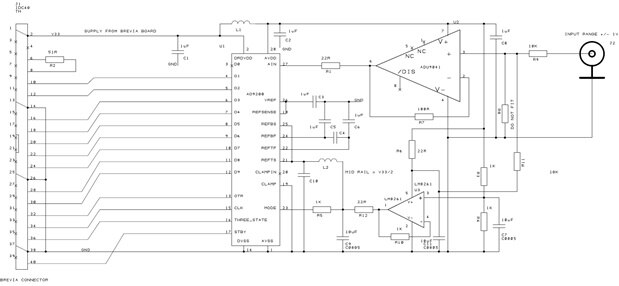
Hello John,
Thanks for the error spotting - I've attached a corrected schematic. The input biasing should have come from rail, not mid-rail. It's an excessively simple design so unless the DC offset is sensitive to source resistance.
I think the LM8261 would be OK but I've added a series R anyway - it can always be left off.
I started this design trying to suggest something to Mira (the OP) that could be made on prototype adapters without a PCB but, as I've said, I think that is likely to be very tricky to do and won't work very well, if at all.
This design would be much improved by adding a buffer amplifier because the simple method of offsetting the input so it can accept -ve voltages results in requiring a very low source impedance drive. It would be much better to buffer the input (and go for 1M input impedance to work with scope probes) but this would need a negative supply.
If I were doing this for a commercial reason I would almost certainly use a four layer board with two power planes. usually I have aground plane and a "vcc" plane with tracks for power but mostly filled in with more ground plane for this kind of circuit. I would probably go for continuous ground planes - when I have split planes they always seem to work better if I join them together again !
MK
Years ago, I worked on products where video was digitised before being processed. We religiously followed the application notes, splitting planes carefully and all the rest, and then the EMC directives came in and it all changed to continuous planes. Unfortunately it was rapid development, done on a small-company budget, and there wasn't time to sit down and evaluate the different strategies properly, we just had to take it all on trust, though there wasn't any noticeable difference in the images we were looking at. But that was just 7- or 8-bits which is a lot less demanding than the kinds of things you are doing with instrumentation.