element14 Community
element14 Community
    Register Log In
  • Site
  • Search
  • Log In Register
  • Community Hub
    Community Hub
    • What's New on element14
    • Feedback and Support
    • Benefits of Membership
    • Personal Blogs
    • Members Area
    • Achievement Levels
  • Learn
    Learn
    • Ask an Expert
    • eBooks
    • element14 presents
    • Learning Center
    • Tech Spotlight
    • STEM Academy
    • Webinars, Training and Events
    • Learning Groups
  • Technologies
    Technologies
    • 3D Printing
    • FPGA
    • Industrial Automation
    • Internet of Things
    • Power & Energy
    • Sensors
    • Technology Groups
  • Challenges & Projects
    Challenges & Projects
    • Design Challenges
    • element14 presents Projects
    • Project14
    • Arduino Projects
    • Raspberry Pi Projects
    • Project Groups
  • Products
    Products
    • Arduino
    • Avnet & Tria Boards Community
    • Dev Tools
    • Manufacturers
    • Multicomp Pro
    • Product Groups
    • Raspberry Pi
    • RoadTests & Reviews
  • About Us
  • Store
    Store
    • Visit Your Store
    • Choose another store...
      • Europe
      •  Austria (German)
      •  Belgium (Dutch, French)
      •  Bulgaria (Bulgarian)
      •  Czech Republic (Czech)
      •  Denmark (Danish)
      •  Estonia (Estonian)
      •  Finland (Finnish)
      •  France (French)
      •  Germany (German)
      •  Hungary (Hungarian)
      •  Ireland
      •  Israel
      •  Italy (Italian)
      •  Latvia (Latvian)
      •  
      •  Lithuania (Lithuanian)
      •  Netherlands (Dutch)
      •  Norway (Norwegian)
      •  Poland (Polish)
      •  Portugal (Portuguese)
      •  Romania (Romanian)
      •  Russia (Russian)
      •  Slovakia (Slovak)
      •  Slovenia (Slovenian)
      •  Spain (Spanish)
      •  Sweden (Swedish)
      •  Switzerland(German, French)
      •  Turkey (Turkish)
      •  United Kingdom
      • Asia Pacific
      •  Australia
      •  China
      •  Hong Kong
      •  India
      • Japan
      •  Korea (Korean)
      •  Malaysia
      •  New Zealand
      •  Philippines
      •  Singapore
      •  Taiwan
      •  Thailand (Thai)
      • Vietnam
      • Americas
      •  Brazil (Portuguese)
      •  Canada
      •  Mexico (Spanish)
      •  United States
      Can't find the country/region you're looking for? Visit our export site or find a local distributor.
  • Translate
  • Profile
  • Settings
FPGA
  • Technologies
  • More
FPGA
Forum Recommended FPGA for Camera SD Card Sniffer
  • Blog
  • Forum
  • Documents
  • Quiz
  • Events
  • Polls
  • Files
  • Members
  • Mentions
  • Sub-Groups
  • Tags
  • More
  • Cancel
  • New
Join FPGA to participate - click to join for free!
Actions
  • Share
  • More
  • Cancel
Forum Thread Details
  • State Suggested Answer
  • Replies 4 replies
  • Answers 3 answers
  • Subscribers 558 subscribers
  • Views 1078 views
  • Users 0 members are here
Related

Recommended FPGA for Camera SD Card Sniffer

tupinambis
tupinambis over 8 years ago

Hello,


I have a particular camera who's maximum resolution for streaming over the HDMI port is not as high as what is possible to write to the camera's SD card.


Using a microSD Sniffer from Sparkfun, I have been able to break out the micro SD card leads and using a logic analyzer to gain some information about the camera's write procedures to the card. I know that the camera's ISP writes MP4 data to the SD card using a 50 MHz clock over a 4-bit parallel bus. Therefore, my goal is to use the camera's clock line into the SD card to trigger sampling of the 4 signal terminals, then pass this to a connected computer for real-time processing and display.


At the heart of the problem is locating a device that is capable of receiving an external clock signal and triggering a sample of 4 IO lines simultaneously based on that clock. GPIO enabled devices such as the Raspberry Pi or Jetson TK1 have very unreliable sampling rates, let alone secondary sampling triggered by a sampling for the clock line. Additionally, such a method would require that the clock line is sampled at two times the clock frequency, making it even more unmanageable for those devices.


I think that an FPGA with DCM is really the way to go, so I figured I'd gather some advice before I spend money on a specific development board. Something like the Mimas - Low Cost Spartan 6 FPGA Development Board seems like the quickest and cheapest way to get going and is especially attractive for its small size when compared to other products, but it lacks any built-in output interfaces to then connect the FPGA to another computer for receiving the video data. With the design goal in mind, are there any specific development boards you can recommend?

  • Sign in to reply
  • Cancel

Top Replies

  • clem57
    clem57 over 8 years ago +1 suggested
    Before you go out for a FPGA, have you considered running Raspberry Pi with Getting Started With ChibiOS/RT on the Raspberry Pi . This is a limited real time OS like RTOS. There you can program on bare…
  • michaelkellett
    michaelkellett over 8 years ago +1 suggested
    If you want to buy a complete board then pretty much anything with a Spartan 6 on it would do. If you want to roll your own it could be done with a Lattice ICE5 part - these are very low power FPGAs -…
  • msimon
    msimon over 8 years ago +1 suggested
    Like Clem and Michael said, it takes time and effort to design with FPGA. However, if you want to go for it, you can implement a VGA design (or HDMI which maybe harder). The board you suggested Mimas …
  • clem57
    0 clem57 over 8 years ago

    Before you go out for a FPGA, have you considered running Raspberry Pi with Getting Started With ChibiOS/RT on the Raspberry Pi . This is a limited real time OS like RTOS. There you can program on bare metal access and use the Pi like an Arduino on steroids. A second option is PCDuino 3 that supports Arduino programing pcDuino vs Beaglebone black vs Raspberry pi – One Mans Anthology . But you must run minimal code other than sketch. It even has WiFi to transmit data to another computer at 100Mb/sec or Ethernet at 1000Mb/sec for more speed. See at https://www.sparkfun.com/products/13707.Unless you have programed an FPGA, the learning curve is steep.

    Clem

    • Cancel
    • Vote Up +1 Vote Down
    • Sign in to reply
    • Verify Answer
    • Reject Answer
    • Cancel
  • michaelkellett
    0 michaelkellett over 8 years ago

    If you want to buy a complete board then pretty much anything with a Spartan 6 on it would do.


    If you want to roll your own it could be done with a Lattice ICE5 part - these are very low power FPGAs - nothing like as capable as a Spartan 6 but you don't need much any way.

    Design tools are available for free and the chips can be had in 48 pin 0.5mm pitch QFN packages which can be hand soldered to low cost boards.


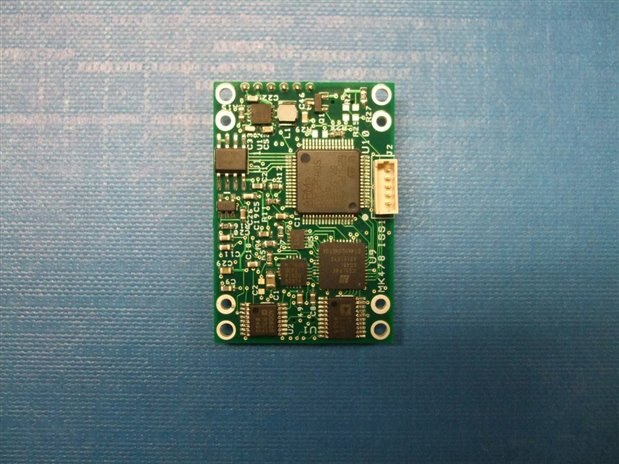
    I've attached a picture of a 16 bit data acquisition system with a 168MHz ARM Cortex, 3500 lut ICE5 FPGA, 16 bit ADC and a load of other signal conditioning stuff. It all fits on a board 28mm x 40mm.


    As Clem has observed, the FPGA will be hard work if you've never done it before -  but I'll add that it will be a lot harder using an application style processor board like the Pi. If you want to stick with processors then look at the Xmos parts - which are designed for this kind of thing and have suitable clocks and a tweaked C tool to programme them.


    image


    MK

    • Cancel
    • Vote Up +1 Vote Down
    • Sign in to reply
    • Verify Answer
    • Reject Answer
    • Cancel
  • msimon
    0 msimon over 8 years ago

    Like Clem and Michael said, it takes time and effort to design with FPGA. However, if you want to go for it, you can implement a VGA design (or HDMI which maybe harder). The board you suggested Mimas - Low Cost Spartan 6 FPGA Development Board is cheap and you can implement a VGA port with hand soldering(http://fpga4fun.com/PongGame.html ). You can check the Why are FPGAs used so often for HDMI video projects? - Electrical Engineering Stack Exchange and see the process is not easy. You can also try Pipistrello board (Pumping 1080p video out of an FPGA | Hackaday). I don't have much experience with FPGA so it looks challenging for me but it is not impossible. I agree with Michael and it may be harder with a processor.


    Good luck,

    mb

    • Cancel
    • Vote Up +1 Vote Down
    • Sign in to reply
    • Verify Answer
    • Reject Answer
    • Cancel
  • msimon
    0 msimon over 8 years ago in reply to michaelkellett

    The board looks amazing, good stuff image

    • Cancel
    • Vote Up 0 Vote Down
    • Sign in to reply
    • Verify Answer
    • Cancel
element14 Community

element14 is the first online community specifically for engineers. Connect with your peers and get expert answers to your questions.

  • Members
  • Learn
  • Technologies
  • Challenges & Projects
  • Products
  • Store
  • About Us
  • Feedback & Support
  • FAQs
  • Terms of Use
  • Privacy Policy
  • Legal and Copyright Notices
  • Sitemap
  • Cookies

An Avnet Company © 2025 Premier Farnell Limited. All Rights Reserved.

Premier Farnell Ltd, registered in England and Wales (no 00876412), registered office: Farnell House, Forge Lane, Leeds LS12 2NE.

ICP 备案号 10220084.

Follow element14

  • X
  • Facebook
  • linkedin
  • YouTube