


Tomorrow there's a solar eclipse. In Brussels, it's a partial one. 90%. I'm going to try and measure the light intensity during that event.
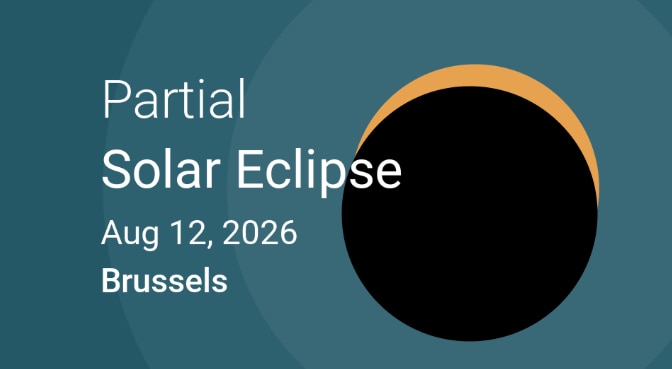
image source: https://www.timeanddate.com/eclipse/in/belgium/brussels?iso=20260812
|
Google AI: In Brussels, the Moon will obscure 89.5% of the Sun’s surface (with a peak magnitude of 0.911) during tomorrow's solar eclipse on Wednesday, August 12, 2026.
Exact Local Timeline for Brussels (CEST)
Because the eclipse occurs right before sunset, timing is critical:
|
I'm going to use TI MSPM0 Launchpad. The kit has a light sensitive diode. And the controller (MSPM0L1306) has a good analogue front end.
Current status: do everything :). I don't have the code yet. But I did check out the schematics for the light sensor.
What I'll probably use:
- that light sensitive diode
- one of the OpAmps available on the L1306
- ADC
- Timer
- UART
I'll have to use the OpAmp as Transimpedance Amplifier. It 'll also have to bias the LED circuit. Luckily, there are examples.
|
I have done this exercise before in 2015, with a Hercules Launchpad.
That time, I also took a photo of the sun every so many minutes. It was a clouded day... |

If I manage to get my design working this evening, I'll share the findings in our community.
Update the day after:
it worked. Berfore the eclipse stated, I put my launchpad in a location that 's not directly in the sun:

I made a design based on TI's Out Of Box example and that application note for transimpedance amplifiers. It did an excellent job - although the photodiode has a daylight blocking filter. There is a measurable component of IR in sunlight, so we are able to measure that.
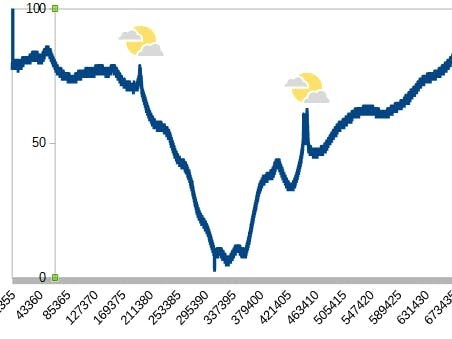
Here is a graph showing the measurements.

start: 19:05 end 21:15
The eclipse happened when the sun was about to set. That's why, after the eclipse, you see both the effect of the end of the eclipse, and of the sun dropping behind the horizon.
|
Google AI:
In indirect sunlight, the percentage of energy between 800 nm and 1000 nm ranges from 4% to 13% of the total spectral energy.
Widening the wavelength window to 200 nm captures a massive portion of the near-infrared (NIR) spectrum. In standard, direct global sunlight, this specific band is highly energetic, accounting for exactly 15% of the sun's total energy (providing about 150 W/m² out of the standard 1,000 W/m² solar baseline). However, just like the narrower band, indirect atmospheric scattering changes these numbers.
1. Clear Sky Indirect Sunlight (Open Shade): ~4% to 6%
If you are standing in the shade on a perfectly crisp, cloudless day, your light is coming entirely from the blue sky.
|
In the comments below, I posted a few action photos. Thank you for reading along.
