element14 Community
element14 Community
    Register Log In
  • Site
  • Search
  • Log In Register
  • Community Hub
    Community Hub
    • What's New on element14
    • Feedback and Support
    • Benefits of Membership
    • Personal Blogs
    • Members Area
    • Achievement Levels
  • Learn
    Learn
    • Ask an Expert
    • eBooks
    • element14 presents
    • Learning Center
    • Tech Spotlight
    • STEM Academy
    • Webinars, Training and Events
    • Learning Groups
  • Technologies
    Technologies
    • 3D Printing
    • FPGA
    • Industrial Automation
    • Internet of Things
    • Power & Energy
    • Sensors
    • Technology Groups
  • Challenges & Projects
    Challenges & Projects
    • Design Challenges
    • element14 presents Projects
    • Project14
    • Arduino Projects
    • Raspberry Pi Projects
    • Project Groups
  • Products
    Products
    • Arduino
    • Avnet & Tria Boards Community
    • Dev Tools
    • Manufacturers
    • Multicomp Pro
    • Product Groups
    • Raspberry Pi
    • RoadTests & Reviews
  • About Us
    About the element14 Community
  • Store
    Store
    • Visit Your Store
    • Choose another store...
      • Europe
      •  Austria (German)
      •  Belgium (Dutch, French)
      •  Bulgaria (Bulgarian)
      •  Czech Republic (Czech)
      •  Denmark (Danish)
      •  Estonia (Estonian)
      •  Finland (Finnish)
      •  France (French)
      •  Germany (German)
      •  Hungary (Hungarian)
      •  Ireland
      •  Israel
      •  Italy (Italian)
      •  Latvia (Latvian)
      •  
      •  Lithuania (Lithuanian)
      •  Netherlands (Dutch)
      •  Norway (Norwegian)
      •  Poland (Polish)
      •  Portugal (Portuguese)
      •  Romania (Romanian)
      •  Russia (Russian)
      •  Slovakia (Slovak)
      •  Slovenia (Slovenian)
      •  Spain (Spanish)
      •  Sweden (Swedish)
      •  Switzerland(German, French)
      •  Turkey (Turkish)
      •  United Kingdom
      • Asia Pacific
      •  Australia
      •  China
      •  Hong Kong
      •  India
      •  Japan
      •  Korea (Korean)
      •  Malaysia
      •  New Zealand
      •  Philippines
      •  Singapore
      •  Taiwan
      •  Thailand (Thai)
      •  Vietnam
      • Americas
      •  Brazil (Portuguese)
      •  Canada
      •  Mexico (Spanish)
      •  United States
      Can't find the country/region you're looking for? Visit our export site or find a local distributor.
  • Translate
  • Profile
  • Settings
Internet of Things
  • Technologies
  • More
Internet of Things
Blog August 12th eclipse: can I measure it?
  • Blog
  • Forum
  • Documents
  • Quiz
  • Events
  • Polls
  • Members
  • Mentions
  • Sub-Groups
  • Tags
  • More
  • Cancel
  • New
Join Internet of Things to participate - click to join for free!
  • Share
  • More
  • Cancel
Group Actions
  • Group RSS
  • More
  • Cancel
Engagement
  • Author Author: Jan Cumps
  • Date Created: 11 Aug 2026 9:27 AM Date Created
  • Views 135 views
  • Likes 8 likes
  • Comments 3 comments
  • MSPM0
  • eclipse
  • solar
  • launchpad
Related
Recommended

August 12th eclipse: can I measure it?

Jan Cumps
Jan Cumps
11 Aug 2026

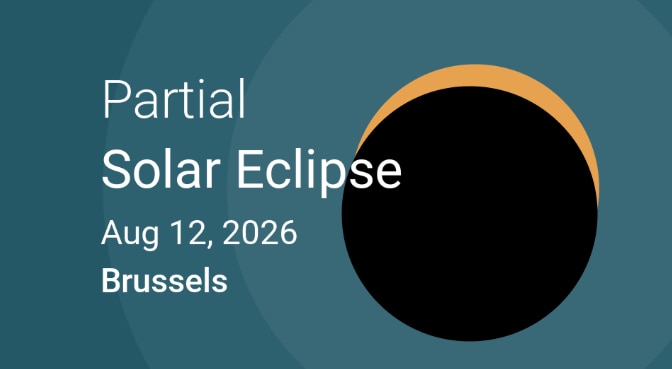
Tomorrow there's a solar eclipse. In Brussels, it's a partial one. 90%. I'm going to try and measure the light intensity during that event.
image
image source: https://www.timeanddate.com/eclipse/in/belgium/brussels?iso=20260812

Google AI:

In Brussels, the Moon will obscure 89.5% of the Sun’s surface (with a peak magnitude of 0.911) during tomorrow's solar eclipse on Wednesday, August 12, 2026.
Exact Local Timeline for Brussels (CEST)
Because the eclipse occurs right before sunset, timing is critical:
  • 7:18 PM – Eclipse Begins: The Moon first touches the edge of the Sun.
  • 8:13 PM – Maximum Coverage: The peak of the deep partial eclipse occurs.
  • 9:09 PM – Eclipse Ends: The event concludes just minutes after the Sun dips below the horizon.

I'm going to use TI MSPM0 Launchpad. The kit has a light sensitive diode. And the controller (MSPM0L1306) has a good analogue front end.

Current status: do everything :). I don't have the code yet. But I did check out the schematics for the light sensor.

What I'll probably use:

  • that light sensitive diode
  • one of the OpAmps available on the L1306
  • ADC
  • Timer
  • UART

I'll have to use the OpAmp as Transimpedance Amplifier. It 'll also have to bias the LED circuit. Luckily, there are examples.

I have done this exercise before in 2015, with a Hercules Launchpad.

image

That time, I also took a photo of the sun every so many minutes. It was a clouded day...
image

If I manage to get my design working this evening, I'll share the findings in our community.

Update the day after:

it worked. Berfore the eclipse stated, I put my launchpad in a location that 's not directly in the sun:

image

I made a design based on TI's Out Of Box example and that application note for transimpedance amplifiers. It did an excellent job - although the photodiode has a daylight blocking filter. There is a measurable component of IR in sunlight, so we are able to measure that.

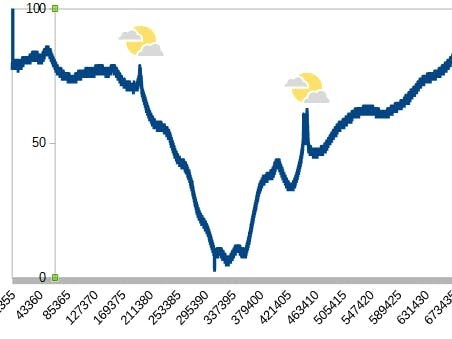
Here is a graph showing the measurements. 

image

start: 19:05 end 21:15

The eclipse happened when the sun was about to set. That's why, after the eclipse, you see both the effect of the end of the eclipse, and of the sun dropping behind the horizon. 

Google AI: 

In indirect sunlight, the percentage of energy between 800 nm and 1000 nm ranges from 4% to 13% of the total spectral energy.
Widening the wavelength window to 200 nm captures a massive portion of the near-infrared (NIR) spectrum. In standard, direct global sunlight, this specific band is highly energetic, accounting for exactly 15% of the sun's total energy (providing about 150 W/m² out of the standard 1,000 W/m² solar baseline). However, just like the narrower band, indirect atmospheric scattering changes these numbers.
1. Clear Sky Indirect Sunlight (Open Shade): ~4% to 6%
If you are standing in the shade on a perfectly crisp, cloudless day, your light is coming entirely from the blue sky.
  • The Atmospheric Filter: Because Rayleigh scattering only affects shorter wavelengths (UV and blue light), the long 800–1000 nm infrared waves pass straight through the atmosphere without bouncing into the shade.
  • The Result: The light is heavily depleted of infrared. Even though the window is wide, the 800–1000 nm band only makes up a small fraction (~4% to 6%) of the ambient shade light.

In the comments below, I posted a few action photos. Thank you for reading along.

  • Sign in to reply
Parents
  • Jan Cumps
    Jan Cumps 25 days ago

    An explanation of the design:  MSPM0 sample photodiode with internal OpAmp and ADC 

    • Cancel
    • Vote Up 0 Vote Down
    • Sign in to reply
    • More
    • Cancel
Comment
  • Jan Cumps
    Jan Cumps 25 days ago

    An explanation of the design:  MSPM0 sample photodiode with internal OpAmp and ADC 

    • Cancel
    • Vote Up 0 Vote Down
    • Sign in to reply
    • More
    • Cancel
Children
No Data
element14 Community

element14 is the first online community specifically for engineers. Connect with your peers and get expert answers to your questions.

  • Members
  • Learn
  • Technologies
  • Challenges & Projects
  • Products
  • Store
  • About Us
  • Feedback & Support
  • FAQs
  • Terms of Use
  • Privacy Policy
  • Legal and Copyright Notices
  • Sitemap
  • Cookies

An Avnet Company © 2026 Premier Farnell Limited. All Rights Reserved.

Premier Farnell Ltd, registered in England and Wales (no 00876412), registered office: Farnell House, Forge Lane, Leeds LS12 2NE.

Follow element14

  • X
  • Facebook
  • linkedin
  • YouTube