element14 Community
element14 Community
    Register Log In
  • Site
  • Search
  • Log In Register
  • Community Hub
    Community Hub
    • What's New on element14
    • Feedback and Support
    • Benefits of Membership
    • Personal Blogs
    • Members Area
    • Achievement Levels
  • Learn
    Learn
    • Ask an Expert
    • eBooks
    • element14 presents
    • Learning Center
    • Tech Spotlight
    • STEM Academy
    • Webinars, Training and Events
    • Learning Groups
  • Technologies
    Technologies
    • 3D Printing
    • FPGA
    • Industrial Automation
    • Internet of Things
    • Power & Energy
    • Sensors
    • Technology Groups
  • Challenges & Projects
    Challenges & Projects
    • Design Challenges
    • element14 presents Projects
    • Project14
    • Arduino Projects
    • Raspberry Pi Projects
    • Project Groups
  • Products
    Products
    • Arduino
    • Avnet & Tria Boards Community
    • Dev Tools
    • Manufacturers
    • Multicomp Pro
    • Product Groups
    • Raspberry Pi
    • RoadTests & Reviews
  • About Us
  • Store
    Store
    • Visit Your Store
    • Choose another store...
      • Europe
      •  Austria (German)
      •  Belgium (Dutch, French)
      •  Bulgaria (Bulgarian)
      •  Czech Republic (Czech)
      •  Denmark (Danish)
      •  Estonia (Estonian)
      •  Finland (Finnish)
      •  France (French)
      •  Germany (German)
      •  Hungary (Hungarian)
      •  Ireland
      •  Israel
      •  Italy (Italian)
      •  Latvia (Latvian)
      •  
      •  Lithuania (Lithuanian)
      •  Netherlands (Dutch)
      •  Norway (Norwegian)
      •  Poland (Polish)
      •  Portugal (Portuguese)
      •  Romania (Romanian)
      •  Russia (Russian)
      •  Slovakia (Slovak)
      •  Slovenia (Slovenian)
      •  Spain (Spanish)
      •  Sweden (Swedish)
      •  Switzerland(German, French)
      •  Turkey (Turkish)
      •  United Kingdom
      • Asia Pacific
      •  Australia
      •  China
      •  Hong Kong
      •  India
      • Japan
      •  Korea (Korean)
      •  Malaysia
      •  New Zealand
      •  Philippines
      •  Singapore
      •  Taiwan
      •  Thailand (Thai)
      • Vietnam
      • Americas
      •  Brazil (Portuguese)
      •  Canada
      •  Mexico (Spanish)
      •  United States
      Can't find the country/region you're looking for? Visit our export site or find a local distributor.
  • Translate
  • Profile
  • Settings
Internet of Things
  • Technologies
  • More
Internet of Things
Blog ESP8266 developing using an Arduino
  • Blog
  • Forum
  • Documents
  • Quiz
  • Events
  • Polls
  • Members
  • Mentions
  • Sub-Groups
  • Tags
  • More
  • Cancel
  • New
Join Internet of Things to participate - click to join for free!
  • Share
  • More
  • Cancel
Group Actions
  • Group RSS
  • More
  • Cancel
Engagement
  • Author Author: camuyano
  • Date Created: 4 Nov 2014 10:00 PM Date Created
  • Views 4123 views
  • Likes 2 likes
  • Comments 23 comments
  • wifi
  • internet_of_things
  • esp8266
  • iot
  • arduino
Related
Recommended

ESP8266 developing using an Arduino

camuyano
camuyano
4 Nov 2014

Currently I am playing with the ESP8266 WIFI module as many others are. Since I want to create some Arduino libraries for it, I am in the need to do some debugging. The Arduino only has one hardware UART. And if you wire anything to the atmega UART port you may run into problems when downloading new code to the Arduino. The Arduino programs the atmega via the hardware UART port and if something is connected it may cause trouble. For downloading you end up disconnecting and reconnecting the ESP module without mentioned that you loose the ability to use the Serial Console for debugging.


To solve this situation I now am using the SoftwareSerial library. Before all this I updated the ESP8266 firmware and the default baud rate is 9600 which is fine for the SoftwareSerial library.

My current setup is:

1. ESP8266 (ESP02) connected to a level shifter (to make 3.3V talks to the Arduino 5V). The level shifter I am using is a 74HC4050N hex non inverting buffer.

2. Wire pin 10, 11 via the level shifter to the ESP8266

3. Load a modified SoftwareSerial echo example to allow me to send serial commands from the Serial Monitor window to the ESP8266 via the arduino. Here is the link to the Arduino code for software echo.

I had it all wired without a level shifter but the SoftwareSerial library responded always like there were data available to receive when there were none. By using the level shifter all that "noise" went away and now I have a clean communication.image
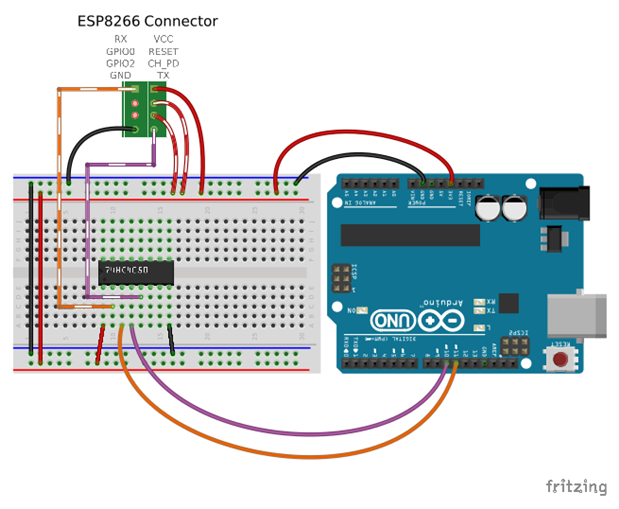
 

What the code do is just wait for anything from the UART serial port and sends it via the SoftwareSerial port (pins 10,11) and back. This way I can upload new code to the Arduino, talk to the ESP8266 and get debug messages via the Serial console without having to rewire things.

I am just starting to use this module, but it looks very interesting. Just wanted to share my current setup in case anyone wants to code for the Arduino and ran into the same problem I did.


Sorry that my diagram do not have a pretty ESP8266 module drawing but you get the idea. Use the legend above the green connector to match your module.


Update:

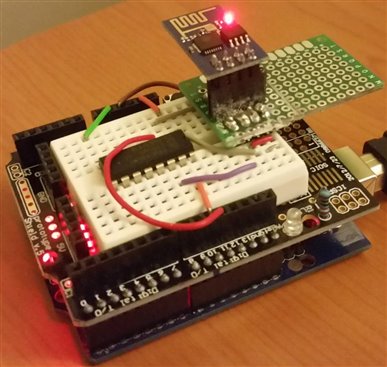
With this same thinking I decided to try a more "permanent solution". So I am in the process of building an interface prototype board for this module. I decided to build a dedicated interface circuit board (no breadboard prototype, straight to production). I blogged about it here if you care.


This is how this setup looks in real life:
image


Note:

Verify your Arduino version maximun 3.3V supply current. The official Arduino Uno R3 can supply something like 150mA tops and that is not enough to make the ESP8266 work always. It may power up but not much more. Arduino compatible boards or clones may have different hardware with more power ratings. If not available then my recommendation is to get an external power source or to reduce the 5V power to 3.3V.

  • Sign in to reply

Top Comments

  • Former Member
    Former Member over 11 years ago +1
    Thanks, it is a good starting point for beginners with ESP8266
  • mcb1
    mcb1 over 10 years ago in reply to scargill +1
    Peter Mohan has provided the datasheet link. https://anibit.com/sites/default/files/product_files/ESP8266_Specifications_English.pdf Unless an IC is specifically designed, it's never a good idea to apply…
Parents
  • scargill
    scargill over 11 years ago

    Hi

    Some comments - using 9600 is fine - originally I thought that it might be a good idea to use 115k - but I was forced to use 9600 by the Lua firmware (and if you're not familiar with that, head over to my blog where you'll find lots on the subject) and actually it's not so bad - so - first things first - you absolutely MUST use level shifting, there is even a possibility of damaging the chip without it (unless of course you are using a 3v3 micro). You don't need it for the output from the ESP chip - but for input I took a 560r resistor from (in my case) the Arduino output to the ESP, then a 1k resistor from the ESP to ground, hence effectively limiting the input voltage - similarly with the reset - and at some point you will need the reset.


    As for serial itself, it is really worth considering unless you're on a REALLY tight budget, the MEGA boards, they have 2 UARTS so you don't have to worry about software UARTS and these boards from China are now as low as £8. Why is a software UART a bad idea? Well it depends on what you're doing but it uses interrupts and so again in the case of the simpler micros, if you're messing with anything else that uses interrupts you could end up with timing issues.  Personally I use `184-based boards a lot (own design) - 2 UARTs, 128K Flash and plenty of RAM.


    Anyway for anyone interested in the ESP8266 and the various boards such as the ESP-01, ESP-03 etc etc my blog has links to just about everything else and this morning I made some improvements to a serial terminal I put together specifically for messing with these boards.


    Great article, if only everyone would put in so much detail and a nice diagram.

    • Cancel
    • Vote Up 0 Vote Down
    • Sign in to reply
    • More
    • Cancel
  • camuyano
    camuyano over 11 years ago in reply to scargill

    Level shifting is a must, I did a small breakout board for this matter (ESP8266 interface board on it's way (WifIco)) Still is a work in progress, I would do a revision of the board since it has a few errors. Also I plan on making a bigger independent board for a specific purpose. It is all just ideas and plans in my head, so I will post about them when they become reality.

    • Cancel
    • Vote Up 0 Vote Down
    • Sign in to reply
    • More
    • Cancel
  • scargill
    scargill over 11 years ago in reply to camuyano

    Will look forward to it - I wonder how many people are re-inventing the wheel right now doing their own boards - we need a forum/showcase for "MY ESP8266 boards" - with Eagle files - wouldn't that be good.

    • Cancel
    • Vote Up 0 Vote Down
    • Sign in to reply
    • More
    • Cancel
  • camuyano
    camuyano over 11 years ago in reply to scargill

    Hackaday has a list of boards and projects from esp8266 (http://hackaday.io/list/3553-esp8266-projects)

    My design is on github full open for anyone to use. And is public domain so no need to say where from got it.

    • Cancel
    • Vote Up 0 Vote Down
    • Sign in to reply
    • More
    • Cancel
  • scargill
    scargill over 11 years ago in reply to camuyano

    Hackaday is such a good site and I keep forgetting about it - thanks for the reminder, Javier...

    • Cancel
    • Vote Up 0 Vote Down
    • Sign in to reply
    • More
    • Cancel
  • Former Member
    Former Member over 10 years ago in reply to camuyano

    Hi Javier, I'm playing with this ESP8266 and I found your project as a good starting point and reference. can you explain why it is needed a level shifter even if the ESP is connected to the 3.3v vout pin of the Arduino Uno?

    • Cancel
    • Vote Up 0 Vote Down
    • Sign in to reply
    • More
    • Cancel
  • scargill
    scargill over 10 years ago in reply to Former Member

    image

    You only need level shifting if you're using a 5v gadget and even then only on inputs. I use 2 resistors and they work just fine at high speed. I made a little adaptor.

    • Cancel
    • Vote Up 0 Vote Down
    • Sign in to reply
    • More
    • Cancel
Comment
  • scargill
    scargill over 10 years ago in reply to Former Member

    image

    You only need level shifting if you're using a 5v gadget and even then only on inputs. I use 2 resistors and they work just fine at high speed. I made a little adaptor.

    • Cancel
    • Vote Up 0 Vote Down
    • Sign in to reply
    • More
    • Cancel
Children
  • Former Member
    Former Member over 10 years ago in reply to scargill

    Yes I see, nice toy (is that SF bay?). So using a Mini Pro 3v3 should be ok without level shifter, or you suggest to plug resistors anyway? I've tried simple examples with both arduino uno and mini pro 3v3 but the result is the same: the ESP goes up (I can see the standard ESP*** Wifi SSID) but cannot talk to it. I see a lot of strange chars on the serial buffer, as Javier said.

    • Cancel
    • Vote Up 0 Vote Down
    • Sign in to reply
    • More
    • Cancel
  • scargill
    scargill over 10 years ago in reply to Former Member

    Hi, no not SF Bay, somewhere in Spain (I'm UK based and the only part of US I generally get to is Chicago).  3v3 no need for level shifters at all. When the ESP turns on it initially chucks out some rubbish at at something like 78k baud - I have asked them repeatedly to do something about this without response - maybe it's something to do with the bootloader.  Older firmware might then resort to 56k or 9600 baud but later software should be 115K.  Firing AT with a carriage return should then elicit "OK" from it.


    • Cancel
    • Vote Up 0 Vote Down
    • Sign in to reply
    • More
    • Cancel
  • Problemchild
    Problemchild over 10 years ago in reply to scargill

    What are you doing with that module there Peter it looks like you put it at the focal point of a dish point out across the bay or was that just an accidental photo ?

    • Cancel
    • Vote Up 0 Vote Down
    • Sign in to reply
    • More
    • Cancel
  • scargill
    scargill over 10 years ago in reply to Problemchild

    Not an accident John but a lot simpler than it looks. Last time I was in Spain (we have a house out in the wilds) I took the photo.. and it is the screen backdrop on my high-res PC screen. I stuck my hand in front of the screen with LED lighting lighting up my hand.. and took the photo :-)


    I agree it would have been more dynamic to actually be standing out in the country but this way was easier - and given that it's zero centigrade (freezing) in the UK right now, a lot more practical :-)

    • Cancel
    • Vote Up 0 Vote Down
    • Sign in to reply
    • More
    • Cancel
  • Problemchild
    Problemchild over 10 years ago in reply to scargill

    I was up the Wrekin  reading this post this morning it was still -2 ish so was thinking of the balmy 0 degree weather you are having image

    • Cancel
    • Vote Up 0 Vote Down
    • Sign in to reply
    • More
    • Cancel
element14 Community

element14 is the first online community specifically for engineers. Connect with your peers and get expert answers to your questions.

  • Members
  • Learn
  • Technologies
  • Challenges & Projects
  • Products
  • Store
  • About Us
  • Feedback & Support
  • FAQs
  • Terms of Use
  • Privacy Policy
  • Legal and Copyright Notices
  • Sitemap
  • Cookies

An Avnet Company © 2025 Premier Farnell Limited. All Rights Reserved.

Premier Farnell Ltd, registered in England and Wales (no 00876412), registered office: Farnell House, Forge Lane, Leeds LS12 2NE.

ICP 备案号 10220084.

Follow element14

  • X
  • Facebook
  • linkedin
  • YouTube