element14 Community
element14 Community
    Register Log In
  • Site
  • Search
  • Log In Register
  • Community Hub
    Community Hub
    • What's New on element14
    • Feedback and Support
    • Benefits of Membership
    • Personal Blogs
    • Members Area
    • Achievement Levels
  • Learn
    Learn
    • Ask an Expert
    • eBooks
    • element14 presents
    • Learning Center
    • Tech Spotlight
    • STEM Academy
    • Webinars, Training and Events
    • Learning Groups
  • Technologies
    Technologies
    • 3D Printing
    • FPGA
    • Industrial Automation
    • Internet of Things
    • Power & Energy
    • Sensors
    • Technology Groups
  • Challenges & Projects
    Challenges & Projects
    • Design Challenges
    • element14 presents Projects
    • Project14
    • Arduino Projects
    • Raspberry Pi Projects
    • Project Groups
  • Products
    Products
    • Arduino
    • Avnet & Tria Boards Community
    • Dev Tools
    • Manufacturers
    • Multicomp Pro
    • Product Groups
    • Raspberry Pi
    • RoadTests & Reviews
  • About Us
  • Store
    Store
    • Visit Your Store
    • Choose another store...
      • Europe
      •  Austria (German)
      •  Belgium (Dutch, French)
      •  Bulgaria (Bulgarian)
      •  Czech Republic (Czech)
      •  Denmark (Danish)
      •  Estonia (Estonian)
      •  Finland (Finnish)
      •  France (French)
      •  Germany (German)
      •  Hungary (Hungarian)
      •  Ireland
      •  Israel
      •  Italy (Italian)
      •  Latvia (Latvian)
      •  
      •  Lithuania (Lithuanian)
      •  Netherlands (Dutch)
      •  Norway (Norwegian)
      •  Poland (Polish)
      •  Portugal (Portuguese)
      •  Romania (Romanian)
      •  Russia (Russian)
      •  Slovakia (Slovak)
      •  Slovenia (Slovenian)
      •  Spain (Spanish)
      •  Sweden (Swedish)
      •  Switzerland(German, French)
      •  Turkey (Turkish)
      •  United Kingdom
      • Asia Pacific
      •  Australia
      •  China
      •  Hong Kong
      •  India
      •  Korea (Korean)
      •  Malaysia
      •  New Zealand
      •  Philippines
      •  Singapore
      •  Taiwan
      •  Thailand (Thai)
      • Americas
      •  Brazil (Portuguese)
      •  Canada
      •  Mexico (Spanish)
      •  United States
      Can't find the country/region you're looking for? Visit our export site or find a local distributor.
  • Translate
  • Profile
  • Settings
Internet of Things
  • Technologies
  • More
Internet of Things
Blog Quadcopter Charge Notifier using Particle Photon
  • Blog
  • Forum
  • Documents
  • Quiz
  • Events
  • Polls
  • Members
  • Mentions
  • Sub-Groups
  • Tags
  • More
  • Cancel
  • New
Join Internet of Things to participate - click to join for free!
  • Share
  • More
  • Cancel
Group Actions
  • Group RSS
  • More
  • Cancel
Engagement
  • Author Author: fvan
  • Date Created: 2 Jan 2016 10:44 PM Date Created
  • Views 2190 views
  • Likes 8 likes
  • Comments 20 comments
  • particle
  • particle_boards
  • photon
  • iot
  • notification
  • quadcopter
Related
Recommended

Quadcopter Charge Notifier using Particle Photon

fvan
fvan
2 Jan 2016

I received my first quadcopter for Christmas, a XS Nano Quad from Revell. It’s a tiny quadcopter, which I find extremely fun to play with. Unfortunately, the battery lasts only about 5 minutes (3.7V 100mAh) and the charge time is between 30 and 40 minutes.
Because I regularly forget I put it to charge, I decided to make a simple device which can notify me as soon as the battery is fully charged, allowing me to maximise play time!


Using a Particle Photon and a photoresistor, changes in light intensity from the charge indicator LED can be measured and used to trigger a notification via the IFTTT service.
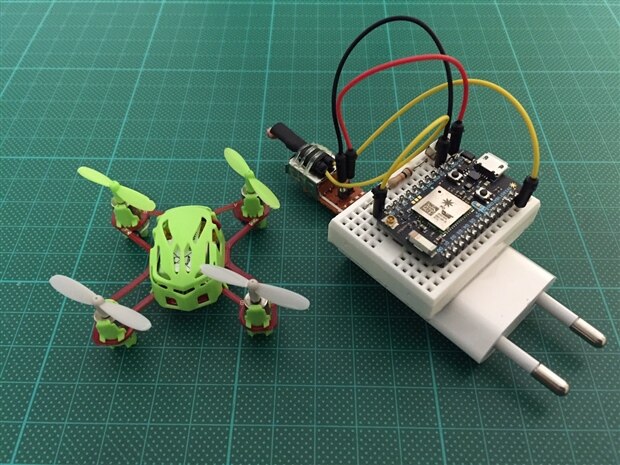

imageimage

As usual, all details including code are available on my blog: Quadcopter Charge Notifier using Particle Photon – Frederick Vandenbosch


Let me know what you think! What would you use such a notification system for?

  • Sign in to reply

Top Comments

  • gadget.iom
    gadget.iom over 9 years ago +2
    Nice little hack! :)
  • mcb1
    mcb1 over 9 years ago +2
    That's a great non invasive method of checking and notifying. I'm sure it has many other applications, especially for small toys. Mark
  • crjeder
    crjeder over 9 years ago in reply to DAB +2
    That's the same with all rotary wings. The just need a lot of energy to stay in the air. For an example to the more extreme end see this: www.youtube.com/watch You need more batteries to have more fun
  • crjeder
    crjeder over 9 years ago in reply to tomaja

    Some of the more expensive batteries can be charged up to 5C. But that lets them age more quickly.

    Reason might be in the chemical reactions which take place. Maybe the reaction for charging takes more time than discharge.

    The internal resistance seems to limit discharge rate. 50C battery has a significant lower resistance than a 20C. And yes, the get hot when discharged even at their rated current. image

    • Cancel
    • Vote Up 0 Vote Down
    • Sign in to reply
    • More
    • Cancel
  • tomaja
    tomaja over 9 years ago in reply to crjeder

    Yes, I tried to say the same thing "1C denotes current of 1 battery capacity / 1h" - in case of your battery: 1.8Ah / 1h = 1.8A

    I don't know either why there's such a big difference in charge and discharge rate but everywhere I find the same advise - charge rate shouldn't be more than 1C. It would probably get too hot (or even burn) when charged with greater current but I didn't want to destroy a battery just to check that image

    • Cancel
    • Vote Up 0 Vote Down
    • Sign in to reply
    • More
    • Cancel
  • crjeder
    crjeder over 9 years ago in reply to crjeder

    BTW: I am nowhere near this.

    My helis crash more often..

    • Cancel
    • Vote Up +1 Vote Down
    • Sign in to reply
    • More
    • Cancel
  • crjeder
    crjeder over 9 years ago in reply to DAB

    That's the same with all rotary wings. The just need a lot of energy to stay in the air.

    For an example to the more extreme end see this:

    You don't have permission to edit metadata of this video.
    Edit media
    x
    image
    Upload Preview
    image

    You need more batteries to have more fun image

    • Cancel
    • Vote Up +2 Vote Down
    • Sign in to reply
    • More
    • Cancel
  • crjeder
    crjeder over 9 years ago in reply to tomaja

    More inprotant than charge times is the amount  current wich you safely can draw. In LiPo batteries 1C acually means that you can charge or discharge a 1 Ah battery with 1 Amp.

    The not physically correct formula is (ignoring all units):

    capatcity (in Ah) * C = current (i A)

    In my bigger (300er) heli I fly a 1,8 Ah battery wich is rated at 30C. That gives the little thing 54 Amps to play with image (at 11,7 V)

    But for bigger RC helis 90C at 22 V is not unusual.

    I don't know why the batteries behave assymetrical, i. e. discharge much faster than they charge.

    • Cancel
    • Vote Up 0 Vote Down
    • Sign in to reply
    • More
    • Cancel
>
element14 Community

element14 is the first online community specifically for engineers. Connect with your peers and get expert answers to your questions.

  • Members
  • Learn
  • Technologies
  • Challenges & Projects
  • Products
  • Store
  • About Us
  • Feedback & Support
  • FAQs
  • Terms of Use
  • Privacy Policy
  • Legal and Copyright Notices
  • Sitemap
  • Cookies

An Avnet Company © 2025 Premier Farnell Limited. All Rights Reserved.

Premier Farnell Ltd, registered in England and Wales (no 00876412), registered office: Farnell House, Forge Lane, Leeds LS12 2NE.

ICP 备案号 10220084.

Follow element14

  • X
  • Facebook
  • linkedin
  • YouTube