element14 Community
element14 Community
    Register Log In
  • Site
  • Search
  • Log In Register
  • Community Hub
    Community Hub
    • What's New on element14
    • Feedback and Support
    • Benefits of Membership
    • Personal Blogs
    • Members Area
    • Achievement Levels
  • Learn
    Learn
    • Ask an Expert
    • eBooks
    • element14 presents
    • Learning Center
    • Tech Spotlight
    • STEM Academy
    • Webinars, Training and Events
    • Learning Groups
  • Technologies
    Technologies
    • 3D Printing
    • FPGA
    • Industrial Automation
    • Internet of Things
    • Power & Energy
    • Sensors
    • Technology Groups
  • Challenges & Projects
    Challenges & Projects
    • Design Challenges
    • element14 presents Projects
    • Project14
    • Arduino Projects
    • Raspberry Pi Projects
    • Project Groups
  • Products & Partners
    Products & Partners
    • Arduino
    • Avnet & Tria Boards Community
    • Dev Tools
    • Manufacturers
    • Multicomp Pro
    • Product Groups
    • Raspberry Pi
    • RoadTests & Reviews
  • About Us
    About the element14 Community
  • Store
    Store
    • Visit Your Store
    • Choose another store...
      • Europe
      •  Austria (German)
      •  Belgium (Dutch, French)
      •  Bulgaria (Bulgarian)
      •  Czech Republic (Czech)
      •  Denmark (Danish)
      •  Estonia (Estonian)
      •  Finland (Finnish)
      •  France (French)
      •  Germany (German)
      •  Hungary (Hungarian)
      •  Ireland
      •  Israel
      •  Italy (Italian)
      •  Latvia (Latvian)
      •  
      •  Lithuania (Lithuanian)
      •  Netherlands (Dutch)
      •  Norway (Norwegian)
      •  Poland (Polish)
      •  Portugal (Portuguese)
      •  Romania (Romanian)
      •  Russia (Russian)
      •  Slovakia (Slovak)
      •  Slovenia (Slovenian)
      •  Spain (Spanish)
      •  Sweden (Swedish)
      •  Switzerland(German, French)
      •  Turkey (Turkish)
      •  United Kingdom
      • Asia Pacific
      •  Australia
      •  China
      •  Hong Kong
      •  India
      •  Japan
      •  Korea (Korean)
      •  Malaysia
      •  New Zealand
      •  Philippines
      •  Singapore
      •  Taiwan
      •  Thailand (Thai)
      •  Vietnam
      • Americas
      •  Brazil (Portuguese)
      •  Canada
      •  Mexico (Spanish)
      •  United States
      Can't find the country/region you're looking for? Visit our export site or find a local distributor.
  • Translate
  • Profile
  • Settings
Sensors
  • Technologies
  • More
Sensors
Blog Audio-Technica U841A Microphone Teardown
  • Blog
  • Forum
  • Documents
  • Quiz
  • Events
  • Polls
  • Members
  • Mentions
  • Sub-Groups
  • Tags
  • More
  • Cancel
  • New
Join Sensors to participate - click to join for free!
  • Share
  • More
  • Cancel
Group Actions
  • Group RSS
  • More
  • Cancel
Engagement
  • Author Author: shabaz
  • Date Created: 23 Sep 2026 11:39 PM Date Created
  • Views 346 views
  • Likes 10 likes
  • Comments 17 comments
  • speech
  • reverse-engineering
  • microphone
  • audio
  • U841A
  • electret
  • condenser
  • conferencing
  • audio-technica
  • teardown
Related
Recommended

Audio-Technica U841A Microphone Teardown

shabaz
shabaz
23 Sep 2026


It’s not everyday I take apart a (reasonably pricey) microphone! But, I was curious, and taking things apart is sometimes how one learns.

A long time ago I took apart an Echo Dot, which contains very different microphone technology (MEMS devices, seven-fold), so check that out too if it's of interest.

Anyway, the U841A is an electret condenser mic, intended for (I believe) speech for audio/videoconferencing purposes. Hopefully any audio experts can provide more detail.


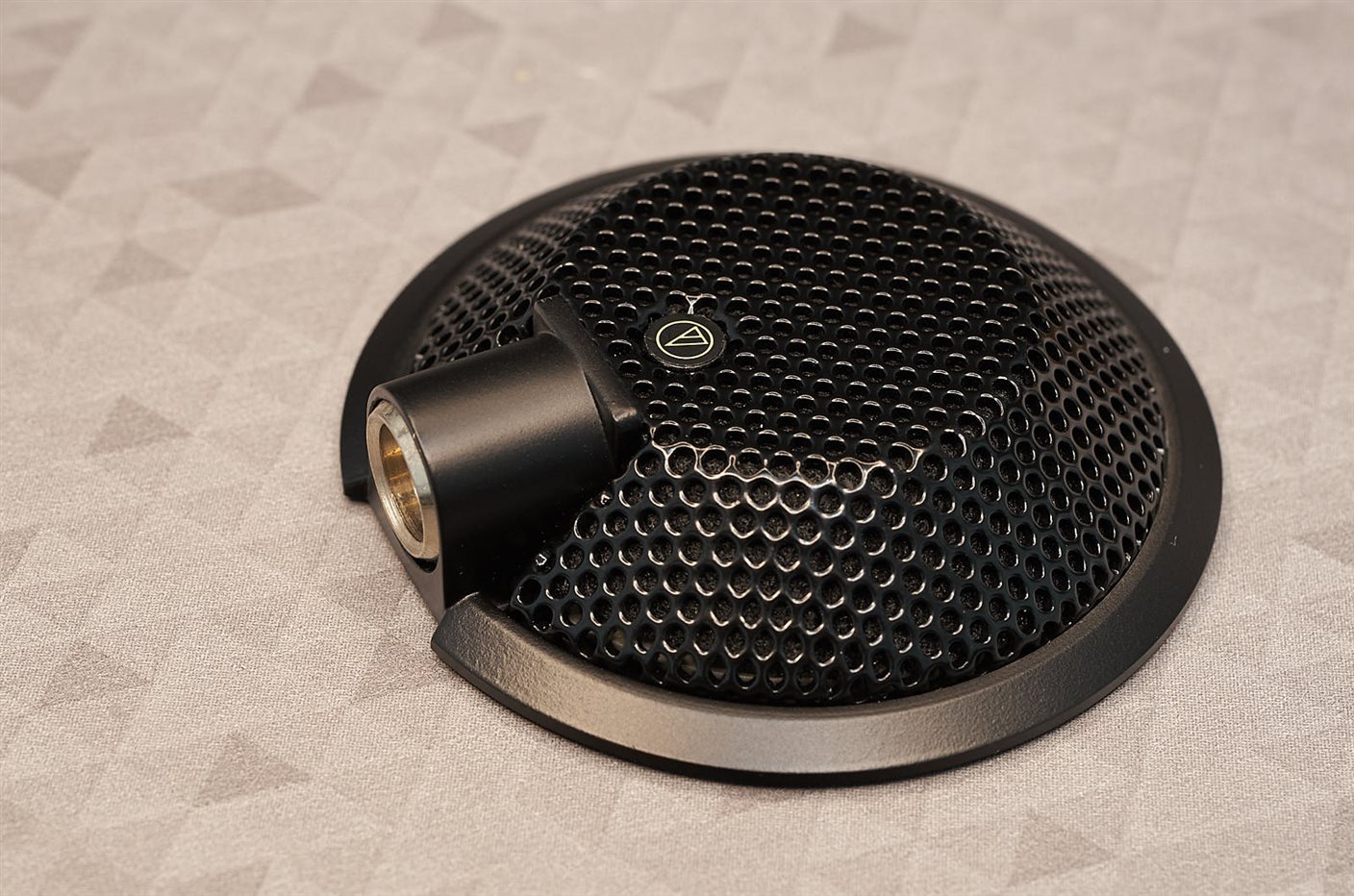
The microphone is very ruggedly built. The secret to opening it up, is to peel off that tiny circular logo on the top; it reveals a screw : ) Then the stamped metal grille lifts off.
image

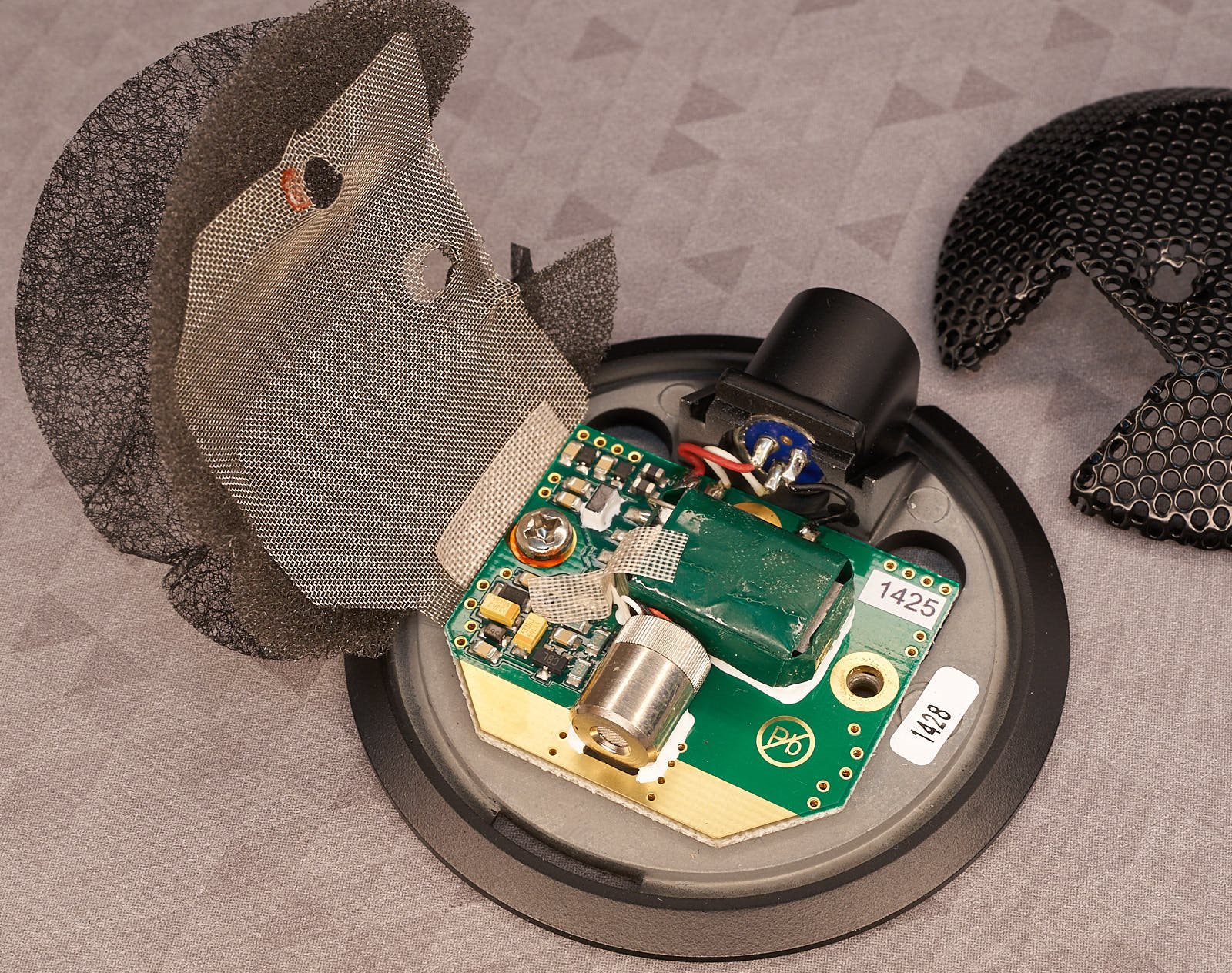
There’s a lot to visually unpack just from the photo below. On the left, you’ll see three material layers; a thin (0.2 mm) stiff layer (kind of like collar lining! there must be a technical name for it..), followed by 2 mm thick soft acoustic foam, followed by (what feels like) nickel mesh 0.25 mm thick (very slightly magnetic), which is secured to the ground, and must be acting as electrical shielding.

The big green rectangle was originally a mystery, although I suspected it may be a transformer. Everything is superbly constructed.
image

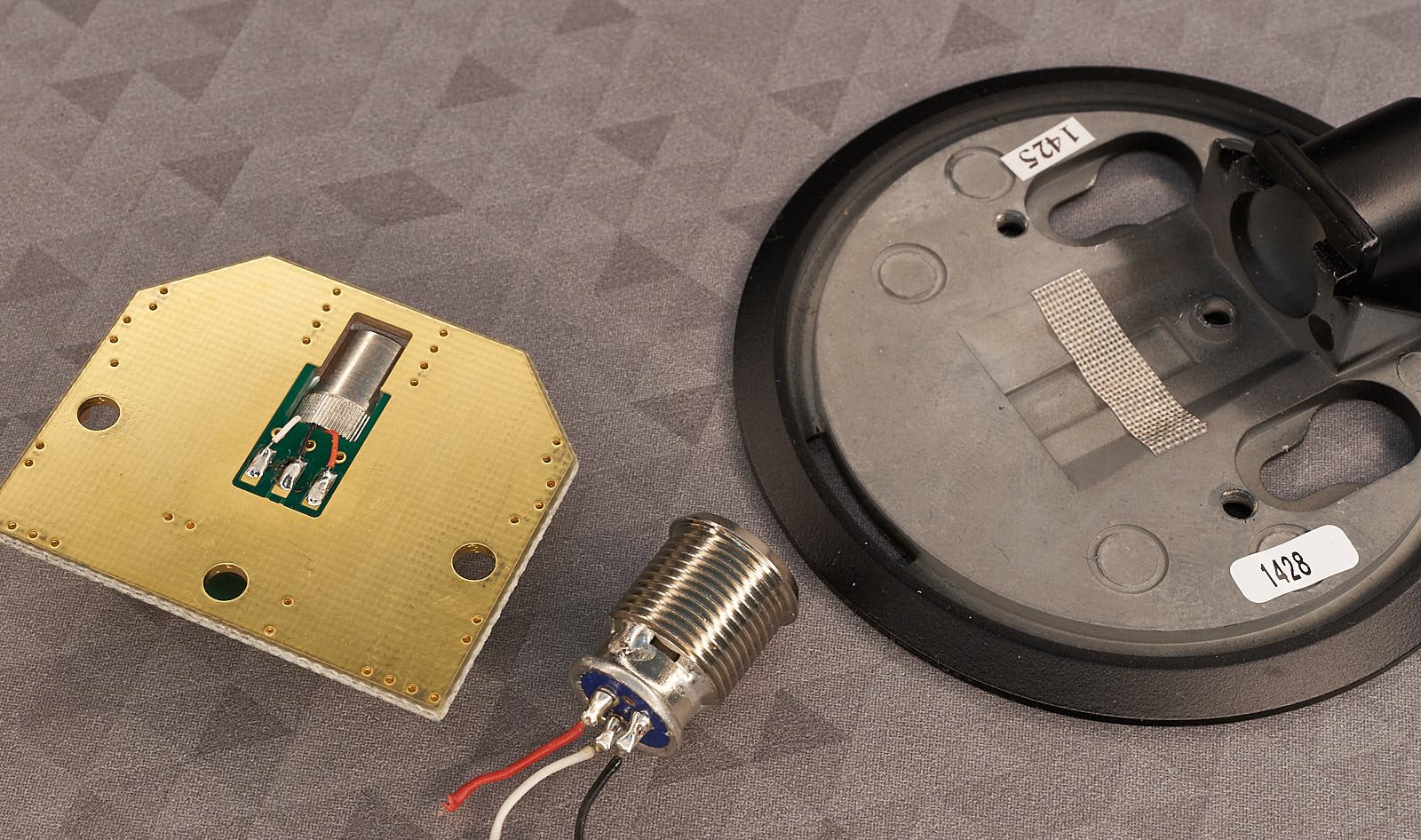
Pulling it apart further (there’s a grub screw which holds the mini XLR connector in place, and it needs to be desoldered to remove the PCB. You can see the electret element has three wires, which suggests it contains an internal amplifier.
image

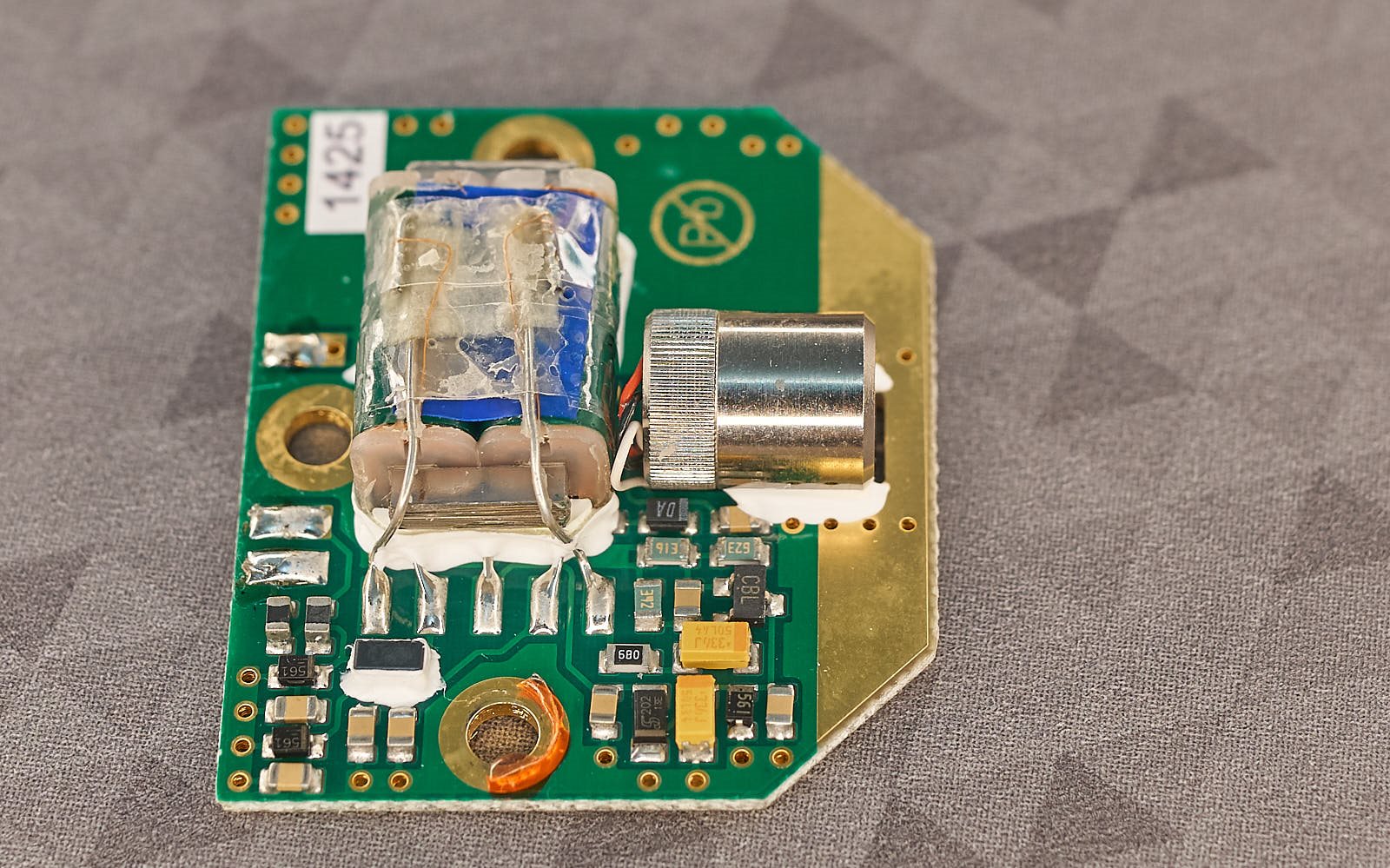
Here’s a closeup of the circuit board, with the green tape removed; now it’s clear that was hiding a transformer.

In the photo below, the board area can be split into three portions; the lower-left contains circuitry for filtering off RF interference arriving via the microphone cable, the center houses the transformer for constructing a balanced output, and the lower-right contains the audio amplifier. 
image

I tried reverse-engineering the circuit (without destroying it, hence I’m sure I have some of this wrong – and all of the non-polarized capacitor values are placeholder guesses).

image

I’m not sure what D1 is, it has a DA inscription. With some thought, the black component inscribed DA must be a capacitor. Edit: now measured out-of-circuit, it is a 100 nF capacitor.

D5/6/7 are guesses (they have a 561 inscription (Edit: see comments below, D6/7 are most likely 56V zener diodes), they may be 5.6V Zener diodes (although I was under the impression this mic supported a far higher phantom voltage input, so either I am mistaken about the part, or this mic may be a slightly different variant). Edit: D5 is possibly 5.6V zener. 

I can’t say I really understand what’s going on with the transformer input and please don’t assume I drew the circuit layout correctly. If you have suggestions/corrections, please let me know. I do intend to fire it up and feed in a signal in place of the mic element and take some measurements one day, but finding time is hard. Funnily enough, I've been thinking about constructing a microphone simulator (but for digital mics).

Any help would be appreciated. Thanks for reading!

  • Sign in to reply
Parents
  • DAB
    DAB 19 days ago

    Always like a  good tear down.

    I have been impressed with the mems microphone technology.

    • Cancel
    • Vote Up 0 Vote Down
    • Sign in to reply
    • More
    • Cancel
Comment
  • DAB
    DAB 19 days ago

    Always like a  good tear down.

    I have been impressed with the mems microphone technology.

    • Cancel
    • Vote Up 0 Vote Down
    • Sign in to reply
    • More
    • Cancel
Children
  • shabaz
    shabaz 19 days ago in reply to DAB

    Same here, that's next on the list to experiment with : ) (I have experimented a little with MEMS mics before).

    I just spent a couple of hours soldering these up.. these are MEMS microphones with Pulse Density Modulation (PDM) out, although I2S versions exist too.

    image

    • Cancel
    • Vote Up 0 Vote Down
    • Sign in to reply
    • More
    • Cancel
  • shabaz
    shabaz 19 days ago in reply to shabaz

    The setup (two mics, with the two data lines going to GPIO 3 and GPIO 4, and the clock is GPIO 5). Both mics have the left/right select pin grounded.

    image

    The signal timimg is really on the edge.. yellow is the clock of course. Since the left/right pin is grounded, I expect the data to be valid when the clock goes low, but according to the datasheet, that can be up to 100 nsec, since the part needs time to get out of high impedance (this is because two parts can have their data lines connected together, for stereo, although as mentioned, I'm not doing that, I have the data lines separated). I do see such a long delay (sometime slightly more than 100nsec). After seeing this, I modified the clock to have shorter positive pulses, and longer negative periods, to read the data a bit later. I forgot to take a 'scope screenshot of that though.

    image

    • Cancel
    • Vote Up 0 Vote Down
    • Sign in to reply
    • More
    • Cancel
element14 Community

element14 is the first online community specifically for engineers. Connect with your peers and get expert answers to your questions.

  • Members
  • Learn
  • Technologies
  • Challenges & Projects
  • Products
  • Store
  • About Us
  • Feedback & Support
  • FAQs
  • Terms of Use
  • Privacy Policy
  • Legal and Copyright Notices
  • Sitemap
  • Cookies

An Avnet Company © 2026 Premier Farnell Limited. All Rights Reserved.

Premier Farnell Ltd, registered in England and Wales (no 00876412), registered office: Farnell House, Forge Lane, Leeds LS12 2NE.

Follow element14

  • X
  • Facebook
  • linkedin
  • YouTube