element14 Community
element14 Community
    Register Log In
  • Site
  • Search
  • Log In Register
  • Community Hub
    Community Hub
    • What's New on element14
    • Feedback and Support
    • Benefits of Membership
    • Personal Blogs
    • Members Area
    • Achievement Levels
  • Learn
    Learn
    • Ask an Expert
    • eBooks
    • element14 presents
    • Learning Center
    • Tech Spotlight
    • STEM Academy
    • Webinars, Training and Events
    • Learning Groups
  • Technologies
    Technologies
    • 3D Printing
    • FPGA
    • Industrial Automation
    • Internet of Things
    • Power & Energy
    • Sensors
    • Technology Groups
  • Challenges & Projects
    Challenges & Projects
    • Design Challenges
    • element14 presents Projects
    • Project14
    • Arduino Projects
    • Raspberry Pi Projects
    • Project Groups
  • Products
    Products
    • Arduino
    • Avnet & Tria Boards Community
    • Dev Tools
    • Manufacturers
    • Multicomp Pro
    • Product Groups
    • Raspberry Pi
    • RoadTests & Reviews
  • About Us
    About the element14 Community
  • Store
    Store
    • Visit Your Store
    • Choose another store...
      • Europe
      •  Austria (German)
      •  Belgium (Dutch, French)
      •  Bulgaria (Bulgarian)
      •  Czech Republic (Czech)
      •  Denmark (Danish)
      •  Estonia (Estonian)
      •  Finland (Finnish)
      •  France (French)
      •  Germany (German)
      •  Hungary (Hungarian)
      •  Ireland
      •  Israel
      •  Italy (Italian)
      •  Latvia (Latvian)
      •  
      •  Lithuania (Lithuanian)
      •  Netherlands (Dutch)
      •  Norway (Norwegian)
      •  Poland (Polish)
      •  Portugal (Portuguese)
      •  Romania (Romanian)
      •  Russia (Russian)
      •  Slovakia (Slovak)
      •  Slovenia (Slovenian)
      •  Spain (Spanish)
      •  Sweden (Swedish)
      •  Switzerland(German, French)
      •  Turkey (Turkish)
      •  United Kingdom
      • Asia Pacific
      •  Australia
      •  China
      •  Hong Kong
      •  India
      •  Japan
      •  Korea (Korean)
      •  Malaysia
      •  New Zealand
      •  Philippines
      •  Singapore
      •  Taiwan
      •  Thailand (Thai)
      •  Vietnam
      • Americas
      •  Brazil (Portuguese)
      •  Canada
      •  Mexico (Spanish)
      •  United States
      Can't find the country/region you're looking for? Visit our export site or find a local distributor.
  • Translate
  • Profile
  • Settings
Project Videos
  • Challenges & Projects
  • element14 presents
  • Project Videos
  • More
  • Cancel
Project Videos
Documents Modern Edge AI on Raspberry Pi 5 for an Animatronic Tracker: Vision Acceleration with AI Hat+ and AI Camera
  • Documents
  • Members
  • Mentions
  • Sub-Groups
  • Tags
  • More
  • Cancel
  • New
Join Project Videos to participate - click to join for free!
Related
Recommended
Toptech-Voices
Engagement
  • Author Author: cstanton
  • Date Created: 23 Apr 2026 9:43 AM Date Created
  • Last Updated Last Updated: 23 Apr 2026 12:36 PM
  • Views 9275 views
  • Likes 4 likes
  • Comments 5 comments

Modern Edge AI on Raspberry Pi 5 for an Animatronic Tracker: Vision Acceleration with AI Hat+ and AI Camera

Clem revisits an earlier animatronic AI project to see what modern Raspberry Pi–based vision hardware can really do in practice. Using today’s AI accelerators and camera technology, he explores how far edge AI vision has progressed, where it still falls short, and what design trade offs emerge when performance, power consumption, heat, and physical mechanics all collide in a real build. Along the way, he works through challenges with model compatibility, motion control, LED feedback, and hardware integration, showing how small design decisions can dramatically affect how lifelike, or unsettling, a vision driven system feels. If you’re interested in building with edge AI, learning from real world limitations, or recreating parts of this project yourself, below you can access the files, code, and discussion.

Watch the Project Build

You don't have permission to edit metadata of this video.
Edit media
x
image
Upload Preview
image

Revisiting an Unsettling Classic: The AI Animatronic Skull Returns

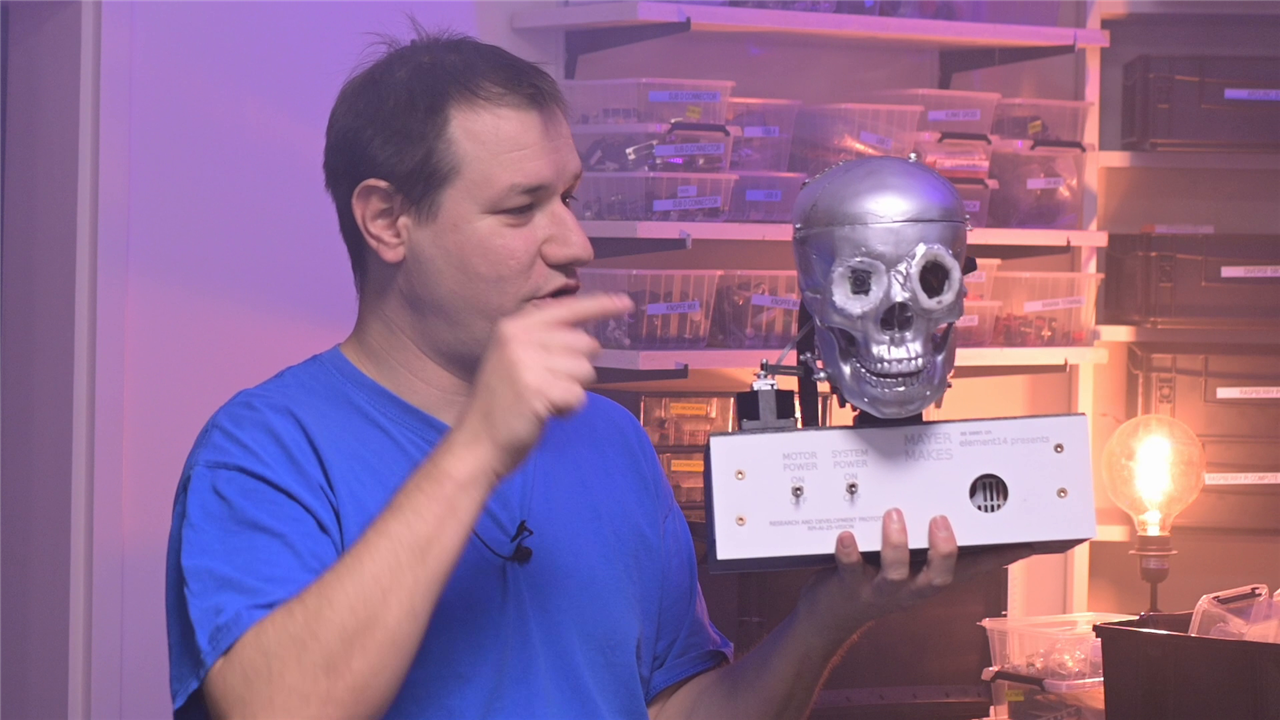
In 2018, Clem built what could only be described as an early warning from the future: a Terminator‑style animatronic skull powered by a BeagleBone‑AI. At the time, it was one of the first hobbyist projects to take on-device AI seriously, using machine vision to detect people and follow them with unnerving intent. It was limited, experimental, and deeply uncomfortable to be alone with, exactly what a robotic skull should be.
Several years on, AI hardware for single‑board computers has advanced significantly. Rather than assume progress on paper translated to progress in practice, Clem chose to rebuild the skull from the ground up, using modern Raspberry Pi–based AI hardware to answer a simple question: "how far have we really come, and is it any more terrifying this time?"
image

New Hardware, Old Questions

The updated skull replaces the original compute platform with a Raspberry Pi 5, paired with two different AI accelerators: the Raspberry Pi AI Camera and the AI Hat+, capable of up to 26 TOPS. The intent was ambitious. Clem wanted to explore whether modern edge AI could support both fast, responsive machine vision and natural language interaction in a single embedded system.
That experiment quickly revealed a hard boundary. While the AI Hat+ and AI Camera dramatically accelerate vision workloads, they provide no meaningful benefit for language models. Clem explains that even very small language models still take seconds to respond when run locally, making real-time interaction impractical:
“I tried running Tiny Llama on there… and even that takes some considerable seconds. So it’s not like you can talk to the machine and it answers back in a natural way.”
For now, conversational AI remains out of reach on this class of hardware. Vision, however, tells a very different story.
image

Why Vision Still Wins on the Edge

Rather than treating this as a failure, Clem reframed the project around what edge AI already does exceptionally well. In his view, vision is currently the most practical application of AI on small systems—grounded in the physical world and free from the abstractions and hallucinations of language models.
Both accelerators are strictly vision‑focused, but they behave very differently in practice. The AI Hat+ delivers significantly better performance, particularly for more complex object detection tasks, but it comes at a cost. It requires a Raspberry Pi 5, draws more power, and produces enough heat that cooling becomes a serious design consideration. Clem notes plainly that “cooling is of the greatest necessity,” and that the overall system power draw is non‑trivial.
By contrast, the Raspberry Pi AI Camera is far more power‑efficient, runs cool, and works across a wider range of boards. For simpler detection tasks—such as presence detection, motion awareness, or checking whether a person has entered a space, it can be the better engineering choice.
The key takeaway is that these two accelerators are not interchangeable parts of a single pipeline. They rely on different model formats and workflows, and while both are capable, they are best treated as separate tools rather than a combined solution.
image

Teaching the Skull What to Care About
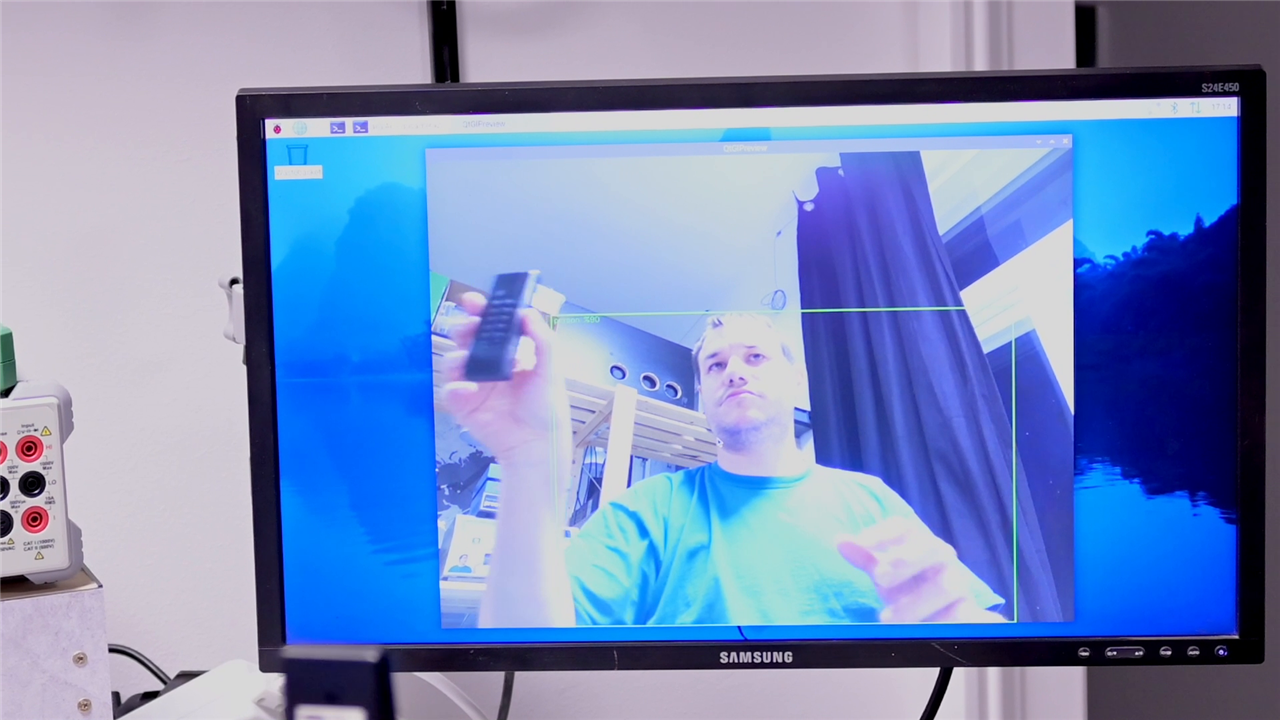
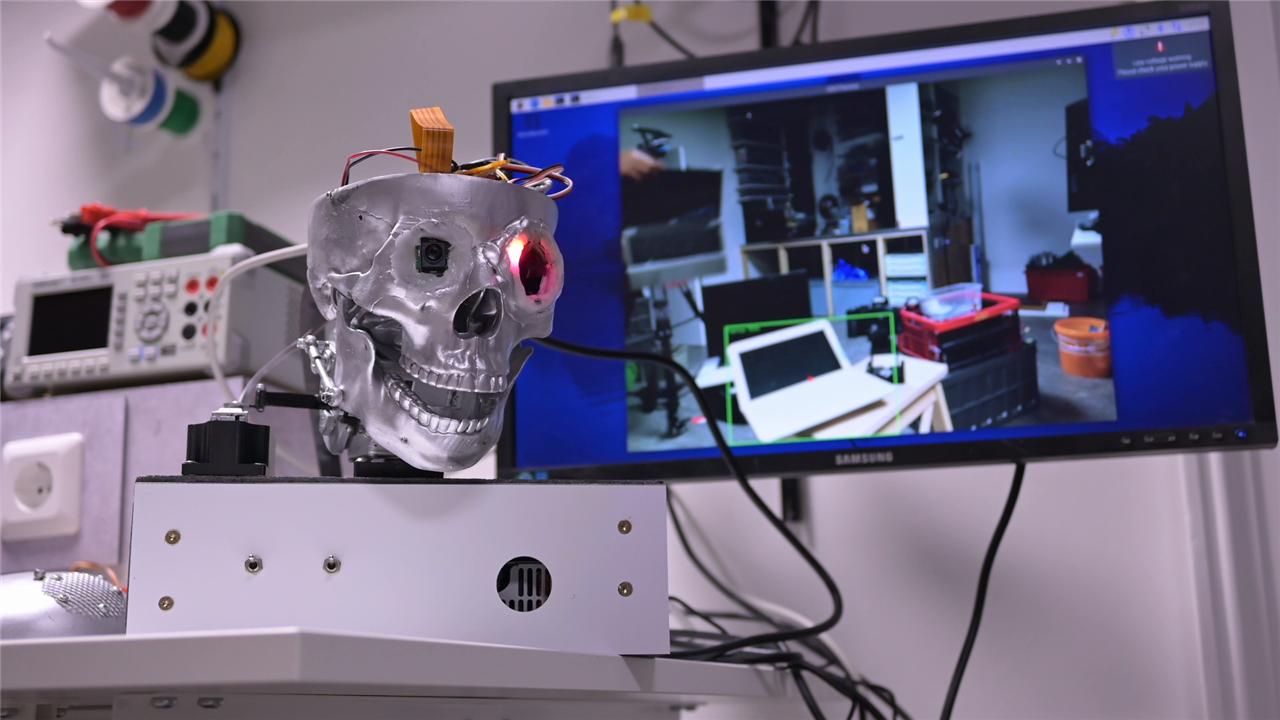
With vision as the focus, the skull’s behaviour becomes far more intentional than in the original build. Instead of reacting to every detection, the system selects a single “object of interest” and commits to it. Humans are prioritised, but devices such as laptops and keyboards are also recognised and tracked when relevant.
Clem describes the selection criteria as simple but effective: the system focuses on the object it is most confident about—the closest, largest, and clearest detection in view. Once chosen, the skull moves to keep that object centred in the frame, using pan and tilt servos to follow it smoothly. 
Just as important is knowing when not to move. The skull allows for a generous margin where the object can drift within the frame without triggering motion. This reduces constant jitter and gives the movement a more deliberate, lifelike quality. If nothing is detected, the skull recentres itself and waits. If something suddenly enters from the edge of the frame, it snaps to attention—an effect Clem admits can be genuinely startling when you forget the system is running.
image

Mechanical Reality and Software Restraint
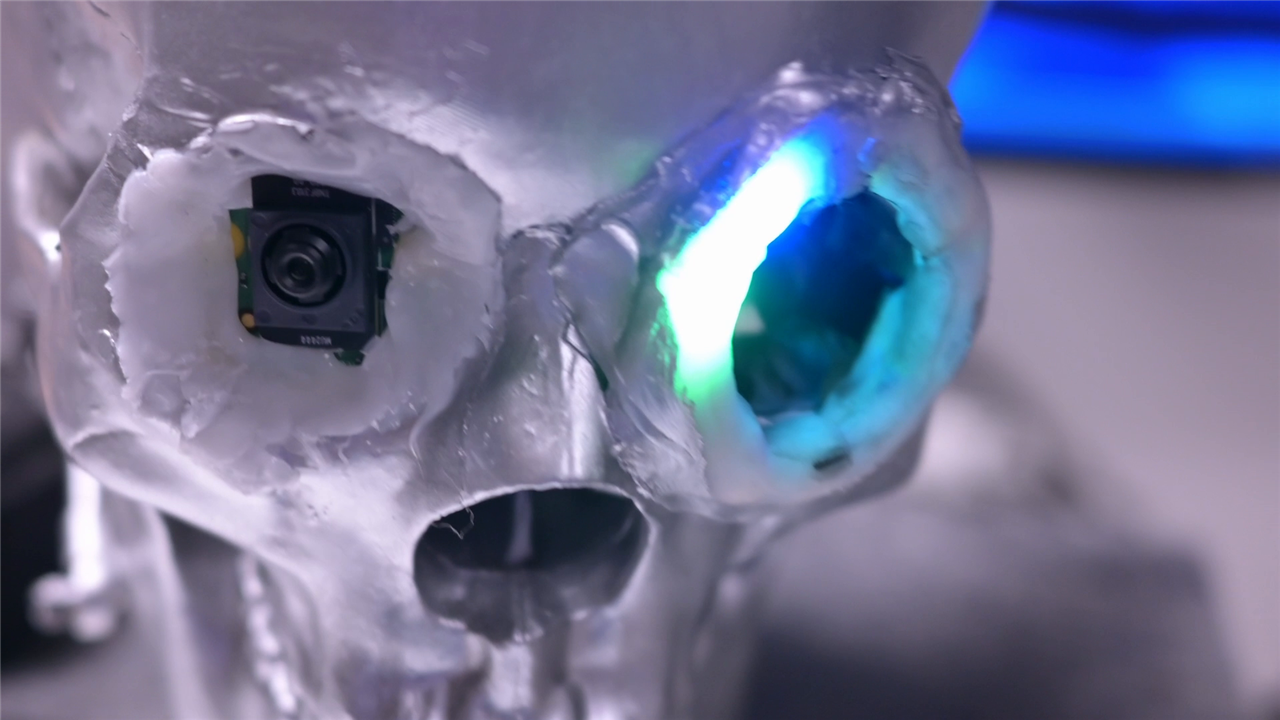
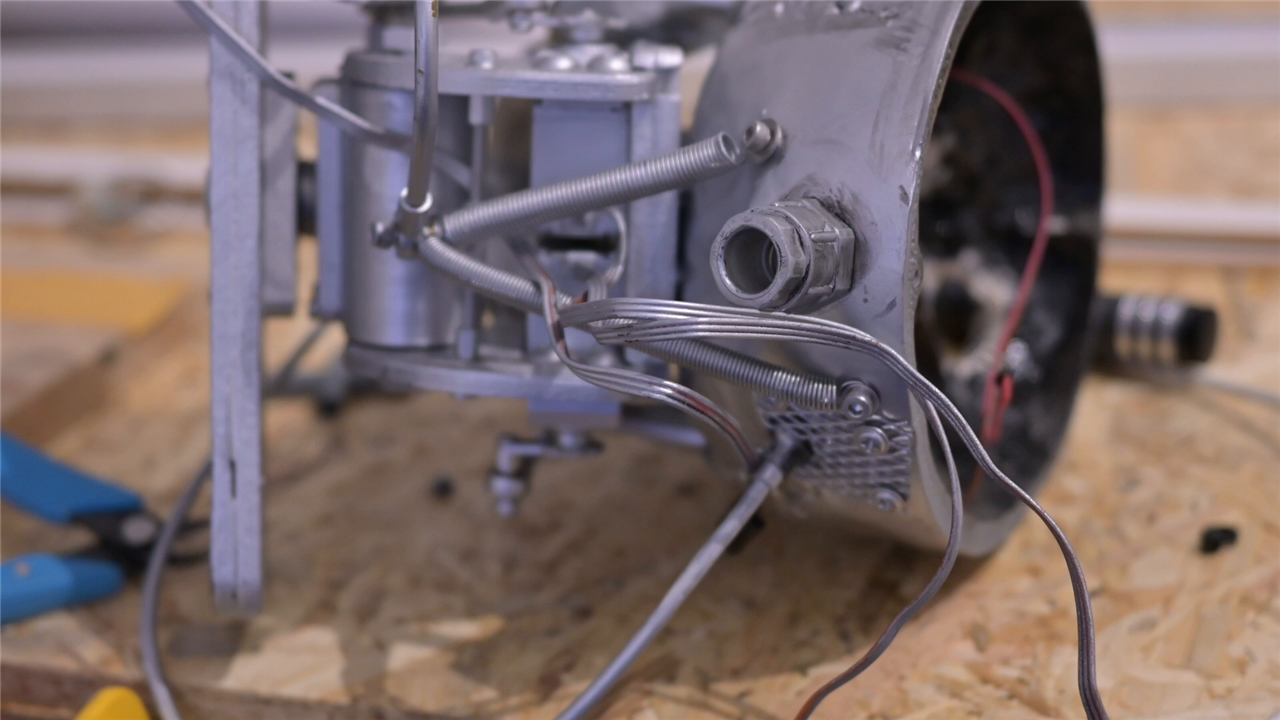
No amount of AI can fully mask the physical realities of a handmade animatronic mechanism. Clem is candid about the skull’s construction: it is intentionally compliant, meaning it will give way if touched. This makes it safe, there’s no risk of pinched fingers, but it also introduces unavoidable jerkiness into the motion.
Rather than fight this in software, the system adapts to it. Movement smoothing, dead zones, and proportional control help reduce unnecessary corrections, but the AI ultimately learns to tolerate mechanical imperfection. The result is not polished in a cinematic sense, but it feels responsive and believable, arguably more so because of its flaws.
image

Visual Feedback Through Light

To make the skull’s perception visible, Clem embedded a NeoPixel LED ring into the eye socket. This acts as a direct, intuitive readout of what the system thinks it sees. When a human is detected, the LEDs glow green; laptops and keyboards are shown in red. The number of illuminated LEDs represents confidence, turning abstract probabilities into something immediately readable at a glance.
There is also an alternative mode where individual LEDs represent individual detections, effectively turning the skull into a live object counter. Additional, less certain detections are shown in blue. This dual‑mode approach makes the skull not just reactive, but informative, useful during development and strangely expressive during operation.
Getting this working on a Raspberry Pi 5 was not straightforward. Standard NeoPixel libraries no longer behave as expected due to changes in how the Pi 5 handles GPIO. Clem had to adopt an SPI‑based approach instead, which brings faster communication but also introduces its own constraints.
image

Building Inside the Head - A More Thoughtful Kind of AI

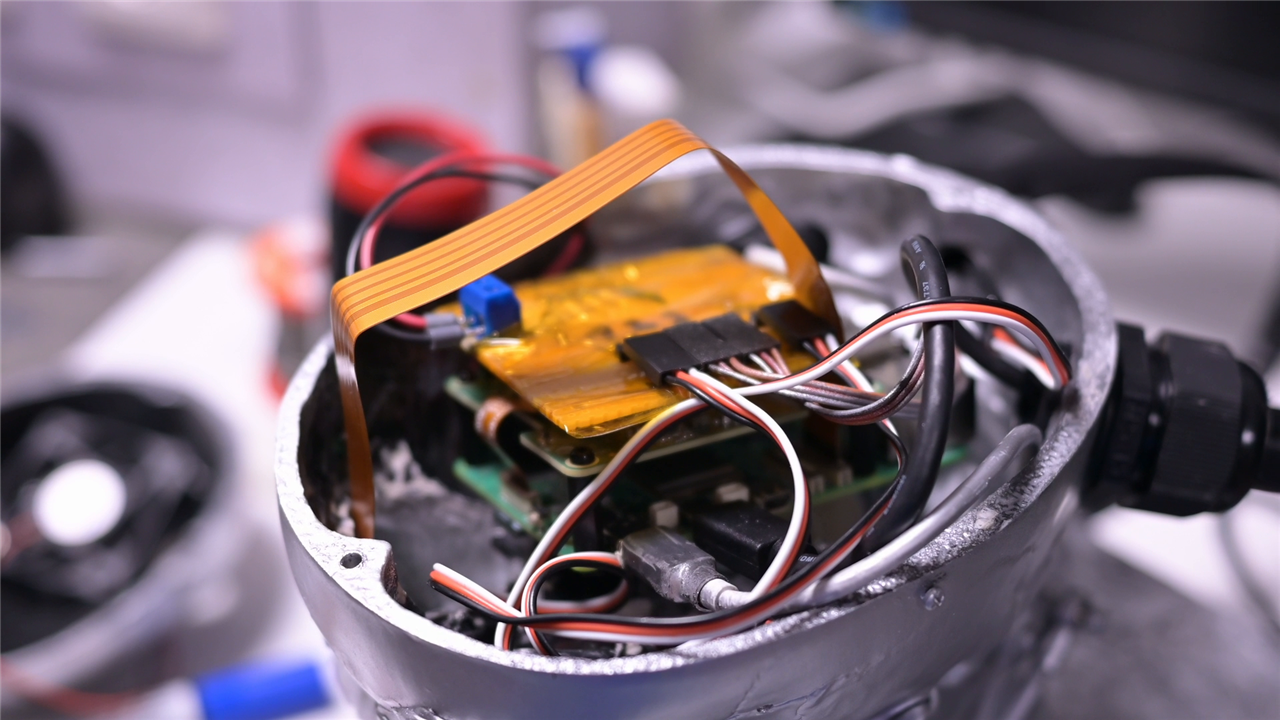
Clem managed to fit all processing hardware inside the skull itself; the only external component is the power supply in the base. Two hardware switches allow the system and motors to be powered independently, making it easy to shut everything down if the skull starts doing something it shouldn’t.
The servo control hardware was assembled by hand using breadboards and prototyping board, with modified headers to ensure reliable connections. It’s not elegant, but it’s practical, and emblematic of the project as a whole.

An interesting shift Clem observes is what modern vision models don’t do. Older examples often focused on profiling people, age, gender, facial attributes. The current ecosystem avoids this entirely, focusing instead on object and pose detection. Clem believes this is a deliberate move toward privacy‑conscious design, and ultimately a more useful direction for real projects.
image

Smaller, Smarter, and Still Uncomfortable

The rebuilt animatronic skull is not a leap toward conversational artificial intelligence, but it is a clear demonstration of how far edge‑based AI vision has come. On relatively inexpensive, compact hardware, the system can see, decide, react, and communicate its intent in real time. It is smoother, more capable, and more expressive than the original—and still deeply unsettling. Clem may joke that “maybe it wasn’t the best idea to build that,” but as a demonstration of modern AI vision, it succeeds precisely because it makes people uneasy. After all, anything that can watch you this closely probably should.

Supporting Links and Files

- Github Repository (Download Mirror)
-  Animatronic Terminator Skull with BeagleBone®︎ AI -- Episode 418  

Bill of Materials

Product Name Manufacturer Quantity Buy Kit
Raspberry pi 5 Raspberry Pi 1 Buy Now
RPI Ai camera Raspberry Pi 1 Buy Now
Raspberry Pi AI HAT+ Add-On Board, Raspberry Pi 5 Boards, 26TOPS, with Built-In Hailo AI Accelerator Raspberry Pi 1 Buy Now
 
  • real-time object detection
  • animatronic robotics project
  • embedded computer vision
  • privacy-aware ai vision
  • raspberry pi 5 ai
  • hailo ai accelerator
  • maker ai vision project
  • e14presents_mayermakes
  • servo-based object tracking
  • low-power ai inference
  • edge ai vision
  • edge ai hardware comparison
  • neopixel visual feedback
  • ai camera projects
  • friday_release
  • machine vision on raspberry pi
  • raspberry pi ai projects
  • Share
  • History
  • More
  • Cancel
Actions
  • Share
  • More
  • Cancel
  • Sign in to reply

Top Comments

  • mayermakes
    mayermakes 17 days ago +1
    Since "AI" is moving so fast here are some updates since I filmed the video: You can now run ollama on RPI5 within Raspberry pi OS . switching to ubuntu is notneeded anymore.-> it demands huge power and…
  • DAB
    DAB 15 days ago in reply to mayermakes

    I agree, more people are willing to let the computer give them a result without worrying about its validity.

    I see many bad decisions ahead by idiots who do not verify their results.

    • Cancel
    • Vote Up 0 Vote Down
    • Sign in to reply
    • More
    • Cancel
  • kmikemoo
    kmikemoo 16 days ago

    Great upgrade!  Yup.  It's still kind of creepy. JoyLaughing

    • Cancel
    • Vote Up 0 Vote Down
    • Sign in to reply
    • More
    • Cancel
  • mayermakes
    mayermakes 17 days ago

    Since "AI" is moving so fast here are some updates since I filmed the video: 
    You can now run ollama on RPI5 within Raspberry pi OS . switching to ubuntu is notneeded anymore.-> it demands huge power and the pi tends to thermal throttle quickly.
    the Ai hat+ 2 was released a month or so after the video was done  and it seems to help with accelerating llms now. but I havent looked into how to deploy or what moelds in which framework it supports. the most practical Ai application on pi still seems to be vision based classification.

    • Cancel
    • Vote Up +1 Vote Down
    • Sign in to reply
    • More
    • Cancel
  • mayermakes
    mayermakes 17 days ago in reply to DAB

    the biggest improvements are so far in how fast and how cheap/available the hardware to run these models got. Sure you can do more by runnign bigger models on faster hardware. but the core principle , the topology and maths is still the basic neural network we knew for decades-> just at scale.
    probability stays probability. What did change is how humans interpret the outcome, even more anthropomorphisation than earlier.

    • Cancel
    • Vote Up 0 Vote Down
    • Sign in to reply
    • More
    • Cancel
  • DAB
    DAB 17 days ago

    Nice project Clem.

    You have confirmed my observations.

    After watching AI for over 45 years, the only thing that has changed is the speed from input to results.

    The results are still speculative and questionable.

    • Cancel
    • Vote Up 0 Vote Down
    • Sign in to reply
    • More
    • Cancel
element14 Community

element14 is the first online community specifically for engineers. Connect with your peers and get expert answers to your questions.

  • Members
  • Learn
  • Technologies
  • Challenges & Projects
  • Products
  • Store
  • About Us
  • Feedback & Support
  • FAQs
  • Terms of Use
  • Privacy Policy
  • Legal and Copyright Notices
  • Sitemap
  • Cookies

An Avnet Company © 2026 Premier Farnell Limited. All Rights Reserved.

Premier Farnell Ltd, registered in England and Wales (no 00876412), registered office: Farnell House, Forge Lane, Leeds LS12 2NE.

ICP 备案号 10220084.

Follow element14

  • X
  • Facebook
  • linkedin
  • YouTube