Welcome to Avnet Heat Sink for Kria K26
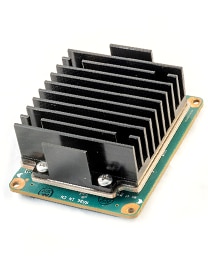
The Avnet Heat Sink for Kria K26 is designed specifically for the AMD-Xilinx Kria K26 system on module (SOM). The heat sink mounts directly to the heat spreader plate that comes standard on the K26 SOM. This solution is “turn key” as it includes the mounting hardware as well as the interface “gap” material preinstalled on the heat sink.
The Avnet Heat Sink for Kria K26 is designed to provide passive relief for designs up to 10W in room temperature (approximately 26C) applications. Designed with flexibility in mind, mounting holes in the heat sink allow for the addition of a standard 50x50mm fan. The addition of a fan provides maximum thermal relief capability allowing for higher power and higher ambient temperature operation. Power and environmental parameters should be considered when selecting your solution. Whether passive or active, Avnet's heat sink for Kria K26 has you covered!
Technical Specification
Click on the images to enlarge
Front View

Front Top View

Left Angle View

Right Angle View

Top View

Pins View

Back View

Bottom View