



element14 Community
element14 Community
    Register Log In
  • Site
  • Search
  • Log In Register
  • Community Hub
    Community Hub
    • What's New on element14
    • Feedback and Support
    • Benefits of Membership
    • Personal Blogs
    • Members Area
    • Achievement Levels
  • Learn
    Learn
    • Ask an Expert
    • eBooks
    • element14 presents
    • Learning Center
    • Tech Spotlight
    • STEM Academy
    • Webinars, Training and Events
    • Learning Groups
  • Technologies
    Technologies
    • 3D Printing
    • FPGA
    • Industrial Automation
    • Internet of Things
    • Power & Energy
    • Sensors
    • Technology Groups
  • Challenges & Projects
    Challenges & Projects
    • Design Challenges
    • element14 presents Projects
    • Project14
    • Arduino Projects
    • Raspberry Pi Projects
    • Project Groups
  • Products
    Products
    • Arduino
    • Avnet & Tria Boards Community
    • Dev Tools
    • Manufacturers
    • Multicomp Pro
    • Product Groups
    • Raspberry Pi
    • RoadTests & Reviews
  • About Us
    About the element14 Community
  • Store
    Store
    • Visit Your Store
    • Choose another store...
      • Europe
      •  Austria (German)
      •  Belgium (Dutch, French)
      •  Bulgaria (Bulgarian)
      •  Czech Republic (Czech)
      •  Denmark (Danish)
      •  Estonia (Estonian)
      •  Finland (Finnish)
      •  France (French)
      •  Germany (German)
      •  Hungary (Hungarian)
      •  Ireland
      •  Israel
      •  Italy (Italian)
      •  Latvia (Latvian)
      •  
      •  Lithuania (Lithuanian)
      •  Netherlands (Dutch)
      •  Norway (Norwegian)
      •  Poland (Polish)
      •  Portugal (Portuguese)
      •  Romania (Romanian)
      •  Russia (Russian)
      •  Slovakia (Slovak)
      •  Slovenia (Slovenian)
      •  Spain (Spanish)
      •  Sweden (Swedish)
      •  Switzerland(German, French)
      •  Turkey (Turkish)
      •  United Kingdom
      • Asia Pacific
      •  Australia
      •  China
      •  Hong Kong
      •  India
      •  Japan
      •  Korea (Korean)
      •  Malaysia
      •  New Zealand
      •  Philippines
      •  Singapore
      •  Taiwan
      •  Thailand (Thai)
      •  Vietnam
      • Americas
      •  Brazil (Portuguese)
      •  Canada
      •  Mexico (Spanish)
      •  United States
      Can't find the country/region you're looking for? Visit our export site or find a local distributor.
  • Translate
  • Profile
  • Settings
Raspberry Pi
  • Products
  • More
Raspberry Pi
Blog Why Should the RP2040 MCU be Specified in Your Next Design? The Heart of the Raspberry Pi Pico
  • Blog
  • Forum
  • Documents
  • Quiz
  • Events
  • Polls
  • Files
  • Members
  • Mentions
  • Sub-Groups
  • Tags
  • More
  • Cancel
  • New
Join Raspberry Pi to participate - click to join for free!
Featured Articles
Announcing Pi
Technical Specifications
Raspberry Pi FAQs
Win a Pi
GPIO Pinout
Raspberry Pi Wishlist
Comparison Chart
Quiz
  • Share
  • More
  • Cancel
Group Actions
  • Group RSS
  • More
  • Cancel
Engagement
  • Author Author: cstanton
  • Date Created: 11 Jan 2023 12:39 PM Date Created
  • Views 6076 views
  • Likes 13 likes
  • Comments 24 comments
Related
Recommended
  • Rapid development and deployment
  • raspberry pi pico
  • Microcontroller-based applications
  • Arm Cortex-M0+
  • rp2040
  • mcu
  • Programmable I/O

Why Should the RP2040 MCU be Specified in Your Next Design? The Heart of the Raspberry Pi Pico

cstanton
cstanton
11 Jan 2023
RP2040 Chip Close-Up

It is a challenge to design low-cost microcontroller-based applications. The designer must balance power and performance with price. It is difficult to decide which instruction set architecture is the best fit for the application. Design and manufacturing concerns also come into play: who will design the system, and who will fabricate it? The answers determine the value and cost-effectiveness of the end product. In this context, the price-to-performance ratio of the RP 2040 microcontroller makes it an obvious choice for the Raspberry Pi Pico. 

What are the specifications of the RP2040 and the Pi Pico?

The RP2040  SoC is a powerful, low-cost microcontroller packing a dual-core Arm® Cortex-M0+ processor that clocks in at a decent 133MHz. It is one of the most energy-saving Arm® processors available. The microcontroller has six banks crammed with 264 kB of embedded SRAM. The RP2040 SoC consumes a low amount of power but yields high performance with minimum leakage.

The Raspberry Pi Pico  board operates over a wide ~1.8 to 5.5V input voltage range and comes with different low-power modes that support battery-powered operation for extended durations. The RP2040 has 30 GPIO pins (four for analogue input), two SPI and I2C controllers, two UART and 16 PWM channels, one USB 1.1 controller, and eight Programmable I/O (PIO). You can set pins opposite the Micro-USB port and connect another Raspberry Pi to program the board directly. The uploaded program automatically runs when turned on.
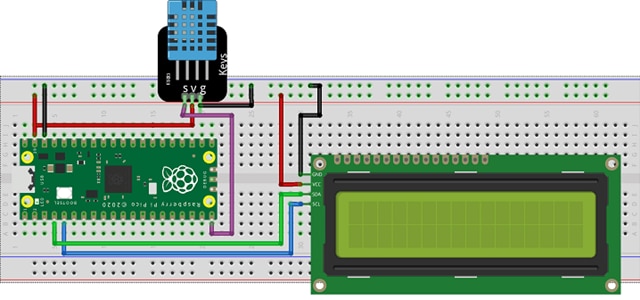
Raspberry Pi Pico on a breadboard

Fig. 1: Temperature and humidity monitoring using Raspberry Pi PICO (Source)

Figure 1 represents a room temperature monitoring system based on the Raspberry Pi Pico board. This application uses Pico’s internal storage to store the data. The data is given a time stamp and stored in a new line format, thus saving the cost of an external SD card module and memory card. Pico gives you the freedom to select the file type, allowing you to store the data in a user-friendly format. It also eliminates the need for proprietary libraries or drivers.

The RP2040 allows rapid code generation in MicroPython or C/C++ with your preferred IDE. The result is a unique platform that supports the rapid development and deployment of endpoint Artificial Intelligence (AI) based applications. You can use TinyML to implement machine learning (ML) models such as voice or image recognition and accelerometer-based gesture recognition or gearbox fault prediction.


Arduino versus the Raspberry Pi Pico - Which to Go For?

Arduino, a microcontroller, is an open-source prototype platform that enables users to create interactive electronic projects. The arrival of the new RP2040 SoC and the Raspberry Pi Pico microcontroller has blurred the line between the Raspberry Pi (a mini-computer) and Arduino ecosystems.

Raspberry Pi Pico uses the improved RP2040 microcontroller RP2040 microcontroller RP2040 microcontroller RP2040 microcontroller RP2040 microcontroller RP2040 microcontroller RP2040 microcontroller RP2040 microcontroller RP2040 microcontroller RP2040 microcontroller RP2040 microcontroller RP2040 microcontroller RP2040 microcontroller RP2040 microcontroller RP2040 microcontroller RP2040 microcontroller RP2040 microcontroller RP2040 microcontroller RP2040 microcontroller RP2040 microcontroller RP2040 microcontroller RP2040 microcontroller RP2040 microcontroller RP2040 microcontroller RP2040 microcontroller RP2040 microcontroller RP2040 microcontroller RP2040 microcontroller RP2040 microcontroller RP2040 microcontroller RP2040 microcontroller RP2040 microcontroller RP2040 microcontroller RP2040 microcontroller RP2040 microcontroller RP2040 microcontroller RP2040 microcontroller RP2040 microcontroller RP2040 microcontroller RP2040 microcontroller RP2040 microcontroller RP2040 microcontroller RP2040 microcontroller RP2040 microcontroller RP2040 microcontroller RP2040 microcontroller RP2040 microcontroller RP2040 microcontroller RP2040 microcontroller RP2040 microcontroller . The Arm® Cortex M0+ in the RP2040 runs at a much faster speed than the Arduino UNO's 16 MHz Atmega328P. The RP2040’s 264 kB SRAM and 2 MB of flash storage are much greater than the Arduino Uno’s 2 kB SRAM and 32 kB flash memory.

Both the Pico and Uno can interact with sensors, motors, display devices, and other physical devices. The Uno operates at 5 V, with six analogue input pins and 14 digital pins for general-purpose input/output (GPIO). Out of 14 pins, six provide PWM output. The Pico operates at 3.3 V, with 26 GPIO pins. The analogue inputs use four pins, and the PWM outputs 16 out of 26 pins. The Pico has an edge on analogue-to-digital conversion (ADC), a faster sampling rate (500 kHz vs. 125 kHz), and a greater resolution (12-bit vs. 10-bit).

The use of serial communication is on the rise in peripheral devices. For example, the Uno has one channel for each UART, I2C, and SPI functionality, while the Pico has twice this number. Pico's programmable IO (PIO) feature supports user-programmable high-speed IO to do tasks such as video output implementation. PIO enables the SD card to interface with software at the hardware level efficiently.

You can code the Arduino Uno in C++ "sketches." The Arduino IDE processes and then compiles and loads the machine code onto the board. In contrast, the RP2040 uses MicroPython, a version of the Python language for small devices. Beginners can use MicroPython for easier and faster coding, while more advanced users have their preference for MicroPython or C/C++.

Have you made your Decision?

The powerful processor and rich functionality of the RP2040 make it a compelling entry into the MCU market. Combined with MicroPython programming, the RP2040 offers an easily accessible gateway for people who want to explore physical computing and microcontrollers at a low cost. The technology, with high-quality documentation and development tools, enables a new generation of hardware and software developers to fill the skills gap in a rapidly growing market.

  • Sign in to reply

Top Comments

  • michaelkellett
    michaelkellett over 3 years ago +1
    I think I should correct a matter of detail on current consumption of the RP2040. One of the key differences between it and most other "low power" ARM M0 based microcontrollers is that it has no on chip…
  • misaz
    misaz over 3 years ago +1
    For me it is mainly cost, in-stock availability at distributors and PIO, but there are several disadvantages when using this MCU like need for external Flash.
  • robogary
    robogary over 3 years ago

    RP2040 is awesome. Micropython does pwm so much easier than Arduino. It has multiple i2c and spi which is helpful on some designs. However, I have a nice inventory of older sensors and modules that have mature reliable libraries and examples for Arduino IDE. Micropython requires a novice to research libraries and coding to begin.It  

    My last project in fact used both arduinos and a raspberry pi pico. The decision on which is best fit for the features needed. 

    • Cancel
    • Vote Up 0 Vote Down
    • Sign in to reply
    • More
    • Cancel
  • shabaz
    shabaz over 3 years ago in reply to michaelkellett

    The RP2040 feels like a test chip for incorporating into future Pi's. I wonder if they can perhaps license it to other well-known manufacturers so that those manufacturers can add their own peripherals etc, otherwise people may be waiting a long time for raspberrypi.org to gain the experience.

    I hope any future RP2040 successor can also have some secure memory built-in, a unique ID, and a way of running from encrypted firmware. Even a tiny bit of EEPROM, because I still feel uncomfortable using portions of Flash for config or saving state, in case something goes wrong that could corrupt the firmware.

    On the positives, the C/C++ SDK is really nice, and having the speed and large memory makes it possible to do things in ways that were not as easy before! I'm working on some code where normally I'd pre-calculate tables, but I can now make a more flexible solution by letting the RP2040 do its own calculations on-the-fly, making it quicker to swap out components and change just one or two parameters (could even be configurable), and no need to upload new look-up tables.

    I'm not looking forward to soldering the 0.4mm pitch QFN though! (I've done 0.4mm in the past so I know I can manage it, but for sure it's a lot harder than 0.5mm). I don't get why raspberrypi.org feel the need to use the tiniest components on the Pico board either. Larger components could fit, making the board more serviceable/adaptable.

    • Cancel
    • Vote Up 0 Vote Down
    • Sign in to reply
    • More
    • Cancel
  • shabaz
    shabaz over 3 years ago in reply to baldengineer

    Totally agree, the C/C++ SDK is excellent, and easy to use! Thonny does stink.. recently I saw a blog post from maxpowerr  that shows how to use PyCharm instead, so I'm going to be trying that in future, to get rid of Thonny: Getting Started with the MicroPython in PyCharm for Raspberry Pi Pico.  

    Incidentally CircuitPython is more feature-rich, but it's so much more unreliable than MicroPython from what little I've seen : ( I've had no end of issues with CircuitPython bugs unfortunately. CircuitPython even has problems with basic maths, it is implemented slightly differently to MicroPython maths.

    For sound, video and all sorts of other stuff, CircuitPython has a wealth of decent libraries and examples, so it's possible to do more with it than MicroPython, but I've not been able to create a reliable solution so far with CircuitPython. I also hit a horrible bug where if the Pico was power-cycled at a specific time (which could happen quite frequently if the user was manually attaching a battery, because it is an intermittent connection until the connection is properly made) the user code would be wiped out from Flash : ( So for that reason, if possible I try to select MicroPython, and only use CircuitPython if there's a feature that I need that I can't recreate in MicroPython (e.g. some graphics libraries, if they don't need to be too complex then I have just created them myself). 

    • Cancel
    • Vote Up 0 Vote Down
    • Sign in to reply
    • More
    • Cancel
  • misaz
    misaz over 3 years ago in reply to cstanton

    Of course! Disadvantage I meant was additional cost + space on PCB.

    I like the concept introduced by some other platform that MCU have some internal flash, but can execute also code from the external if for some reason higher  amount of FLASH is needed. Many nowadays MCU have possibility map QSPI Flash to the address apce for executing code.

    • Cancel
    • Vote Up 0 Vote Down
    • Sign in to reply
    • More
    • Cancel
  • baldengineer
    baldengineer over 3 years ago

    Like all things in engineering, first you must determine if a product is a good fit for your need.

    The RP2040's biggest advantage right now is that it is highly available. No significant customer has allocated large stock to their device... yet.

    Another advantage is that the RP2040 isn't carrying a decade+ of technology debt along with it. It's a new design with many interesting features without "leftover" crud from previous product iterations. The PIO is, by far, my favorite.

    That said, its power consumption is rather high when sleeping. So it is not really ideal for ultra-low power applications.

    Also, I will always recommend CircuitPython over MicroPython. It has a much more robust ecosystem around it with far more maker/hobby/prototype-friendly libraries. Also, it's much easier to work with any editing environment you wish since the MCU appears as a mass storage device in the PC's operating system. Plus, you don't have to bother with the absolutely terrible Thonny garbage. (Though, you can if you hate being productive.)

    And now, I"ll really put on my old-man persona. I find it frustrating how many people jump into the Pi Pico with MicroPython and do not realize how much power they have available if they switch to C. Even if they would use the Arduino library to program the RP2040. MicroPython and CircuitPython are great. And if they work for what you want to do, that's great too. But it just amazes me how many people seem to think the Pi Pico is ONLY capable of MicroPython. (and to that extent, how many people seem to think the Pi Pico has anything to do with the Raspberry Pi SBCs.)

    • Cancel
    • Vote Up 0 Vote Down
    • Sign in to reply
    • More
    • Cancel
<>
element14 Community

element14 is the first online community specifically for engineers. Connect with your peers and get expert answers to your questions.

  • Members
  • Learn
  • Technologies
  • Challenges & Projects
  • Products
  • Store
  • About Us
  • Feedback & Support
  • FAQs
  • Terms of Use
  • Privacy Policy
  • Legal and Copyright Notices
  • Sitemap
  • Cookies

An Avnet Company © 2026 Premier Farnell Limited. All Rights Reserved.

Premier Farnell Ltd, registered in England and Wales (no 00876412), registered office: Farnell House, Forge Lane, Leeds LS12 2NE.

Follow element14

  • X
  • Facebook
  • linkedin
  • YouTube