element14 Community
element14 Community
    Register Log In
  • Site
  • Search
  • Log In Register
  • Community Hub
    Community Hub
    • What's New on element14
    • Feedback and Support
    • Benefits of Membership
    • Personal Blogs
    • Members Area
    • Achievement Levels
  • Learn
    Learn
    • Ask an Expert
    • eBooks
    • element14 presents
    • Learning Center
    • Tech Spotlight
    • STEM Academy
    • Webinars, Training and Events
    • Learning Groups
  • Technologies
    Technologies
    • 3D Printing
    • FPGA
    • Industrial Automation
    • Internet of Things
    • Power & Energy
    • Sensors
    • Technology Groups
  • Challenges & Projects
    Challenges & Projects
    • Design Challenges
    • element14 presents Projects
    • Project14
    • Arduino Projects
    • Raspberry Pi Projects
    • Project Groups
  • Products
    Products
    • Arduino
    • Avnet & Tria Boards Community
    • Dev Tools
    • Manufacturers
    • Multicomp Pro
    • Product Groups
    • Raspberry Pi
    • RoadTests & Reviews
  • About Us
    About the element14 Community
  • Store
    Store
    • Visit Your Store
    • Choose another store...
      • Europe
      •  Austria (German)
      •  Belgium (Dutch, French)
      •  Bulgaria (Bulgarian)
      •  Czech Republic (Czech)
      •  Denmark (Danish)
      •  Estonia (Estonian)
      •  Finland (Finnish)
      •  France (French)
      •  Germany (German)
      •  Hungary (Hungarian)
      •  Ireland
      •  Israel
      •  Italy (Italian)
      •  Latvia (Latvian)
      •  
      •  Lithuania (Lithuanian)
      •  Netherlands (Dutch)
      •  Norway (Norwegian)
      •  Poland (Polish)
      •  Portugal (Portuguese)
      •  Romania (Romanian)
      •  Russia (Russian)
      •  Slovakia (Slovak)
      •  Slovenia (Slovenian)
      •  Spain (Spanish)
      •  Sweden (Swedish)
      •  Switzerland(German, French)
      •  Turkey (Turkish)
      •  United Kingdom
      • Asia Pacific
      •  Australia
      •  China
      •  Hong Kong
      •  India
      •  Japan
      •  Korea (Korean)
      •  Malaysia
      •  New Zealand
      •  Philippines
      •  Singapore
      •  Taiwan
      •  Thailand (Thai)
      •  Vietnam
      • Americas
      •  Brazil (Portuguese)
      •  Canada
      •  Mexico (Spanish)
      •  United States
      Can't find the country/region you're looking for? Visit our export site or find a local distributor.
  • Translate
  • Profile
  • Settings
Embedded and Microcontrollers
  • Technologies
  • More
Embedded and Microcontrollers
Embedded Forum Thought Experiment; Detecting Distance
  • Blog
  • Forum
  • Documents
  • Quiz
  • Polls
  • Files
  • Members
  • Mentions
  • Sub-Groups
  • Tags
  • More
  • Cancel
  • New
Join Embedded and Microcontrollers to participate - click to join for free!
Actions
  • Share
  • More
  • Cancel
Forum Thread Details
  • State Suggested Answer
  • Replies 37 replies
  • Answers 5 answers
  • Subscribers 483 subscribers
  • Views 3037 views
  • Users 0 members are here
  • embedded
  • development
  • mcu
  • puzzle
Related

Thought Experiment; Detecting Distance

Catwell
Catwell over 15 years ago
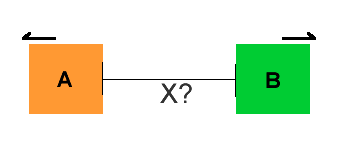
We have two blocks, A & B shown below, moving away from each other. How can one detect that the separation has reached a certain point, distance X in this case?
 
The most obvious solution is two rods, one on each block, that make contact when the distance is X. But this is a crude and cumbersome option. It's 2010, how about a high tech solution?
image


There is no right or wrong, just an excellent chance to work out the prefrontal cortex and showing off some creativity.
  • Sign in to reply
  • Cancel

Top Replies

  • DAB
    DAB over 14 years ago +1
    Hi Cabe, A very simple approach is to set up two laser pointers set up to hit the same spot at only the correct distance. As you move one box towards the other, the two laser spots will converge. If you…
  • Former Member
    0 Former Member over 14 years ago

    Late joiner!


    I would recommend capacitance, assuming (1) there is an opportunity to calibrate and (2) the environment is fairly free of non-repeatable (i.e., cannot be captured during calibration) outside influences. Block A has active electronics on it. Block B has a metal (foil works) plate on the side facing Block A. Block A includes one plate of a capacitor, a driven shield for that plate, and a ground "plate" (consisting of a ring of foil around the perimeter of the side facing Block B).


    The field from the driven center plate to the grounded perimeter is forced to extend fairly far out into space. The disturbance by the foil on Block B alters the capacitance between the center plate and ground. Measure the capacitance (there are various ways) vs. distance to establish a calibration curve and you are done. This is fairly immune to temperature, very susceptible to dielectric constant change of the intervening material, and very cheap to build (under $30 in electronics - voice of experience!). One part in 400 is not too difficult to do with a 2nd order curve fit (8-bit microcontroller is sufficient, but a math library helps!), but accuracy also depends on movement being restricted to X direction.

    • Cancel
    • Vote Up 0 Vote Down
    • Sign in to reply
    • Verify Answer
    • Cancel
  • billpenner
    0 billpenner over 14 years ago in reply to Catwell

    I know this is old but just ran across some Light to frequency converters. With a resolution of 16 bits and a wide range of sensitivities, Looks as if this might be the low cost answer. Please check taosinc.com for more info.The available devices include both analog and digital.Some with programmable gain. for a wide range of light sensitivity. Couple this with a reflectivity of block A or source on block A with sensor on block B, the range can can be varied. Also using an adjustable light source, the distance can be varied over a wide range. The cost of the sensors are only a couple bucks. I am going to build a motion sensor using one of the analog as well as one of the digital sensors. I have a need to measure the absolute speed of motion of an object independent of direction. Sorry for the long response time.

    Bill

    • Cancel
    • Vote Up 0 Vote Down
    • Sign in to reply
    • Verify Answer
    • Cancel
  • Catwell
    0 Catwell over 14 years ago in reply to billpenner

    Brilliant ideas. All worth trying.


    Timatthelab, would block B's foil still be affected to a detectable margin at far distances. Say, at 20cm?


    Saturation, I can not wait to try the light range finder option.


    Billpenner, I am going to look into your option.


    Cabe

    • Cancel
    • Vote Up 0 Vote Down
    • Sign in to reply
    • Verify Answer
    • Cancel
  • Former Member
    0 Former Member over 14 years ago in reply to Catwell

    The range for capacitance measurements depends primarily on the geometry, of which the distance is a big part. I have found that the usable range is about 1 to 3 times the diameter of the electrode "plate" used. In this case, one plate is the center sensor, while the other is the ground ring, complicated by the "reflection" off of the Block B target. With sufficient width of the ground ring, one could expect decent results to about 2 to 3 times the sensor diameter. If you get much farther than that, the amount of gain required is so great that the noise become problematic (although you can recover from it to a point if you can average over a long enough time).


    Also, note that Block B does not necessarily need a foil, if it's dielectric constant is sufficiently high. E.g., the raw material used in soylent green is full of water, so you can use this technique as a decent "person detector".

    • Cancel
    • Vote Up 0 Vote Down
    • Sign in to reply
    • Verify Answer
    • Cancel
  • Former Member
    0 Former Member over 14 years ago

    What about String-pots?

    http://www.unimeasure.com/


    With a little bit of calibration/interpolation, you can probably achieve the accuracy you're after


    Or LVDTs?

    http://www.lvdt.co.uk/pdf/AML-E.pdf


    Or finally magnetic encoders;

    http://www.renishaw.com/en/magnetic-linear-encoders-and-magnetic-ring-encoders--9802


    Any of those are simpler/easier to implement that optical or US solutions, and should give you the kind of accuracy you're after.

    • Cancel
    • Vote Up 0 Vote Down
    • Sign in to reply
    • Verify Answer
    • Reject Answer
    • Cancel
  • Former Member
    0 Former Member over 14 years ago in reply to Former Member

    String pots aren't a bad idea, except when you have to worry about humidity changes and string stretch.  Good for being able to replace them though, and wouldn't be too hard to implement a centering capability with end cap limit switches.  The LVDT's are quite a bit more accurate, IMHO, used them for flight control position sensing on Helicopters.  Currently work with encoders and wheels that measure speed/distance for conveyor belts.  They work well if you can find the right combination to get the 7.5 degree measurements to equal a specific linear measurement. 

    • Cancel
    • Vote Up 0 Vote Down
    • Sign in to reply
    • Verify Answer
    • Cancel
  • Former Member
    0 Former Member over 14 years ago in reply to Former Member

    Regular calibration (yearly) should take care of any stretch in the steel wire used for the pots strings.. not sure how humidity would affect that. (temperature is likely to much bigger effect).


    As for the encoders, take a look at the link.. I meant linear magnetic encoders, they use magnetic strips with alternating poles with a moving reader head. the accuracy can be down to a micron if required, 20microns is quite common (0.02mm). Bit more difficult to use but worth it if accuracy and reliability is what you need

    • Cancel
    • Vote Up 0 Vote Down
    • Sign in to reply
    • Verify Answer
    • Cancel
<
element14 Community

element14 is the first online community specifically for engineers. Connect with your peers and get expert answers to your questions.

  • Members
  • Learn
  • Technologies
  • Challenges & Projects
  • Products
  • Store
  • About Us
  • Feedback & Support
  • FAQs
  • Terms of Use
  • Privacy Policy
  • Legal and Copyright Notices
  • Sitemap
  • Cookies

An Avnet Company © 2026 Premier Farnell Limited. All Rights Reserved.

Premier Farnell Ltd, registered in England and Wales (no 00876412), registered office: Farnell House, Forge Lane, Leeds LS12 2NE.

ICP 备案号 10220084.

Follow element14

  • X
  • Facebook
  • linkedin
  • YouTube