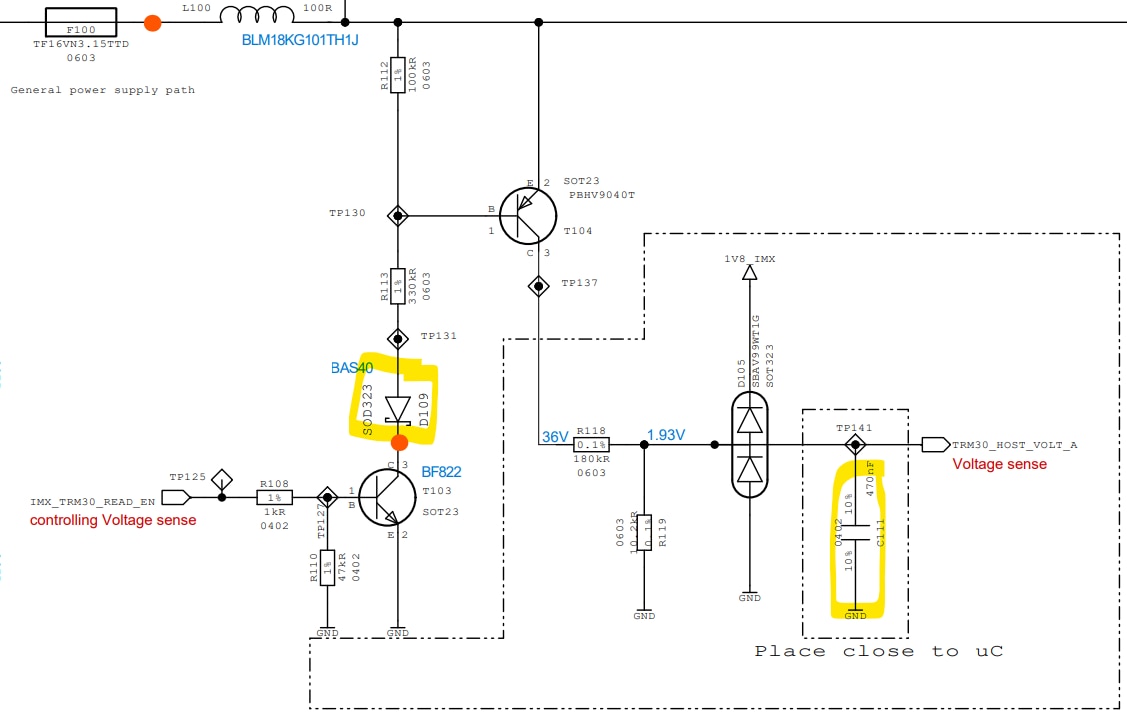
Why is the Schottky diode being used in control circuit? and why is the 470nF cap is added at that voltage divider output? how is the Cap value 470nF calculated?
Be sure to click 'more' and select 'suggest as answer'!
If you're the thread creator, be sure to click 'more' then 'Verify as Answer'!
Why is the Schottky diode being used in control circuit? and why is the 470nF cap is added at that voltage divider output? how is the Cap value 470nF calculated?
I would need to know more about the function of the circuit to make an informed comment.
The two transistors are high voltage parts (250V and 500V).
What are the inductor connections and what is the working voltage on emitter of T104 ?
D108 is only rated for 40V reverse voltage.
I suspect that the diode is to protect T103 from negative voltages at TP131 - but without more information its only a guess.
MK
D108 is only rated for 40V reverse voltage.
Good catch. Hopefully the input voltage is less than that... mind you when the NPN transistor is off the diode cathode is isolated from GND.
[Edit] next to R118 there is a bit of text that says 36V... so I guess we are safe.
In terms of operation....
The only condition in which current runs through the Schottky is during the positive AC cycle and when the NPN is on. Otherwise the voltage at the base of the PNP is the same as the emitter so the PNP remains off.
When the NPN is turned on, the positive half of the cycle is allowed to pass through the PNP. The voltage divided at its output would indeed be around 1.93V assuming 36V peak voltage. The capacitor is of course used to smooth out the signal to essentially DC.
It seems that the 470nF is part of some sort of peak detector. I recently built one. They consist of a diode to rectify, resistor to ensure slow discharge and capacitor to store the charge so that the resulting measured voltage is all balanced and rectified. But I am not sure maybe I’m way off here so correct me if I’m wrong!