element14 Community
element14 Community
    Register Log In
  • Site
  • Search
  • Log In Register
  • Community Hub
    Community Hub
    • What's New on element14
    • Feedback and Support
    • Benefits of Membership
    • Personal Blogs
    • Members Area
    • Achievement Levels
  • Learn
    Learn
    • Ask an Expert
    • eBooks
    • element14 presents
    • Learning Center
    • Tech Spotlight
    • STEM Academy
    • Webinars, Training and Events
    • Learning Groups
  • Technologies
    Technologies
    • 3D Printing
    • FPGA
    • Industrial Automation
    • Internet of Things
    • Power & Energy
    • Sensors
    • Technology Groups
  • Challenges & Projects
    Challenges & Projects
    • Design Challenges
    • element14 presents Projects
    • Project14
    • Arduino Projects
    • Raspberry Pi Projects
    • Project Groups
  • Products
    Products
    • Arduino
    • Avnet & Tria Boards Community
    • Dev Tools
    • Manufacturers
    • Multicomp Pro
    • Product Groups
    • Raspberry Pi
    • RoadTests & Reviews
  • About Us
  • Store
    Store
    • Visit Your Store
    • Choose another store...
      • Europe
      •  Austria (German)
      •  Belgium (Dutch, French)
      •  Bulgaria (Bulgarian)
      •  Czech Republic (Czech)
      •  Denmark (Danish)
      •  Estonia (Estonian)
      •  Finland (Finnish)
      •  France (French)
      •  Germany (German)
      •  Hungary (Hungarian)
      •  Ireland
      •  Israel
      •  Italy (Italian)
      •  Latvia (Latvian)
      •  
      •  Lithuania (Lithuanian)
      •  Netherlands (Dutch)
      •  Norway (Norwegian)
      •  Poland (Polish)
      •  Portugal (Portuguese)
      •  Romania (Romanian)
      •  Russia (Russian)
      •  Slovakia (Slovak)
      •  Slovenia (Slovenian)
      •  Spain (Spanish)
      •  Sweden (Swedish)
      •  Switzerland(German, French)
      •  Turkey (Turkish)
      •  United Kingdom
      • Asia Pacific
      •  Australia
      •  China
      •  Hong Kong
      •  India
      • Japan
      •  Korea (Korean)
      •  Malaysia
      •  New Zealand
      •  Philippines
      •  Singapore
      •  Taiwan
      •  Thailand (Thai)
      • Vietnam
      • Americas
      •  Brazil (Portuguese)
      •  Canada
      •  Mexico (Spanish)
      •  United States
      Can't find the country/region you're looking for? Visit our export site or find a local distributor.
  • Translate
  • Profile
  • Settings
FPGA
  • Technologies
  • More
FPGA
Forum Is there an FPGA that you don't need a computer engineering degree just to get a light to blink?
  • Blog
  • Forum
  • Documents
  • Quiz
  • Events
  • Polls
  • Files
  • Members
  • Mentions
  • Sub-Groups
  • Tags
  • More
  • Cancel
  • New
Join FPGA to participate - click to join for free!
Actions
  • Share
  • More
  • Cancel
Forum Thread Details
  • Replies 17 replies
  • Subscribers 559 subscribers
  • Views 2883 views
  • Users 0 members are here
Related

Is there an FPGA that you don't need a computer engineering degree just to get a light to blink?

Former Member
Former Member over 9 years ago

I have an Altera CPLD, Altera DE0-Nano-SoC, and a xilinx mojo v3.

the CPLD is the only I could get working with a lot of stupid usb drive hoops to jump through.


Does anyone make a board with good documentation on installation and troubleshooting.

I feel like Altera and Xilinx don't care about the maker community but want our money without putting any effort out on there part.


David

  • Sign in to reply
  • Cancel

Top Replies

  • shabaz
    shabaz over 9 years ago +2
    Hi David, Which area are you specifically concerned about, the development software (toolchain), or the software that will push the final synthesized design into the board? Regardless of the board, you…
  • Former Member
    Former Member over 9 years ago in reply to Jan Cumps +2
    I am trying to build a computer from first principals, a hardware version of NAND2Tetris The Elements of Computing Systems / Nisan & Schocken
  • Jan Cumps
    Jan Cumps over 9 years ago in reply to Jan Cumps +2
    I've filmed my first endeavours - warning: I had no knowledge at all when filming this, so it's really from a starters point of view. Only the last video is an own design (with most code blatantly stolen…
  • shabaz
    shabaz over 9 years ago

    Hi David,


    Which area are you specifically concerned about, the development software (toolchain), or the software that will push the final synthesized design into the board?


    Regardless of the board, you will still have to use the same FPGA/CPLD vendor software to test and synthesize your design (this is a broad statement, there are actually alternatives for (say) the testing portion of the workflow, and with the exception of Lattice for which an open source toolchain also exists as far as I know (johnbeetem will know more). It won't necessarily be less complex however).


    Regardless of the FPGA/CPLD silicon vendor the only slightly board-specific area of the workflow will be how to get the final bit file onto the board.


    Many boards are created by the 'maker community', so if the creator's don't care about the community enough to publish sufficient detail on how to program their board, I cannot see that Altera and Xilinx can be blamed for that.


    To get a light to blink, you need to describe the hardware (so you need familiarity with digital logic) and be able to write stimulus and the expected response in order to be able to simulate it, and be able to use the vendor tools to synthesize it and make it fit into the FPGA and pin layout as desired. All of these steps are different to writing and compiling computer programs.


    I think the Xlinx and Altera toolchains are not too bad to use (takes a day or so with tutorials to figure out the steps), the difficulty lies in being able to describe hardware in a HDL (hardware description language) and testing it. I have not used Altera software in a very long time though, and Xilinx's ISE is not recent for me either. However the user docs/tutorials for Xilinx seemed straightforward at the time, enough to get my projects to function. There are other vendors too such as Lattice as mentioned.


    Regarding boards, for my last project I just used a cheap Xilinx CPLD board and it was possible to push the final synthesized design file (i.e. you of course still need to use Xilinx ISE to actually perform all the previous steps) into it using free software running on the BeagleBone Black.

    See here for the free software and the wiring diagram. It is drag-and-drop to program it, so couldn't be easier. It is free so unsupported except for general assistance from the community, i.e. we try our best to help where we can:

    BBB - FPGA / CPLD Programmer for the BeagleBone Black

    • Cancel
    • Vote Up +2 Vote Down
    • Sign in to reply
    • Cancel
  • johnbeetem
    johnbeetem over 9 years ago

    I haven't used the Mojo V3 board myself.  Its maker Embedded Micro has tutorials and a forum.  I'd recommend trying the tutorials and checking the forum if you get stuck.


    Unfortunately, there's a steep learning curve with all the FPGAs if you're using vendor tools.  With each release the curve gets worse.  If you've been designing with a vendor's parts for a long time, you don't really notice it that much since each release only makes incremental changes.  However, if you're just starting out you're trying to drink from a firehose and it's pretty brutal.  See the discussion: Barriers to designing with FPGAs?


    Altera and Xilinx are interesting in selling you huge quantities of reasonably-priced chips or medium quantities of very expensive chips.  If you're just a maker they're not going to give you individual help, though you can get useful information from the Xilinx community forum.  So your best bet is the tutorials and forum of whoever makes your board.


    I like Gadget Factory and their Papilio boards.  They have a very helpful forum.  However, you're still going to have to install and learn to use Xilinx ISE.  Plus the Xilinx Spartan-6 on the Mojo and Papilio DUO is a very complex beast.  So you're liable to get strange error messages and warnings.


    I really like the Lattice iCE40 as a simple chip for new users.  This is the only FPGA I know of that has open-source design tools (IceStorm).  They are quite simple to use, but a bit of a pain to install.  I use them on Ubuntu GNU/Linux.  I don't know whether they've been installed successfully on Windows.  People who care about open-source software usually have a GNU/Linux machine handy.


    I've backed a nice iCE40 board called Nandland Go Board which is designed for new users.  Its creator's site has some nice tutorials.  I expect to get my board by the end of March 2016.


    If you stick with it, FPGAs can do amazing things that you simply cannot do with a CPU.  Here's my "elevator speech" on why someone would want to learn FPGAs:

    Have you ever wanted a custom digital chip for a project, but didn't have $1 million lying around to pay for fabricating it?   Well, an FPGA lets you do it for tens of dollars.

    Hope this helps!

    • Cancel
    • Vote Up 0 Vote Down
    • Sign in to reply
    • Cancel
  • Former Member
    Former Member over 9 years ago in reply to johnbeetem

    Thank you for the responses and The Nandland Go board looks interesting.


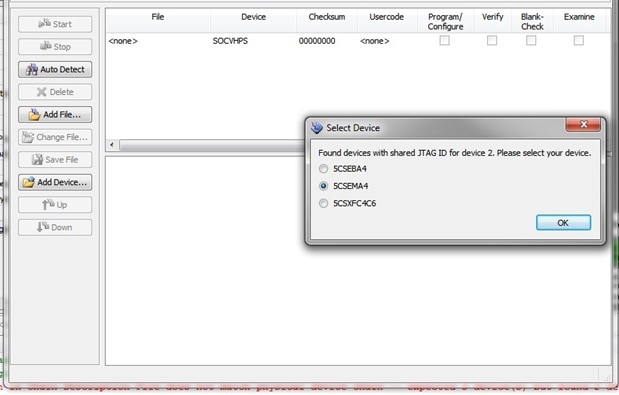
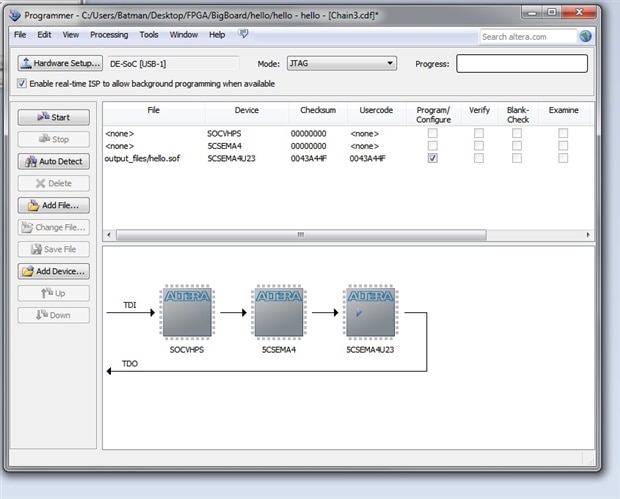
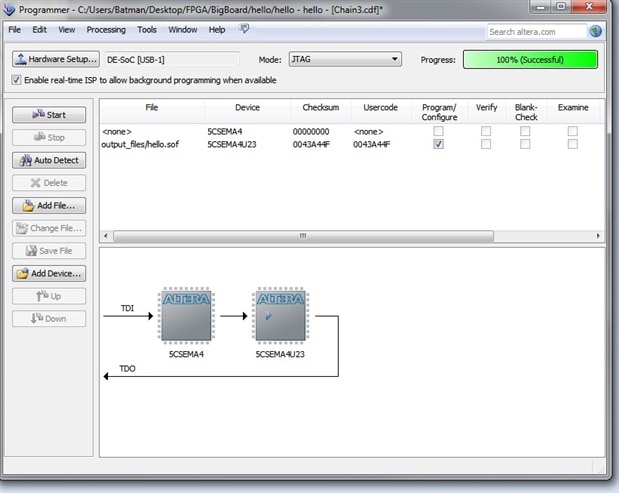
    Let me illustrate what I have an issue with. I finally got the Altera DE0-Nano-SoC board working (kinda).

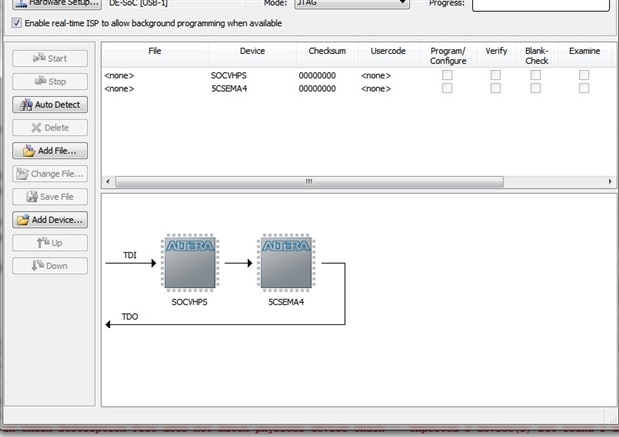
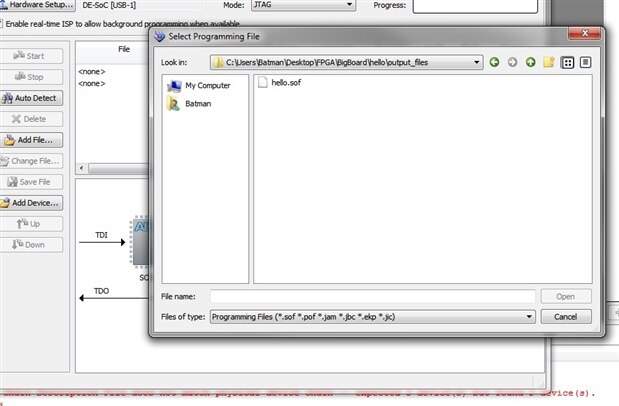
    I put in my steps so it may help others.


    1.do an auto detect and choose the middle one

    2 load the .sof

    3 delete SOCVHPS

    4 then hit the Start button


    At No point do I get any feedback nor have I seen any troubleshooting guide to give me any Idea what to do it when it FAILS


    It uploaded but the AND gate turned into NAND gate I think it's because the buttons on the board don't have pull up resistors.

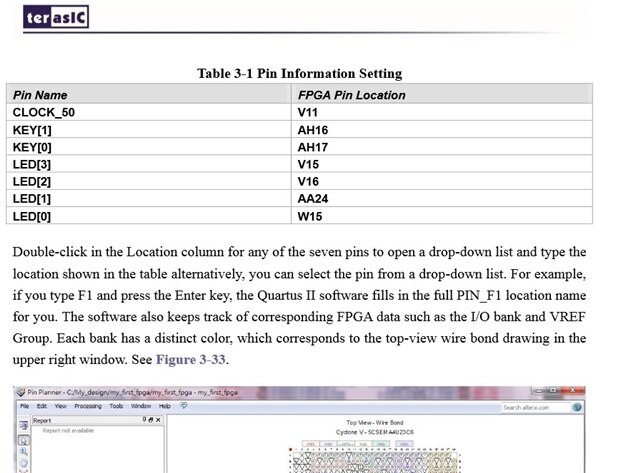
    I would use the other pins and a breadboard but I can't find the full Pin Name to FPGA Pin Location (with a picture of the board)

    At least the Mojo and the CPLD have the Pin names printed on the board.


    image


    imageimageimageimageimage

    • Cancel
    • Vote Up 0 Vote Down
    • Sign in to reply
    • Cancel
  • Former Member
    Former Member over 9 years ago in reply to johnbeetem

    It is The "They are quite simple to use, but a bit of a pain to install." I have an issue and where I call out both Altera and Xilinx for not supporting the community because It is left to the community to make videos like :https://www.youtube.com/watch?v=wF9vlO-ah-A

    • Cancel
    • Vote Up 0 Vote Down
    • Sign in to reply
    • Cancel
  • Former Member
    Former Member over 9 years ago in reply to Former Member

    The Pin assignments are  in the DE0-Nano-SoC_User_manual.pdf starting at page 26

    • Cancel
    • Vote Up 0 Vote Down
    • Sign in to reply
    • Cancel
  • Jan Cumps
    Jan Cumps over 9 years ago in reply to Former Member

    I didn't have issues getting the toolchain for Xilinx and Papilio running. And hamsternz has a getting started guide that I like very much.


    I have a harder time stepping up from where that tutorial ends though image .
    I'm not that used anymore to think in digital hardware terms. The brain turned a little bit lazy now that I use a microcontroller as the hammer to hit any digital nail.

    • Cancel
    • Vote Up 0 Vote Down
    • Sign in to reply
    • Cancel
  • Former Member
    Former Member over 9 years ago in reply to Jan Cumps

    I am trying to build a computer from first principals, a hardware version of NAND2Tetris The Elements of Computing Systems / Nisan & Schocken

    • Cancel
    • Vote Up +2 Vote Down
    • Sign in to reply
    • Cancel
  • Jan Cumps
    Jan Cumps over 9 years ago in reply to Former Member

    That's definitely more advanced than blinking the proverbial led.

    • Cancel
    • Vote Up +1 Vote Down
    • Sign in to reply
    • Cancel
  • clem57
    clem57 over 9 years ago in reply to Former Member

    I like the idea, but you may come up short because it it much simpler to simulate hardware than to build the real thing.

    Clem

    • Cancel
    • Vote Up +1 Vote Down
    • Sign in to reply
    • Cancel
  • shabaz
    shabaz over 9 years ago in reply to Former Member

    I have a copy of that book, and found it only slightly useful, and would definitely not be a book for building a computer with an FPGA. I think it would be difficult to use such a book for your aim (despite the extended title of the book being "Building a Modern Computer System from First Principles") . HDL is relegated to a tiny appendix in the book, and the book is intended for computer science (and for a really tiny fraction of a CS course at best), not for hardware designers (an FPGA needs hardware design knowledge). It simply isn't possible to use a computer science or a software program approach (as detailed in the book) to design a computer in an FPGA.

    I can't suggest a specific book on building a computer in an FPGA. Usually there are books on computer architecture, and there are books on HDL, and there are books on digital design. You might find online fpga computer projects to do what you approximately want, but they may not be documented well either unfortunately.

    • Cancel
    • Vote Up +1 Vote Down
    • Sign in to reply
    • Cancel
>
element14 Community

element14 is the first online community specifically for engineers. Connect with your peers and get expert answers to your questions.

  • Members
  • Learn
  • Technologies
  • Challenges & Projects
  • Products
  • Store
  • About Us
  • Feedback & Support
  • FAQs
  • Terms of Use
  • Privacy Policy
  • Legal and Copyright Notices
  • Sitemap
  • Cookies

An Avnet Company © 2025 Premier Farnell Limited. All Rights Reserved.

Premier Farnell Ltd, registered in England and Wales (no 00876412), registered office: Farnell House, Forge Lane, Leeds LS12 2NE.

ICP 备案号 10220084.

Follow element14

  • X
  • Facebook
  • linkedin
  • YouTube