element14 Community
element14 Community
    Register Log In
  • Site
  • Search
  • Log In Register
  • Community Hub
    Community Hub
    • What's New on element14
    • Feedback and Support
    • Benefits of Membership
    • Personal Blogs
    • Members Area
    • Achievement Levels
  • Learn
    Learn
    • Ask an Expert
    • eBooks
    • element14 presents
    • Learning Center
    • Tech Spotlight
    • STEM Academy
    • Webinars, Training and Events
    • Learning Groups
  • Technologies
    Technologies
    • 3D Printing
    • FPGA
    • Industrial Automation
    • Internet of Things
    • Power & Energy
    • Sensors
    • Technology Groups
  • Challenges & Projects
    Challenges & Projects
    • Design Challenges
    • element14 presents Projects
    • Project14
    • Arduino Projects
    • Raspberry Pi Projects
    • Project Groups
  • Products
    Products
    • Arduino
    • Avnet & Tria Boards Community
    • Dev Tools
    • Manufacturers
    • Multicomp Pro
    • Product Groups
    • Raspberry Pi
    • RoadTests & Reviews
  • About Us
  • Store
    Store
    • Visit Your Store
    • Choose another store...
      • Europe
      •  Austria (German)
      •  Belgium (Dutch, French)
      •  Bulgaria (Bulgarian)
      •  Czech Republic (Czech)
      •  Denmark (Danish)
      •  Estonia (Estonian)
      •  Finland (Finnish)
      •  France (French)
      •  Germany (German)
      •  Hungary (Hungarian)
      •  Ireland
      •  Israel
      •  Italy (Italian)
      •  Latvia (Latvian)
      •  
      •  Lithuania (Lithuanian)
      •  Netherlands (Dutch)
      •  Norway (Norwegian)
      •  Poland (Polish)
      •  Portugal (Portuguese)
      •  Romania (Romanian)
      •  Russia (Russian)
      •  Slovakia (Slovak)
      •  Slovenia (Slovenian)
      •  Spain (Spanish)
      •  Sweden (Swedish)
      •  Switzerland(German, French)
      •  Turkey (Turkish)
      •  United Kingdom
      • Asia Pacific
      •  Australia
      •  China
      •  Hong Kong
      •  India
      •  Korea (Korean)
      •  Malaysia
      •  New Zealand
      •  Philippines
      •  Singapore
      •  Taiwan
      •  Thailand (Thai)
      • Americas
      •  Brazil (Portuguese)
      •  Canada
      •  Mexico (Spanish)
      •  United States
      Can't find the country/region you're looking for? Visit our export site or find a local distributor.
  • Translate
  • Profile
  • Settings
FPGA
  • Technologies
  • More
FPGA
Forum FPGAs you can buy
  • Blog
  • Forum
  • Documents
  • Quiz
  • Events
  • Polls
  • Files
  • Members
  • Mentions
  • Sub-Groups
  • Tags
  • More
  • Cancel
  • New
Join FPGA to participate - click to join for free!
Actions
  • Share
  • More
  • Cancel
Forum Thread Details
  • Replies 14 replies
  • Subscribers 559 subscribers
  • Views 3682 views
  • Users 0 members are here
  • fpga
Related

FPGAs you can buy

michaelkellett
michaelkellett over 3 years ago

I know  a lot of you are busy with the Sparty 7 board so there may be a lack of bandwidth.

Many parts are unobtainable now: Farnell list 541 Xilinx FPGAs of whcih two are in stock:

image

These are nice enough parts but no good for playing with at home ! (and anyway they only have one of each)

Lattice and Altera used to be good for simple parts in reasonable packages but have also becom impossible to buy.

I've been keeping an eye on the market and especially on Gowin and Efnix.

For simple prototyping and projects you need packages you can solder by hand or with simple gear (TQFP or QFN).

And for small budget (home or commercial) projects you need simple dev software, small gate counts and low cost.

Digikey currently have Efnix T8 and T20 parts in 144 pin TQFP in stock at £5.73 and about £10 each in small numbers. They have thousands.

The T8 gives you 8k LUTs, 8 18x18 multipliers and not a lot else, but it is low power and quite big enough for all sorts of good work (about half of my commercial designs have used less than 8k LUTs)

I've ordered a dev board £74 and a few chips.

Mouser have some Gowin parts but the prices are a bit high.

MK

  • Sign in to reply
  • Cancel

Top Replies

  • michaelkellett
    michaelkellett over 3 years ago in reply to ajmorin369 +2
    You really don't need hot air to solder 0.5mm (or even 0,4mm) pitch pins on TQFP packages or pads on QFN packages. I try to do new boards with solder paste applied with a stainless stencil and reflowed…
  • shabaz
    shabaz over 3 years ago +1
    Hi Michael, From the screenshots the Efinity software looks nice. I've not heard of this manufacturer before, it's great that TQFP parts are available! The dev board is a reasonable price too. I still…
  • scottiebabe
    scottiebabe over 3 years ago +1
    lcsc appears to have odds and sods in stock... https://www.lcsc.com/products/Programmable-Logic-Device-CPLDs-FPGAs_11330.html
Parents
  • shabaz
    shabaz over 3 years ago

    Hi Michael,

    From the screenshots the Efinity software looks nice. I've not heard of this manufacturer before, it's great that TQFP parts are available! The dev board is a reasonable price too.

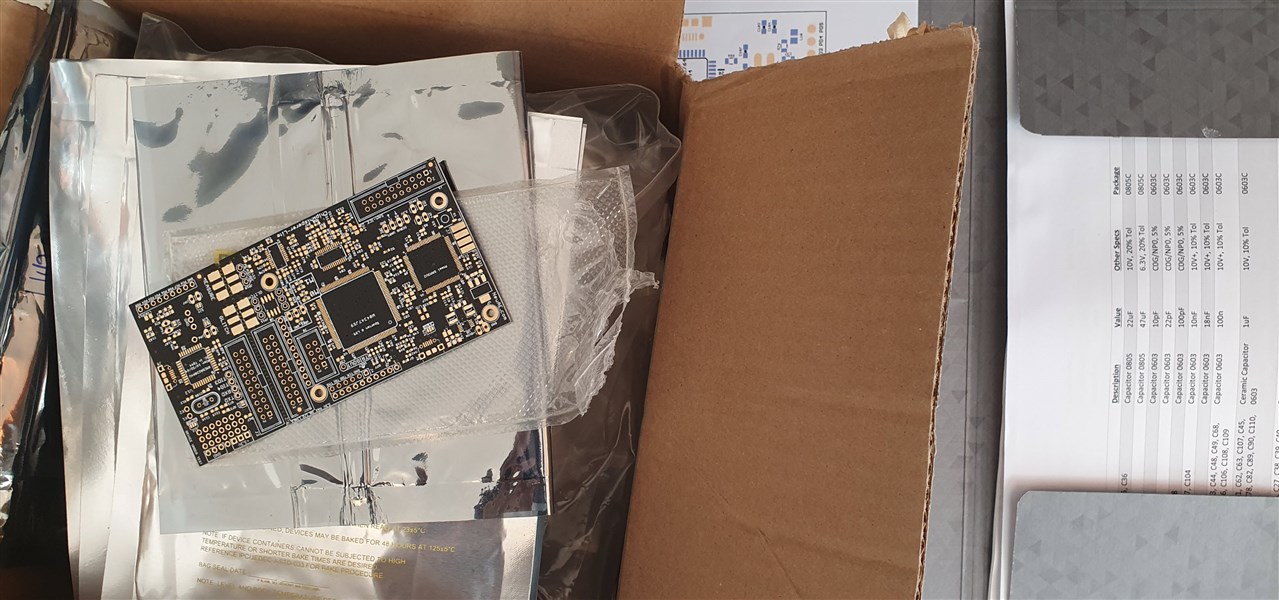
    I still have one final Spartan 6 project to assemble, but thankfully I don't need to download the old IDE for Spartan 6, since the bitfile is already available. It's this project:

    https://rtfm.newae.com/Capture/ChipWhisperer-Lite/

    I bought the PCB and parts for it several years ago, but only this week finally printed out the documentation to start trying to put it together. Not sure I will use it much, I wanted it for some specific tests but the requirement has gone away,  it's a waste if I don't use the parts though so although this project is a low-priority I may as well give it a shot if I get some spare time.

    image

    • Cancel
    • Vote Up +1 Vote Down
    • Sign in to reply
    • Cancel
  • ajmorin369
    ajmorin369 over 3 years ago in reply to shabaz

    If you want I might be able to take it off your hands. I'm just trying to get into doing these types of projects and if you didn't want to waste it and the parts I'd be willing to do the project for you. Just thought I'd say that since I'm new to this whole thing and just want to be apart of the community here. I've got tons of free time available to do things like this so if it's something you'd be willing to do just let me know. Thank you.

    • Cancel
    • Vote Up +1 Vote Down
    • Sign in to reply
    • Cancel
  • shabaz
    shabaz over 3 years ago in reply to ajmorin369

    Hi,

    That's a good idea, however this is not really a starter project, it would just set a beginner up for failure.

    The parts are tiny (0.5 mm pitch) and 0402 parts that are approaching dust size - half a dozen of them will pack in the volume of a normal through-hole in a circuit board.

    One headache is the documentation is several years old, I've not found any blogs where anyone has assembled it and programmed it up from scratch (most people have bought the ready-assembled board it seems.

    For assembly I have the equipment to reflow-solder, but the stencil (used for laying down the solder paste) that came with the circuit board looks really bad (it's not a proper steel stencil, it is plastic/acetate) so that's another hurdle.

    If you're interested in FPGAs probably the smoothest/low cost way is to obtain a Lattice Stick ICE40HX1K-STICK-EVN where you can plug in jumper wires to a breadboard and try out (say) controlling LED displays etc. However that stick is currently zero stock everywhere but worth looking out for in case any appear. I found it fun to use, but FPGA development has a particular learning curve different to software coding.

    Otherwise, if you're more interested in normal software rather than FPGA HDL then the Pi Pico could be a great option, since it's available, low-cost, and allows development in normal languages like Python and C. I like using Python with it a lot. There are lots of projects for it (especially on this site), it is surprisingly useful for all sorts of experiments and problem-solving, and probably a lot of people here (including me) could help if you get stuck on any aspect. If you need any suggestions of starter projects or how to start coding with it, let me know.

    • Cancel
    • Vote Up 0 Vote Down
    • Sign in to reply
    • Cancel
  • ajmorin369
    ajmorin369 over 3 years ago in reply to shabaz

    Thank you for responding. I completely understand what you mean by the size of the components being very, very tiny. So I guess, it's my fault for not giving you enough information. You see, I'm a US Air Force Veteran who's disabled and unable to work but my only income is $300 per month since 2011. I became homeless in 2013 and had gotten into a housing program in 2015. Ever since then I was teaching myself a lot of extra stuff that wasn't taught to me from my days in the Air Force as a Communications-Computer Planning and Implementation Project manager. I've been obsessed with computer language since I was a toddler when my Grandmother had purchased a brand new home computer that was big bulky, beige, and had everything on the monitor in green, and you had to run the computer by using 5 1/4 in. floppy disc....lol... back in the late 80's. Since then in High school I was taught MS-Dos and how to network using it, along with windows. Then I was taught html, of course all of these are now obsolete and were already out the door before I graduated in 2000. I'm not new to the whole thing, but I'm new to this whole community on element 14. In fact, the reason I brought all of this up is because in 2017 I wanted to expand my knowledge and wanted to do more and so I got out my old soldering iron and some supply's I bought on Amazon and then ordered about 6 SMD Soldering practice boards that came with solder, tweezers, the resisters and capacitors that would fill he board, which were 0402, 0603, 0805, 1206, 1812, LL34, SOT23, SO 8, and QFP44. After the first 2 boards I and taught myself how to get the resistors soldered on and when I tested the boards all the numbers were correct, as far as resistance and capacitance goes. After those I decided to get bigger, so I bought a DIY Oscilloscope and put it together and it still works great, for being as small as it is anyways. Then I went and found other cheap and silly SMD Solder Practice boards, an electronic dice one it still works, then an infrared backup sensor which also still works, also a board that is a radio, I've built 2 power supplies but hey are tiny nothing much about them, and by the end I could do it no problem. My latest one is an Adventure Kit from inventr.io that uses a Hero Digital PWM and a space story with online videos to follow a story of being lost in space but I'm not yet done with that one, I only got it because they apparently ordered way too many and were selling them for only $15, so yeah I like that buy and can't wait to finish it. My only BIG hurdle was that I didn't have a hot air station because I felt I could do better at the microprocessor pins using the hot air instead of using the fine tip of a soldering iron, however, just last year I bought myself a cheap one and so far I'm doing good just need more practice. So I guess when I said I was new to this I didn't elaborate enough and now that I'm working on my Degree in Software Engineering, I thought I'd try to do more complex tasks and stuff and just thought I'd ask you about that kit, because there's not harm in asking and the worst you could say is no, and that's that. So I hope that this very long story has helped you understand what I meant and still am fine with you saying no, it's okay, I just thought I should clarify.... ha ha, so you and anyone else knows what I meant. Thanks for sharing your info, I appreciate your help.

    • Cancel
    • Vote Up +1 Vote Down
    • Sign in to reply
    • Cancel
  • shabaz
    shabaz over 3 years ago in reply to ajmorin369

    Hi, 

    That helps loads, it makes it clear that you're definitely comfortable soldering. Since you're doing software engineering, I'm wondering if you'd be interested in working with the Pi. I put together some kits for teaching Python, primarily for kids to copy-paste the code, but the underlying hardware/software has a lot of interest for anyone interested in coding I think. 

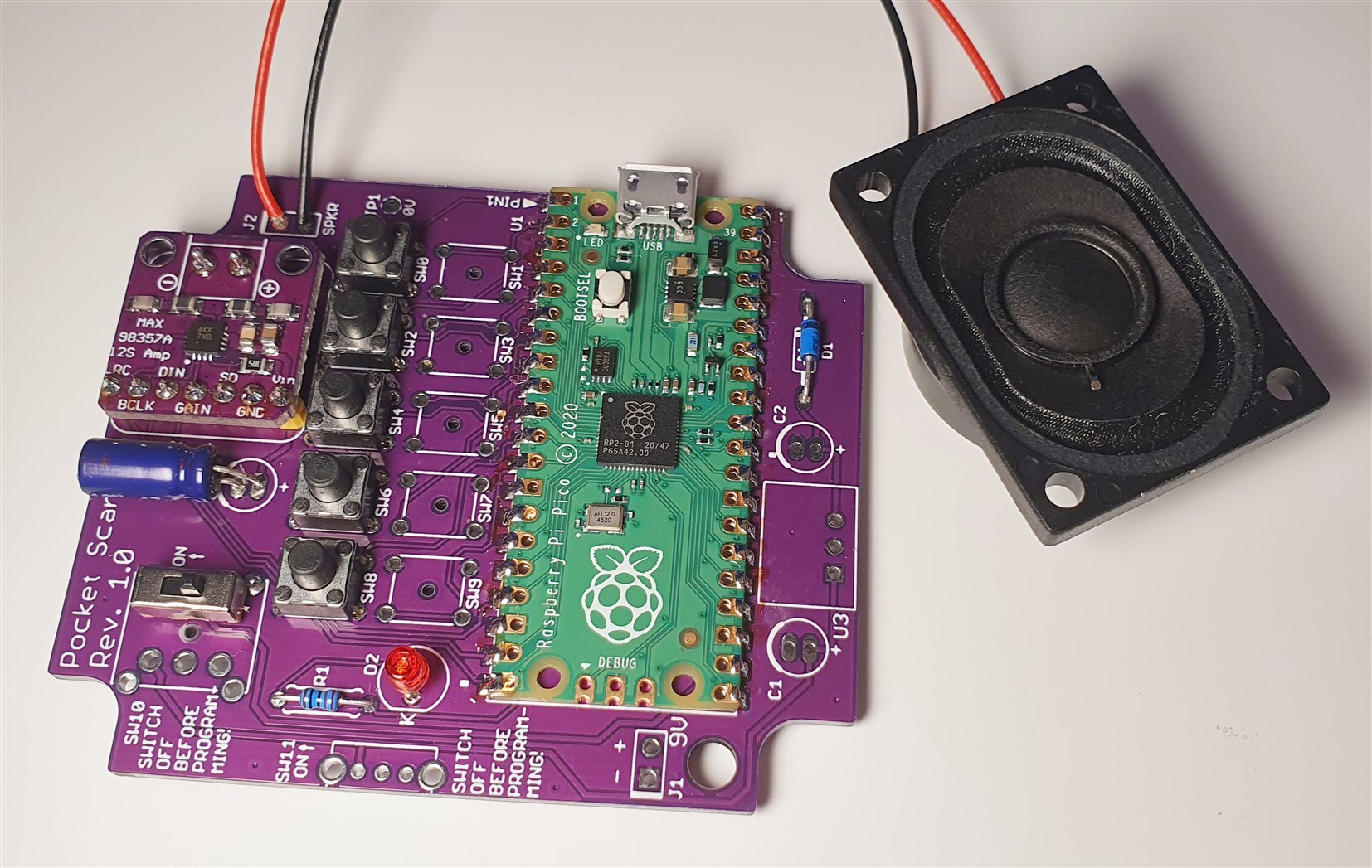
    The project is an MP3 player, for short sound clips. The idea being that kids can upload MP3 snippets from their favourite movies and maybe one day edit the code once they see how easy it is, because they have to edit the code to put the names of their MP3 files in, so that kind of forces them to observe the code file.

    The photo below is the assembled board (there should be some other parts so that a battery can be connected, but they are optional, and they are out of stock so we just assembled the minimal boards and powered via the USB connection, it works fine). 

    The project is detailed here: Pocket Scarface

    If you're interested, I'd be happy to send you a kit to assemble (if you can hover over my username, select 'Request Friendship' and then I'll accept and then click on 'Send Message', send me your address via a private message, then I'll post the kit to you).

    And if you get stuck assembling or uploading the code, then just post a comment on that blog and I or someone will respond, since there's many people familiar with Python. 

    The project used a Pi Pico, and a sound module, and the entire code is a single Python file and can be reused for any purpose where audio prompts could be handy. I was planning to adapt the code one day to convert it to a 'Simon' type game, where it could say things like "One Two Two Five" and the user would have to press those buttons, or alternatively a Speak-n-Math type thing, since there is space for 10 buttons, and code could be written to prompt with a math question for instance. You may have much better ideas for the board, the above were just some initial thoughts.

    image

    • Cancel
    • Vote Up +1 Vote Down
    • Sign in to reply
    • Cancel
  • michaelkellett
    michaelkellett over 3 years ago in reply to ajmorin369

    You really don't need hot air to solder 0.5mm (or even 0,4mm) pitch pins on TQFP packages or pads on QFN packages.

    I try to do new boards with solder paste applied with a stainless stencil and reflowed in commercial reflow machine.

    But when I have to rework a TQFP package I cut the old one off using a scalpel to cut the pins and solder a new one on using what is generally called the "solder drag" method. Having a hollow tipped iron helps but is not essential. To my  mind the key to easy solder dragging is very runny (like water) flux. I use Warburtons Future 315 but there are others. I have a hot air rework stations (fancy IR one and hot air pencil) but I don't use them very often.

    Google "solder drag method" for lots of articles and videos.

    MK

    • Cancel
    • Vote Up +2 Vote Down
    • Sign in to reply
    • Cancel
Reply
  • michaelkellett
    michaelkellett over 3 years ago in reply to ajmorin369

    You really don't need hot air to solder 0.5mm (or even 0,4mm) pitch pins on TQFP packages or pads on QFN packages.

    I try to do new boards with solder paste applied with a stainless stencil and reflowed in commercial reflow machine.

    But when I have to rework a TQFP package I cut the old one off using a scalpel to cut the pins and solder a new one on using what is generally called the "solder drag" method. Having a hollow tipped iron helps but is not essential. To my  mind the key to easy solder dragging is very runny (like water) flux. I use Warburtons Future 315 but there are others. I have a hot air rework stations (fancy IR one and hot air pencil) but I don't use them very often.

    Google "solder drag method" for lots of articles and videos.

    MK

    • Cancel
    • Vote Up +2 Vote Down
    • Sign in to reply
    • Cancel
Children
  • javagoza
    javagoza over 3 years ago in reply to michaelkellett

    Thanks for commenting on your technique, certainly sometimes the simplest things are the last things that come to mind. I had already used that pin cutting technique, but not as a technique but as a desperate method after trying other methods, I felt like cheating. But thinking about it now, if the component is already damaged that technique is definitely the simplest if you don't have the right equipment.

    • Cancel
    • Vote Up 0 Vote Down
    • Sign in to reply
    • Cancel
  • michaelkellett
    michaelkellett over 3 years ago in reply to javagoza

    It also has the advantage of not heating up other parts. A lot of the the boards I work on have thermally delicate plastic optical reflectors on them close to other parts so using a hot air tool is very risky.

    The scalpel technique avoids un-necessary heat.

    MK

    • Cancel
    • Vote Up 0 Vote Down
    • Sign in to reply
    • Cancel
element14 Community

element14 is the first online community specifically for engineers. Connect with your peers and get expert answers to your questions.

  • Members
  • Learn
  • Technologies
  • Challenges & Projects
  • Products
  • Store
  • About Us
  • Feedback & Support
  • FAQs
  • Terms of Use
  • Privacy Policy
  • Legal and Copyright Notices
  • Sitemap
  • Cookies

An Avnet Company © 2025 Premier Farnell Limited. All Rights Reserved.

Premier Farnell Ltd, registered in England and Wales (no 00876412), registered office: Farnell House, Forge Lane, Leeds LS12 2NE.

ICP 备案号 10220084.

Follow element14

  • X
  • Facebook
  • linkedin
  • YouTube