element14 Community
element14 Community
    Register Log In
  • Site
  • Search
  • Log In Register
  • Community Hub
    Community Hub
    • What's New on element14
    • Feedback and Support
    • Benefits of Membership
    • Personal Blogs
    • Members Area
    • Achievement Levels
  • Learn
    Learn
    • Ask an Expert
    • eBooks
    • element14 presents
    • Learning Center
    • Tech Spotlight
    • STEM Academy
    • Webinars, Training and Events
    • Learning Groups
  • Technologies
    Technologies
    • 3D Printing
    • FPGA
    • Industrial Automation
    • Internet of Things
    • Power & Energy
    • Sensors
    • Technology Groups
  • Challenges & Projects
    Challenges & Projects
    • Design Challenges
    • element14 presents Projects
    • Project14
    • Arduino Projects
    • Raspberry Pi Projects
    • Project Groups
  • Products
    Products
    • Arduino
    • Avnet & Tria Boards Community
    • Dev Tools
    • Manufacturers
    • Multicomp Pro
    • Product Groups
    • Raspberry Pi
    • RoadTests & Reviews
  • About Us
  • Store
    Store
    • Visit Your Store
    • Choose another store...
      • Europe
      •  Austria (German)
      •  Belgium (Dutch, French)
      •  Bulgaria (Bulgarian)
      •  Czech Republic (Czech)
      •  Denmark (Danish)
      •  Estonia (Estonian)
      •  Finland (Finnish)
      •  France (French)
      •  Germany (German)
      •  Hungary (Hungarian)
      •  Ireland
      •  Israel
      •  Italy (Italian)
      •  Latvia (Latvian)
      •  
      •  Lithuania (Lithuanian)
      •  Netherlands (Dutch)
      •  Norway (Norwegian)
      •  Poland (Polish)
      •  Portugal (Portuguese)
      •  Romania (Romanian)
      •  Russia (Russian)
      •  Slovakia (Slovak)
      •  Slovenia (Slovenian)
      •  Spain (Spanish)
      •  Sweden (Swedish)
      •  Switzerland(German, French)
      •  Turkey (Turkish)
      •  United Kingdom
      • Asia Pacific
      •  Australia
      •  China
      •  Hong Kong
      •  India
      • Japan
      •  Korea (Korean)
      •  Malaysia
      •  New Zealand
      •  Philippines
      •  Singapore
      •  Taiwan
      •  Thailand (Thai)
      • Vietnam
      • Americas
      •  Brazil (Portuguese)
      •  Canada
      •  Mexico (Spanish)
      •  United States
      Can't find the country/region you're looking for? Visit our export site or find a local distributor.
  • Translate
  • Profile
  • Settings
FPGA
  • Technologies
  • More
FPGA
Forum In Preparation for the AVNET MiniZed (Xilinx Zynq XC7Z007S SoC) RoadTest. What Do You Need?
  • Blog
  • Forum
  • Documents
  • Quiz
  • Events
  • Polls
  • Files
  • Members
  • Mentions
  • Sub-Groups
  • Tags
  • More
  • Cancel
  • New
Join FPGA to participate - click to join for free!
Actions
  • Share
  • More
  • Cancel
Forum Thread Details
  • Replies 37 replies
  • Subscribers 563 subscribers
  • Views 5074 views
  • Users 0 members are here
  • scasny
  • avnet
  • xilinx
  • avnet_rt
  • fpga
  • xilinx zynq soc
Related

In Preparation for the AVNET MiniZed (Xilinx Zynq XC7Z007S SoC) RoadTest. What Do You Need?

rscasny
rscasny over 8 years ago

We will be roadtesting the AVNET MiniZed FPGA SoC development board in September. I find this to be an exicting prospect and can't wait to let it loose on the element14 community.


In brief, the MiniZedTm is a single-core Zynq 7Z007S development board. This board targets entry-level Zynq developers with a low-cost prototyping platform.image
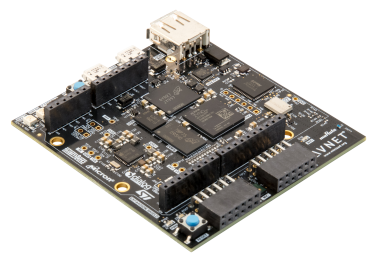
 

The Minized's compact design features on-board connectivity through USB, Wi-Fi and Bluetooth. Peripherals can be plugged into dual Pmod-compatible connectors, the Arduino-compatible shield interface or the USB 2.0 host interface. JTAG circuitry is incorporated onto the MiniZed base board, so with a single micro-USB cable to your laptop you are already up and running. User LED’s, a button and a switch allow for a physical board interface.


Micron memory solutions are presented for QSPI flash, DDR3L memory and on-board eMMC instead of an external SD card. The Murata Type 1DX wireless solution incorporates 802.11b/g /n Wi-Fi as well as Bluetooth 4.1, which provides both Bluetooth Classic and Low Energy (BLE). The integrated power supply from Dialog generates all on-board voltages, while an auxiliary supply input can be used to power designs that require additional current. From ST Micro there is an on-board motion and temperature sensor, as well as a digital microphone.


MiniZed provides for an efficient hardware reference design, while it is also an inexpensive board that can be used to run workshops and tutorials. The board aims to showcase the power of Zynq, where the Cortex A9 processor core integrates seamlessly with the programmable fabric to provide signal processing and control solutions. The on-board digital microphone serves as an input for a variety of illustrations of how to implement FIR filters, FFT’s and direct memory access.


Feel free to download the attached pdf to learn more about the Minized.


In preparation of roadtesting the Minized, what do you feel you need?


  • Technical Information?
  • Tutorials?
  • Example Projects?
  • Other?


Please leave your comments below. I will try to get any additional information and post it to both the RoadTest and the FPGA groups.


Sincerely,


Randall Scasny

RoadTest Program Manager

Attachments:
image5239-PB-XC7Z007S-1CLG225C-V11a.pdf
  • Sign in to reply
  • Cancel

Top Replies

  • michaelkellett
    michaelkellett over 8 years ago in reply to johnbeetem +5
    I'd like to echo John's comment that this board is not really suitable for initial learning about FPGAs - the Zynq chips are very, very difficult to get to grips with. There is all the difficulty of the…
  • balearicdynamics
    balearicdynamics over 8 years ago in reply to michaelkellett +5
    Michael, considering your opinion trustable - as I do - as it is also following logic and a minimal knowledge of the FPGA world, why do they assume that this is (one of) the best solution for projects…
  • Jan Cumps
    Jan Cumps over 8 years ago in reply to balearicdynamics +5
    Enrico Miglino wrote: ... why do they assume that this is (one of) the best solution for projects oriented to hobbyists and makers? ... Enrico, I don't see this claim being made. The description says it…
Parents
  • johnbeetem
    johnbeetem over 8 years ago

    I see the tradeoffs of MiniZed versus a simple FPGA board to be similar to Raspberry Pi versus a simple microcontroller board like Arduino or ST Discovery.  In terms of raw power for the price, MiniZed and RasPi (especially including VideoCore IV) are clearly superior.  However, it requires a great deal of knowledge to use that power effectively.  Most people use RasPi as a tiny mainframe, running a mainframe operating system like GNU/Linux.  This means that accessing I/O devices is difficult: just giving yourself permission to access memory-mapped devices is a challenge for the new user.  I can only imagine the amount of code required to initialize RasPi, and I've never tried to write and download my own VideoCore IV software.  So you have a great deal of computing power, but actually using it is a steep learning curve.


    In contrast, with a microcontroller like an STM32 or Cypress PSoC 4 it's really easy.  The GPIO is fully documented and you just read and write memory locations documented in the data sheet and tech ref manual.  You can blink an LED with zero lines of code if you come in through the well-documented "single wire" debug (SWD) port.  For the most part, it's simple and clean and like playing with a PDP-11 minicomputer.


    Similarly, it's really easy to understand a simple FPGA like a Lattice iCE40.  It's a toy compared to a Zynq, but for learning FPGA principles it's a very educational toy.  With an Xilinx FPGA newer than a Spartan-3A, you face a steep learning curve where even simple things are complex and you have multiple tech ref manuals to cover clocking, block memory, I/O pins, etc.  Zynq, Spartan-6, and newer FPGAs are very powerful and have attractive prices for their capabilities.  But they can be pretty daunting for a new user.  Like RasPi, you can ignore the underlying complexity and work at a high level.  But then you're not really learning what's going on.


    JMO/YMMV

    • Cancel
    • Vote Up +2 Vote Down
    • Sign in to reply
    • Cancel
Reply
  • johnbeetem
    johnbeetem over 8 years ago

    I see the tradeoffs of MiniZed versus a simple FPGA board to be similar to Raspberry Pi versus a simple microcontroller board like Arduino or ST Discovery.  In terms of raw power for the price, MiniZed and RasPi (especially including VideoCore IV) are clearly superior.  However, it requires a great deal of knowledge to use that power effectively.  Most people use RasPi as a tiny mainframe, running a mainframe operating system like GNU/Linux.  This means that accessing I/O devices is difficult: just giving yourself permission to access memory-mapped devices is a challenge for the new user.  I can only imagine the amount of code required to initialize RasPi, and I've never tried to write and download my own VideoCore IV software.  So you have a great deal of computing power, but actually using it is a steep learning curve.


    In contrast, with a microcontroller like an STM32 or Cypress PSoC 4 it's really easy.  The GPIO is fully documented and you just read and write memory locations documented in the data sheet and tech ref manual.  You can blink an LED with zero lines of code if you come in through the well-documented "single wire" debug (SWD) port.  For the most part, it's simple and clean and like playing with a PDP-11 minicomputer.


    Similarly, it's really easy to understand a simple FPGA like a Lattice iCE40.  It's a toy compared to a Zynq, but for learning FPGA principles it's a very educational toy.  With an Xilinx FPGA newer than a Spartan-3A, you face a steep learning curve where even simple things are complex and you have multiple tech ref manuals to cover clocking, block memory, I/O pins, etc.  Zynq, Spartan-6, and newer FPGAs are very powerful and have attractive prices for their capabilities.  But they can be pretty daunting for a new user.  Like RasPi, you can ignore the underlying complexity and work at a high level.  But then you're not really learning what's going on.


    JMO/YMMV

    • Cancel
    • Vote Up +2 Vote Down
    • Sign in to reply
    • Cancel
Children
  • balearicdynamics
    balearicdynamics over 8 years ago in reply to johnbeetem

    John,


    I don't know the STM32 but I can say about the PSoC4 that it's not so easy. I am thinking to a maker, someone used to make projects on Arduino boards or similar and I imagine that approaching a project on a PSoC model by Cypress can found it extremely difficult. This is the reason that despite the rumors when Cypress launched the PSoC ecosystem supposed to be the "Arduino killer" this never occurred. I think for this reason.

    Take in account that I am not an expert of FPGA but I am almost sure that if a system offers wider options I tend to prefer it as expecting more flexibility.


    It is true that in most of the cases (and projects) also the Raspberry Pi is used with just its basically features; but occurs also with the Arduino - just to mention to most famous micro controller. It is a sort of false positive; reality is that you can find a lot of preset projects easy to adapt with few changes, something totally different than proficiently using a micro controller IMHO. For example robotics: you can make a relatively complex robot based on Arduino but not because things are easy; the reason is that you find all the libraries you need for download, the designs for 3D printing the parts if needed, the ready-to-use Arduino shields and more. I bet that the number of Arduino makers or "inventors" able to make their own C library or create some new are under the 10-20% of the makers you can find.

    The same happens with Raspberry Pi. With a positive difference: this embedded linux board has more flexibility and more options to evolve and has a good support to be used in the educational world.


    Enrico

    • Cancel
    • Vote Up +2 Vote Down
    • Sign in to reply
    • Cancel
  • Jan Cumps
    Jan Cumps over 8 years ago in reply to balearicdynamics

    Enrico, maybe this is because many makers know software programming well but aren't strong on electronics principles.

    For the PSoC, the real power comes when you understand comparators, opamps and the likes.

    For FPGA and also to get the maximum out of the PSoC, digital electronics is a required skill.

    I think that these skills are less common with makers than programming skills.


    (I also think that with little programming knowledge, google and a debugger, most people can make something that works on a cpu without external help - not so with an fpga)

    • Cancel
    • Vote Up +3 Vote Down
    • Sign in to reply
    • Cancel
  • balearicdynamics
    balearicdynamics over 8 years ago in reply to Jan Cumps

    Perfectly agree. The limit (if we can say it is a limit) of FPGA is that also "something that do something" is not obvious with FPGA


    Enrico

    • Cancel
    • Vote Up +2 Vote Down
    • Sign in to reply
    • Cancel
element14 Community

element14 is the first online community specifically for engineers. Connect with your peers and get expert answers to your questions.

  • Members
  • Learn
  • Technologies
  • Challenges & Projects
  • Products
  • Store
  • About Us
  • Feedback & Support
  • FAQs
  • Terms of Use
  • Privacy Policy
  • Legal and Copyright Notices
  • Sitemap
  • Cookies

An Avnet Company © 2026 Premier Farnell Limited. All Rights Reserved.

Premier Farnell Ltd, registered in England and Wales (no 00876412), registered office: Farnell House, Forge Lane, Leeds LS12 2NE.

ICP 备案号 10220084.

Follow element14

  • X
  • Facebook
  • linkedin
  • YouTube