


I just found out about the Nandland Go Board on KickStarter. It’s a nice little FPGA board that looks very well suited to learning about FPGAs since it includes the I/O devices you need for basic FPGA projects.
The Go Board uses the Lattice iCE40 HX1K FPGA, the same one as the Lattice iCEstick. While the HX1K is a rather small FPGA, iCE40 is the only available FPGA I know of that supports open-source FPGA design tools, specifically IceStorm and its partner tools arachne-pnr and yosys. iCE40 is also a very simple architecture, which is nice for people just getting started with FPGAs. Nandland wants to make it fun to learn about FPGAs and play with them -- iCE40 is a good way to avoid the complexity of more advanced FPGAs like Xilinx Spartan-6.
The big strength of the Go Board is its built-in I/O devices:
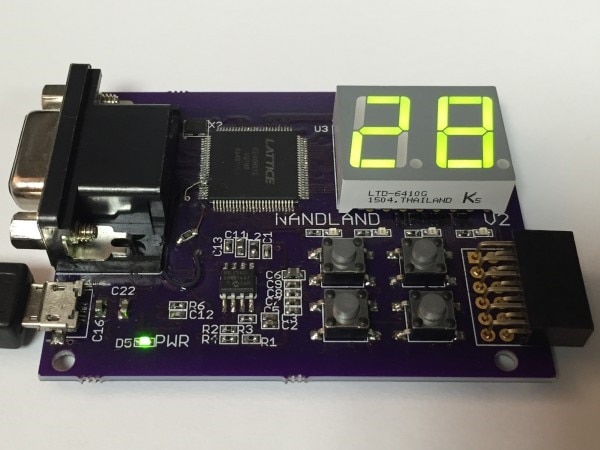
- Four user-programmable LEDs.
- Four push-button switches for user input.
- Dual 7-Segment LED display.
- VGA connector for video output.
- Digilent Pmod
 connector for external I/O.
 - 25 MHz oscillator.
- 1 Mb Flash for booting the FPGA.
- FTDI FT2232H serial USB chip for FPGA programming and UART communication to projects.
All you need to program a Go Board from a PC is a Micro USB cable. The FT2232H is also used on the Lattice iCEstick, Papilio DUO, and other FPGA boards. It has both GNU/Linux and Windows support, and the IceStorm programming tool knows how to talk to it so IceStorm should be able to work with the Go Board.
The Kickstarter video that demonstrates the board is quite impressive, with some nice LED, VGA, and UART communications examples. It even has a Pong game  The Nandland web site has some nice-looking tutorials as well, both VHDL and Verilog.
[I don’t have any relationship with Nandland, except as a backer. As with all Kickstarters, there’s some risk. However, the Go Board prototype works and the PC board isn’t pushing the state of the art. February 2016 delivery is probably optimistic what with the holidays and all.]


