element14 Community
element14 Community
    Register Log In
  • Site
  • Search
  • Log In Register
  • Community Hub
    Community Hub
    • What's New on element14
    • Feedback and Support
    • Benefits of Membership
    • Personal Blogs
    • Members Area
    • Achievement Levels
  • Learn
    Learn
    • Ask an Expert
    • eBooks
    • element14 presents
    • Learning Center
    • Tech Spotlight
    • STEM Academy
    • Webinars, Training and Events
    • Learning Groups
  • Technologies
    Technologies
    • 3D Printing
    • FPGA
    • Industrial Automation
    • Internet of Things
    • Power & Energy
    • Sensors
    • Technology Groups
  • Challenges & Projects
    Challenges & Projects
    • Design Challenges
    • element14 presents Projects
    • Project14
    • Arduino Projects
    • Raspberry Pi Projects
    • Project Groups
  • Products
    Products
    • Arduino
    • Avnet & Tria Boards Community
    • Dev Tools
    • Manufacturers
    • Multicomp Pro
    • Product Groups
    • Raspberry Pi
    • RoadTests & Reviews
  • About Us
    About the element14 Community
  • Store
    Store
    • Visit Your Store
    • Choose another store...
      • Europe
      •  Austria (German)
      •  Belgium (Dutch, French)
      •  Bulgaria (Bulgarian)
      •  Czech Republic (Czech)
      •  Denmark (Danish)
      •  Estonia (Estonian)
      •  Finland (Finnish)
      •  France (French)
      •  Germany (German)
      •  Hungary (Hungarian)
      •  Ireland
      •  Israel
      •  Italy (Italian)
      •  Latvia (Latvian)
      •  
      •  Lithuania (Lithuanian)
      •  Netherlands (Dutch)
      •  Norway (Norwegian)
      •  Poland (Polish)
      •  Portugal (Portuguese)
      •  Romania (Romanian)
      •  Russia (Russian)
      •  Slovakia (Slovak)
      •  Slovenia (Slovenian)
      •  Spain (Spanish)
      •  Sweden (Swedish)
      •  Switzerland(German, French)
      •  Turkey (Turkish)
      •  United Kingdom
      • Asia Pacific
      •  Australia
      •  China
      •  Hong Kong
      •  India
      •  Japan
      •  Korea (Korean)
      •  Malaysia
      •  New Zealand
      •  Philippines
      •  Singapore
      •  Taiwan
      •  Thailand (Thai)
      •  Vietnam
      • Americas
      •  Brazil (Portuguese)
      •  Canada
      •  Mexico (Spanish)
      •  United States
      Can't find the country/region you're looking for? Visit our export site or find a local distributor.
  • Translate
  • Profile
  • Settings
Internet of Things
  • Technologies
  • More
Internet of Things
Forum RE: Power Connection problem
  • Blog
  • Forum
  • Documents
  • Quiz
  • Events
  • Polls
  • Members
  • Mentions
  • Sub-Groups
  • Tags
  • More
  • Cancel
  • New
Join Internet of Things to participate - click to join for free!
Actions
  • Share
  • More
  • Cancel
Forum Thread Details
  • Replies 10 replies
  • Subscribers 520 subscribers
  • Views 239 views
  • Users 0 members are here
  • pico
  • raspberry_pi_3
Related

RE: Power Connection problem

GeoForeman
GeoForeman 7 days ago

Hi Everyone, I have a project  that needs to connect rp2040, rapsberry pi pico 0 to modules : HW‑357, 3.7v 4000mA battery, usb for charging, now for other sensors

Ky-008 ,HC-SR501 , NEO-M8, 3V-5V DC vibration motors ,microSD card breakout board / microSD card Adapter, please include the breadboard..

  • Sign in to reply
  • Cancel

Top Replies

  • michaelkellett
    michaelkellett 6 days ago in reply to dang74 +4
    If you must have 3.3V you will have a hard choice. To get the most out of a nominal 3.7V Lithium Ion battery you would like to run it down to 3V or even 2.7V. Fully charged it will deliver 4V. For…
  • dougw
    dougw 7 days ago +1
    The battery could have a max voltage higher than its nominal 3.7V , maybe as high as 4.2 V. Pico has a regulator that outputs 3.3V and expects interface signals to be 3.3V compatible. Do you have a specific…
  • dougw
    dougw 6 days ago in reply to dang74 +1
    Systems that require multiple supply voltages are very common and it is much simpler now to use efficient switching converters to meet these requirements than it used to be. It is very common to generate…
  • robogary
    robogary 7 days ago

    Recommend you first draw or sketch a schematic and check each component for 3.7v capability. You may need to include 5v circuits as well as 3v circuits. 

    I usually build my own breadboard using convenient connectors for power distribution , usually pcb to screw terminals. Ill include screw terminals for an external fuse and on/off switch. 

    • Cancel
    • Vote Up 0 Vote Down
    • Sign in to reply
    • Cancel
  • dougw
    dougw 7 days ago

    The battery could have a max voltage higher than its nominal 3.7V , maybe as high as 4.2 V. Pico has a regulator that outputs 3.3V and expects interface signals to be 3.3V compatible. Do you have a specific question about the peripherals you mentioned? Are you looking for a schematic?

    • Cancel
    • Vote Up +1 Vote Down
    • Sign in to reply
    • Cancel
  • dang74
    dang74 7 days ago in reply to dougw

    In the future I was considering starting a project that will use a chargeable battery.  I was thinking of having a SEPIC converter between the battery and my downstream 3.3V devices.  The thought process being that it could handle the higher than expected voltages like the 4.2V that you cite and also keep ticking as the battery voltage gets depleted.  Do you know if this is a common approach?

    • Cancel
    • Vote Up 0 Vote Down
    • Sign in to reply
    • Cancel
  • dougw
    dougw 6 days ago in reply to dang74

    Systems that require multiple supply voltages are very common and it is much simpler now to use efficient switching converters to meet these requirements than it used to be. It is very common to generate high voltages with step-up converters. 

    • Cancel
    • Vote Up +1 Vote Down
    • Sign in to reply
    • Cancel
  • michaelkellett
    michaelkellett 6 days ago in reply to dang74

    If you must have 3.3V you will have a hard choice. To get the most out of a nominal 3.7V Lithium Ion battery you would like to run it down to 3V or even 2.7V. 

    Fully charged it will deliver 4V. 

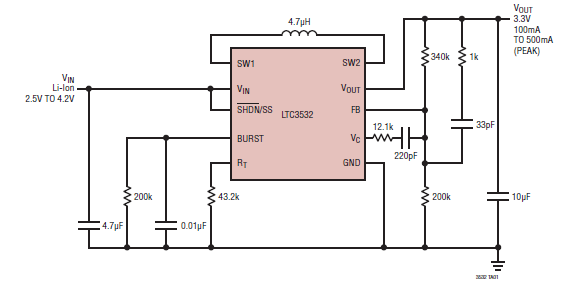
    For low power stuff you could use an LTC3532 regulator which will do the business:

    image

    I think this is a quite common approach - and there will be other (and cheaper) chips than the LTC3532  but I've used it and know it works. It is also supported by a good model in LTSpice.

    The max input voltage for the chip is only 5.5V so don't forget to have some kind of transient clamp on the input.

    MK

    • Cancel
    • Vote Up +4 Vote Down
    • Sign in to reply
    • Cancel
  • dang74
    dang74 6 days ago in reply to michaelkellett

    Thanks michaelkellett this is what I want to achieve.

    • Cancel
    • Vote Up 0 Vote Down
    • Sign in to reply
    • Cancel
  • dang74
    dang74 6 days ago in reply to dougw

    Thanks dougw 

    • Cancel
    • Vote Up 0 Vote Down
    • Sign in to reply
    • Cancel
  • GeoForeman
    GeoForeman 6 days ago in reply to robogary

    Thanks I will draw it.

    • Cancel
    • Vote Up 0 Vote Down
    • Sign in to reply
    • Cancel
  • GeoForeman
    GeoForeman 6 days ago in reply to dougw

    Hi, Sorry for being a noob. I want to start with the charging unit, I am using FP6277 as charger / booster, I want to connect the 3.7v 4000mA battery to the FP6277 and raspberry pi pico 0 : RP2040, in such a way that it it can charge the battery while connected to usb port and run and boost the voltage as necessary even without connected to USB. It would be helpful if you can send me a schematics so that I would have an idea. I need to see the connection how it is connected also to pico ports. Thanks.

    • Cancel
    • Vote Up 0 Vote Down
    • Sign in to reply
    • Cancel
  • michaelkellett
    michaelkellett 6 days ago in reply to GeoForeman

    The FP6277 is a boost converter - not a battery charger.

    You don't need a booster to charge a Lithium Ion battery from USB - just a charger control chip.

    https://www.adafruit.com/product/259

    https://www.amazon.co.uk/Lithium-Battery-Charging-Protection-Functions/dp/B08DQXPNR1/ref=asc_df_B08DQXPNR1

    You could then connect the Pico directly to the battery.

    https://randomnerdtutorials.com/power-raspberry-pi-pico-6-different-ways/#batteries

    I haven't tried or tested any of the above.

    I suggest that you do a good bit more web research before spending money.

    MK

    • Cancel
    • Vote Up 0 Vote Down
    • Sign in to reply
    • Cancel
element14 Community

element14 is the first online community specifically for engineers. Connect with your peers and get expert answers to your questions.

  • Members
  • Learn
  • Technologies
  • Challenges & Projects
  • Products
  • Store
  • About Us
  • Feedback & Support
  • FAQs
  • Terms of Use
  • Privacy Policy
  • Legal and Copyright Notices
  • Sitemap
  • Cookies

An Avnet Company © 2026 Premier Farnell Limited. All Rights Reserved.

Premier Farnell Ltd, registered in England and Wales (no 00876412), registered office: Farnell House, Forge Lane, Leeds LS12 2NE.

Follow element14

  • X
  • Facebook
  • linkedin
  • YouTube