


UpCycle IT – R2I INDEX:
|
Blog #2 – Designing:
Robert Peter Oakes & mcb1 (Peter & Mark) have been providing some interesting dialogue with my first introduction post and so I thought with this blog I would better layout the physical space I am working with and possibly tweak it a little to allow for more testing per suggestions.
Thank you to both of them!
This type of interaction is something I really appreciate and I think is a big bonus to working the weekly blogs.

The basic minifridge. Flipped upside down due consideration for allowing for changes in testing.
Rough external measurements are 17.5 inches tall x 18.5 inches wide x 15 5/8 inches deep.
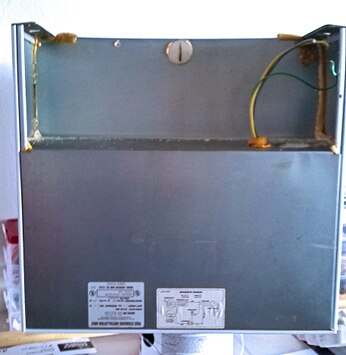
The rear of the minifridge. One of the things I like about having if flipped upside down is this creates a shelf area for me to place items I want to keep outside of the heat and humidity that will be inside the R2I.
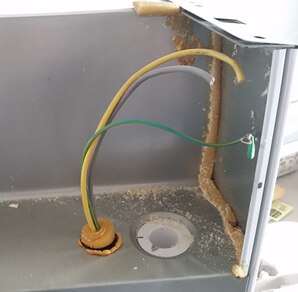
Zoom in on the shelf, right hand side. We have the internally ran 3 wires as well as a small hole that goes inside the R2I that I can use to run additional wires through.

Here is the inside showing the hole coming down into the R2I as well as those 3 wires over on the bottom right.
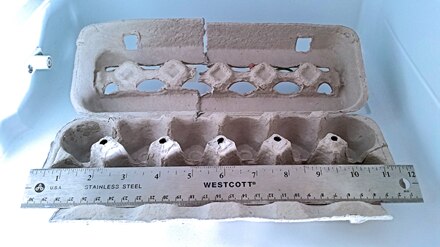

Here is a basic 12 egg, egg carton with ruler to show sizing. Using this I believe I can easily accommodate 4 rows of 6 eggs for a total of 24 eggs. Based on chicken eggs.
Future modifications will be made to allow for swapping out for smaller eggs such as quail or larger such as duck. Although some of our chicken eggs are as large as duck eggs!
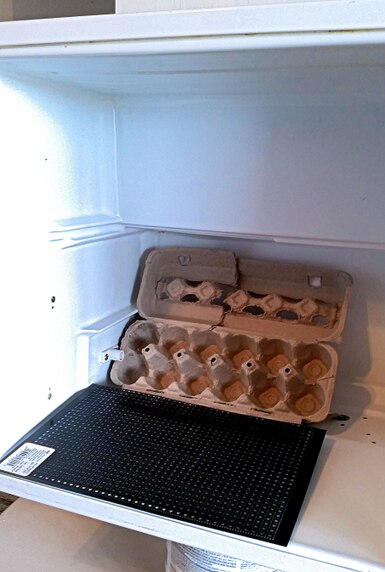
My first idea is to take some aluminum I have been working with and mark out the 24 eggs. Then clipping in an X for each egg, bend the cut pieces down to allow for the eggs to be inserted into the framing.
A central support rod will be ran across the top from left to right that the egg frame will be attached to.
If you look really closely on the left hand side you will see a mark up on the top 3rd of the wall. That is where I am looking to run the support rod to allow for the eggs to be rotated.
If you notice, the aluminum leaves spacing on the right hand side of the R2I. Originally I was going to run the framing across the entire area allowing for more eggs. But with discussion about testing a lightbulb I have decided to keep a space open there for the light bulb to be placed. A fan will circulate the air above the light bulb.
This has the added benefit to hopefully avoid goo/debris from dropping onto the heat source as the eggs hatch.
There is plenty of space on the bottom to allow for a water dish for humidity control or other items I may want to include but keep clear of goo/debris.
With the shelf outside on the back and access hole inside I am seriously considering keeping as much of the electronic controls outside the R2I as possible.
This will also give me some flexibility in regards to adding some type of display on top of the outside. I like the idea of an external display with the temperature and humidity being shown as well as a timer to track everything.
Once the actual kit arrives I will start lining things up on the actual feasibility of where it can all go and what might be needed to be moved.
Please keep providing suggestions/comments and I will try to adapt where I can and it seems to help the project. I enjoyed shabaz idea for overloading an RPI as a heat source but at this point am trying to stay with something that would be an easy to duplicate and use project. Hence the desire to test out the light bulb heat source and be able to modify to heat tape/ceramic easily.
Top Comments
-

mcb1
-
Cancel
-
Vote Up
+1
Vote Down
-
-
Sign in to reply
-
More
-
Cancel
-

Robert Peter Oakes
in reply to mcb1
-
Cancel
-
Vote Up
+2
Vote Down
-
-
Sign in to reply
-
More
-
Cancel
Comment-

Robert Peter Oakes
in reply to mcb1
-
Cancel
-
Vote Up
+2
Vote Down
-
-
Sign in to reply
-
More
-
Cancel
Children