element14 Community
element14 Community
    Register Log In
  • Site
  • Search
  • Log In Register
  • Community Hub
    Community Hub
    • What's New on element14
    • Feedback and Support
    • Benefits of Membership
    • Personal Blogs
    • Members Area
    • Achievement Levels
  • Learn
    Learn
    • Ask an Expert
    • eBooks
    • element14 presents
    • Learning Center
    • Tech Spotlight
    • STEM Academy
    • Webinars, Training and Events
    • Learning Groups
  • Technologies
    Technologies
    • 3D Printing
    • FPGA
    • Industrial Automation
    • Internet of Things
    • Power & Energy
    • Sensors
    • Technology Groups
  • Challenges & Projects
    Challenges & Projects
    • Design Challenges
    • element14 presents Projects
    • Project14
    • Arduino Projects
    • Raspberry Pi Projects
    • Project Groups
  • Products
    Products
    • Arduino
    • Avnet & Tria Boards Community
    • Dev Tools
    • Manufacturers
    • Multicomp Pro
    • Product Groups
    • Raspberry Pi
    • RoadTests & Reviews
  • About Us
    About the element14 Community
  • Store
    Store
    • Visit Your Store
    • Choose another store...
      • Europe
      •  Austria (German)
      •  Belgium (Dutch, French)
      •  Bulgaria (Bulgarian)
      •  Czech Republic (Czech)
      •  Denmark (Danish)
      •  Estonia (Estonian)
      •  Finland (Finnish)
      •  France (French)
      •  Germany (German)
      •  Hungary (Hungarian)
      •  Ireland
      •  Israel
      •  Italy (Italian)
      •  Latvia (Latvian)
      •  
      •  Lithuania (Lithuanian)
      •  Netherlands (Dutch)
      •  Norway (Norwegian)
      •  Poland (Polish)
      •  Portugal (Portuguese)
      •  Romania (Romanian)
      •  Russia (Russian)
      •  Slovakia (Slovak)
      •  Slovenia (Slovenian)
      •  Spain (Spanish)
      •  Sweden (Swedish)
      •  Switzerland(German, French)
      •  Turkey (Turkish)
      •  United Kingdom
      • Asia Pacific
      •  Australia
      •  China
      •  Hong Kong
      •  India
      •  Japan
      •  Korea (Korean)
      •  Malaysia
      •  New Zealand
      •  Philippines
      •  Singapore
      •  Taiwan
      •  Thailand (Thai)
      •  Vietnam
      • Americas
      •  Brazil (Portuguese)
      •  Canada
      •  Mexico (Spanish)
      •  United States
      Can't find the country/region you're looking for? Visit our export site or find a local distributor.
  • Translate
  • Profile
  • Settings
Experts, Learning and Guidance
  • Technologies
  • More
Experts, Learning and Guidance
Ask an Expert Forum Why is the Schottky diode being used in control circuit?
  • Blog
  • Forum
  • Documents
  • Leaderboard
  • Files
  • Members
  • Mentions
  • Sub-Groups
  • Tags
  • More
  • Cancel
  • New
Join Experts, Learning and Guidance to participate - click to join for free!
Actions
  • Share
  • More
  • Cancel
Forum Thread Details
  • Replies 26 replies
  • Subscribers 313 subscribers
  • Views 656 views
  • Users 0 members are here
Related
See a helpful answer?

Be sure to click 'more' and select 'suggest as answer'!

If you're the thread creator, be sure to click 'more' then 'Verify as Answer'!

Why is the Schottky diode being used in control circuit?

Humaninsane
Humaninsane 6 days ago

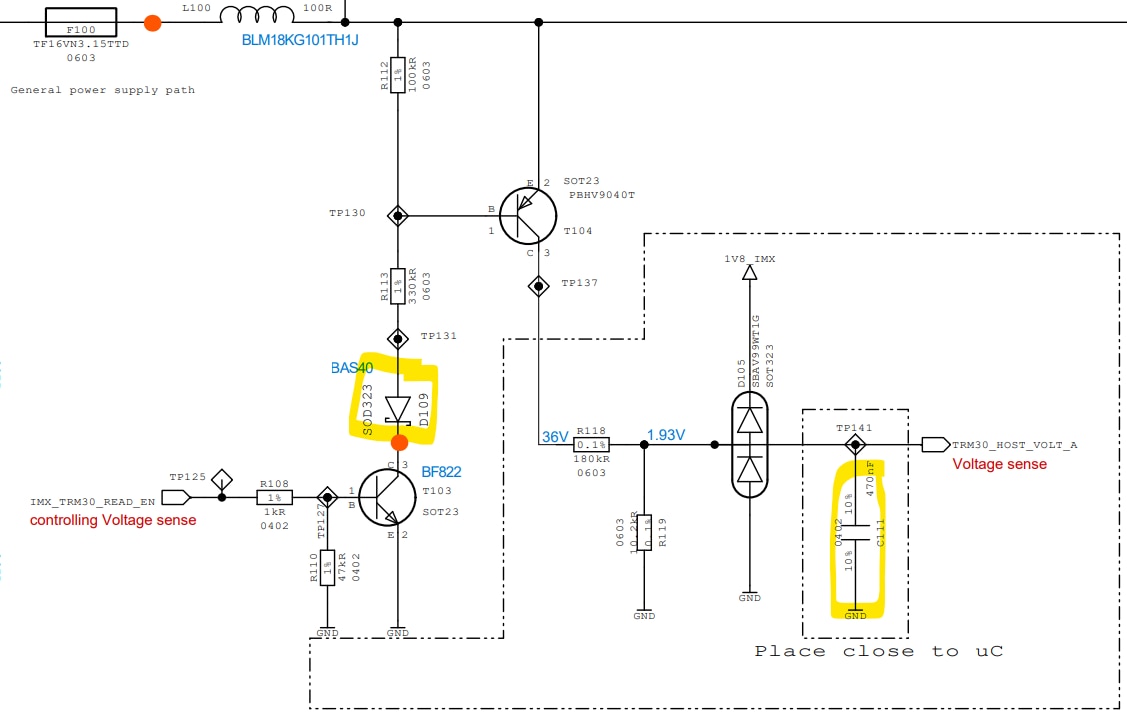
imageWhy is the Schottky diode being used in control circuit? and why is the 470nF cap is added at that voltage divider output? how is the Cap value 470nF calculated?

  • Sign in to reply
  • Cancel

Top Replies

  • michaelkellett
    michaelkellett 6 days ago in reply to Humaninsane +2
    I think I can see what the ciruit is attempting: T103 switches T104 on and T104 connects R108 to the supply rail. R108 and R119 attenuate the signal by a factor of (180 + 10.2)/10.2. C111 makes a…
  • geralds
    geralds 4 days ago in reply to michaelkellett +2
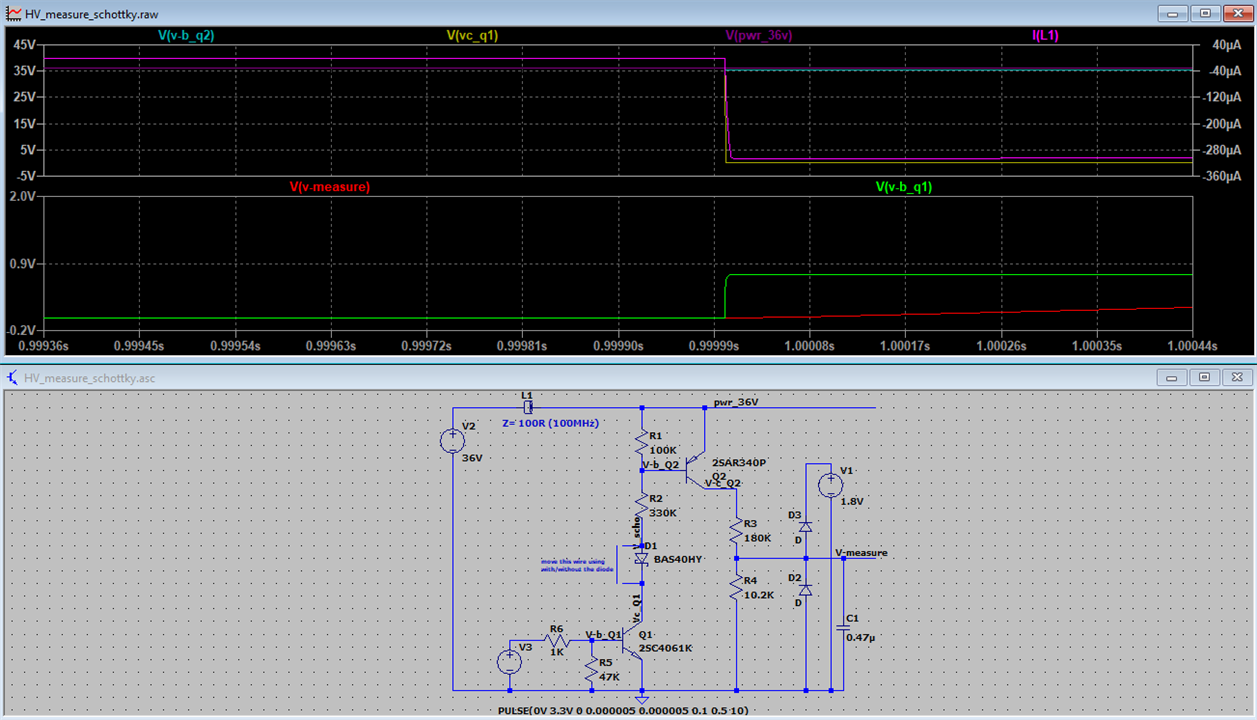
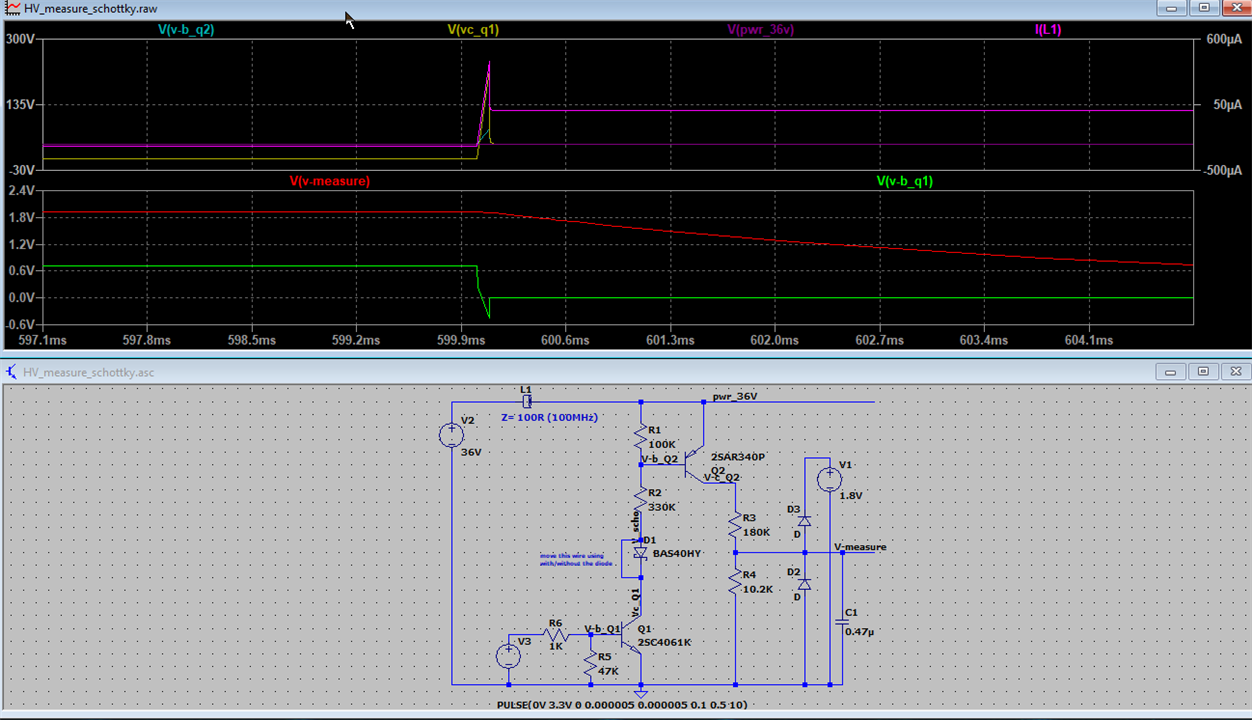
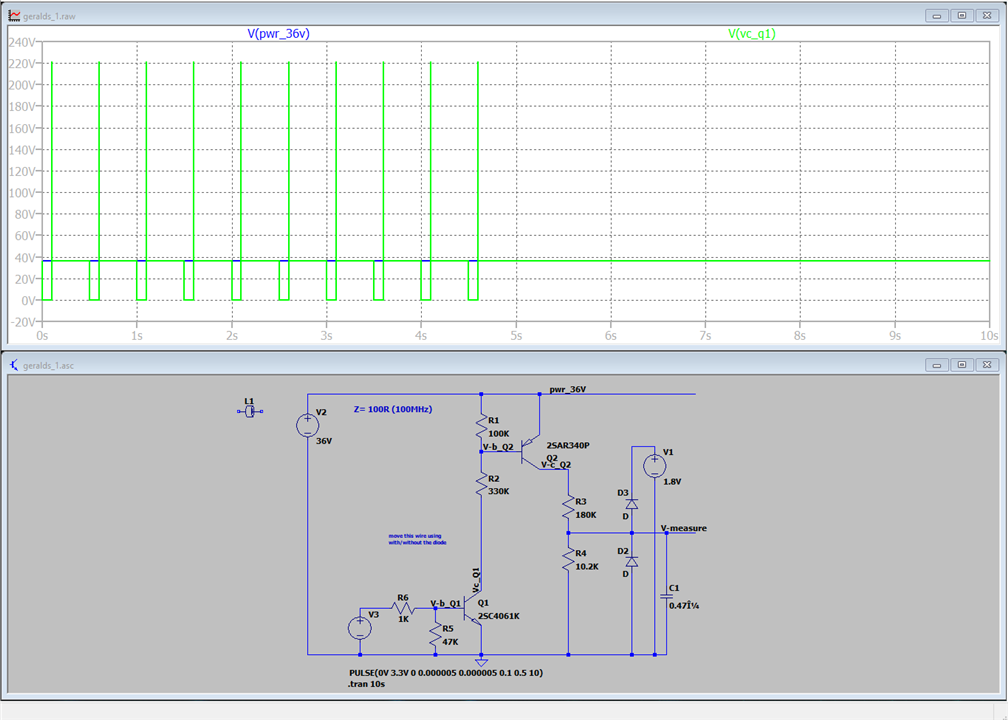
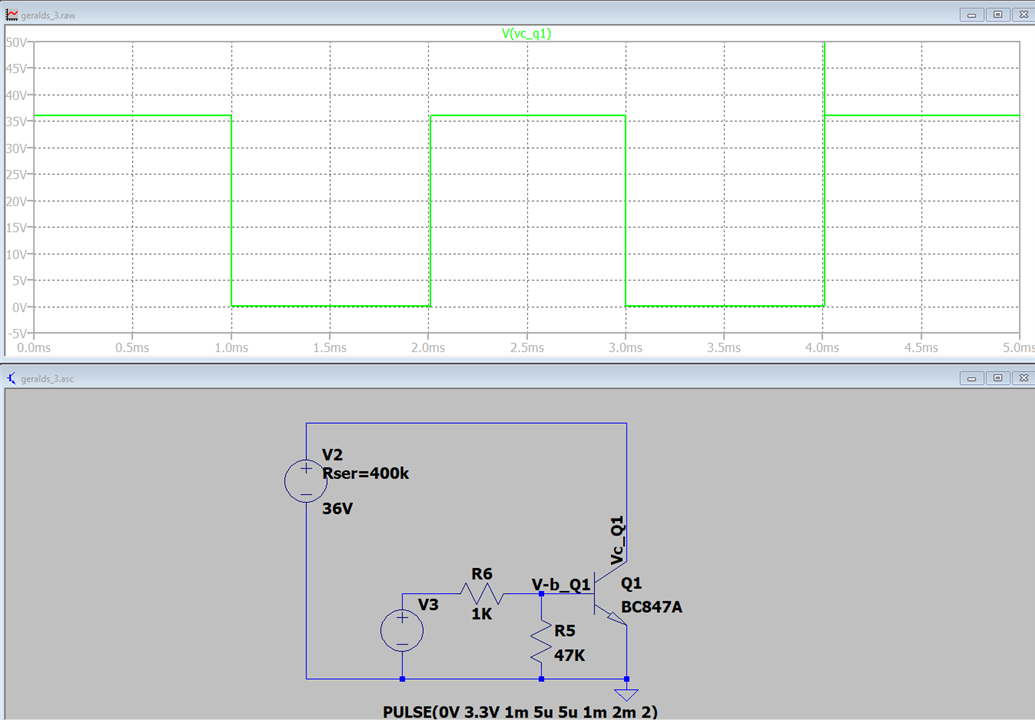
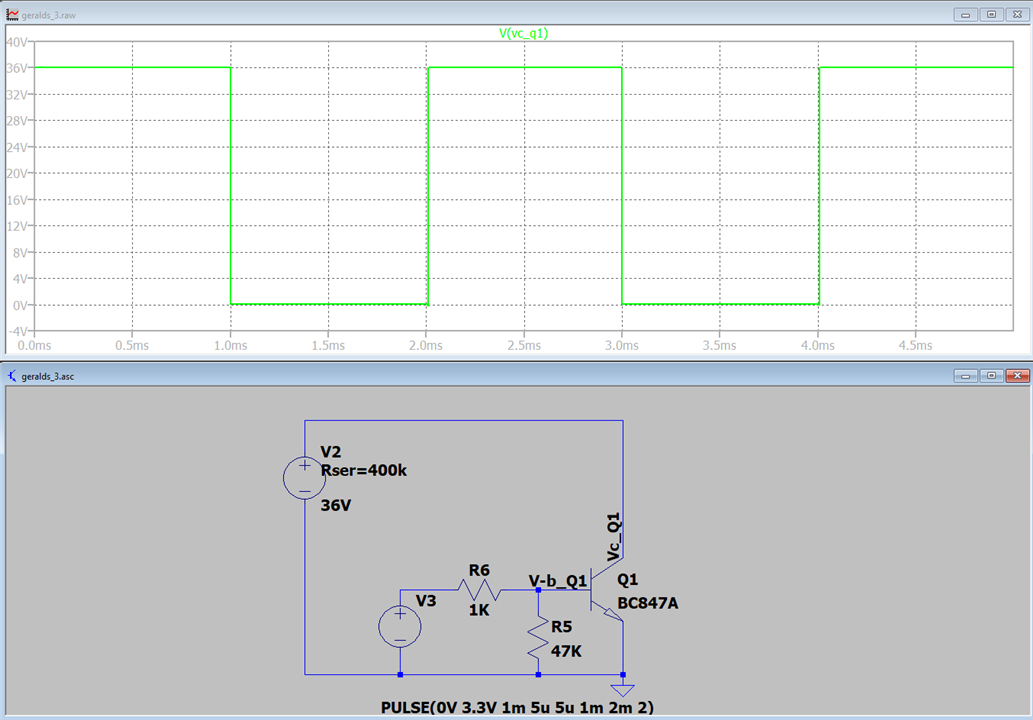
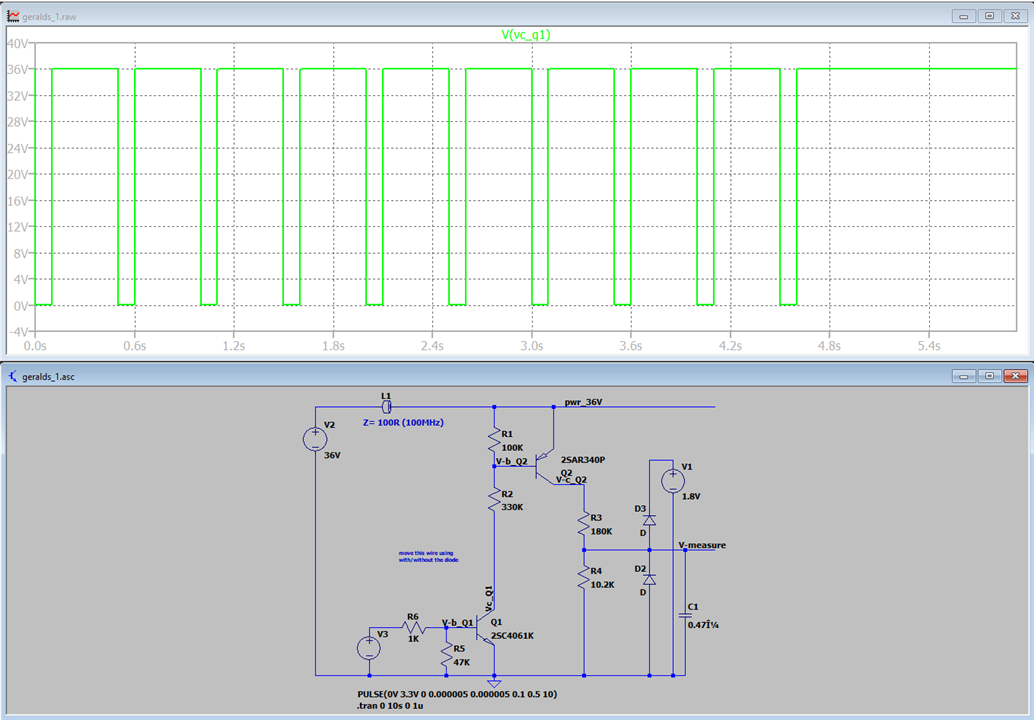
    Hi simulation with Schottky diode: simulation without Schottky diode: The Schottky diode is important during switching off the transistors. Without Schottky it can produce very high…
  • geralds
    geralds 5 days ago in reply to Humaninsane +1
    Hi, I would say that the T103 is a simple switching transistor in a higher voltage-rated circuit. A BC846 would be too small at 60V. The microcontroller's output switches it on to measure the voltage…
Parents
  • michaelkellett
    michaelkellett 6 days ago

    I would need to know more about the function of the circuit to make an informed comment.

    The two transistors are high voltage parts (250V and 500V).

    What are the inductor connections and what is the working voltage on emitter of T104 ?

    D108 is only rated for 40V reverse voltage.

    I suspect that the diode is to protect T103 from negative voltages at TP131 - but without more information its only a guess. 

    MK

    • Cancel
    • Vote Up 0 Vote Down
    • Sign in to reply
    • Cancel
  • Humaninsane
    Humaninsane 6 days ago in reply to michaelkellett

    The two transistors are high voltage parts (250V and 500V)- fuse & inductor path is max60V from Lead-acid battery. This a random selection. 100V part cab used.

    What are the inductor connections and what is the working voltage on emitter of T104 ? -  ferrite bead used for High Impedance at high frequency (EMI/EMC) 

    D108 is only rated for 40V reverse voltage. - D109, after 100k and 300k, 60V will drop...so they have used 40V schottky

    I suspect that the diode is to protect T103 from negative voltages at TP131 - do we get -ve voltage in between?not sure, I thought it's only at product out (Connector/GND...).

    • Cancel
    • Vote Up 0 Vote Down
    • Sign in to reply
    • Cancel
  • Humaninsane
    Humaninsane 4 days ago in reply to geralds

    Thanks for the effortsHeart️.

    Without Schottky it can produce very high voltage spikes during switching off. - you are refereing T103(npn)?. 

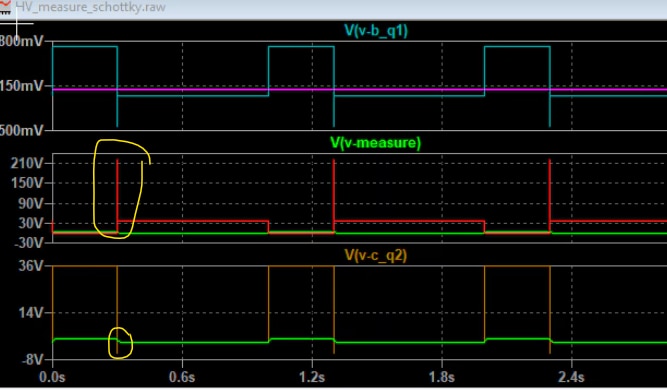
    as we can see in the 2nd waveform (VC-Q1 - red)  there is high voltage spike...in-turn leading Vc-q2 (orange) -ve spike....image

    But any how this -ve spike will be suppressed by clamping diode right? so can we remove schottky?...

    And can you please share the Simulation settings. If you can share the .asc file that would be greatSweat smile. 

    • Cancel
    • Vote Up 0 Vote Down
    • Sign in to reply
    • Cancel
  • geralds
    geralds 4 days ago in reply to Humaninsane

    Hi,

    diagram with schottky current ferritbead

    diagram without schottky current ferritbead

    With Schottky - the current through the ferrite bead is minimal few micro ampere.
    Without Schottky - the current is much more - it produce a current spike, that produce a spike voltage on the Q1 transistor during switching off.
    This diode blocks the back current, which will stored in the induction during switching off, it separates Q1 from Q2.
    refer what michaelkellet told - flyback diode

    -->>> see also switched power supplies, such circuits looking similar.

    copy this .docx file to your folder and rename the extension docx to .asc.

    Best Regards

    Gerald

    --

    • Cancel
    • Vote Up +1 Vote Down
    • Sign in to reply
    • Cancel
  • Humaninsane
    Humaninsane 4 days ago in reply to geralds

    Ok now its clear. Once again thanks for the support

    • Cancel
    • Vote Up 0 Vote Down
    • Sign in to reply
    • Cancel
  • Humaninsane
    Humaninsane 4 days ago in reply to michaelkellett

    Thank for the efforts and discussionsHeart️.

    • Cancel
    • Vote Up 0 Vote Down
    • Sign in to reply
    • Cancel
  • michaelkellett
    michaelkellett 4 days ago in reply to geralds

    Hello Gerald,

    I have replicated your model quite closely in LTSpice and it shows no sign of the huge spikes.

    image

    I used a Wurth ferrite bead:

    image

    MK

    • Cancel
    • Vote Up 0 Vote Down
    • Sign in to reply
    • Cancel
  • geralds
    geralds 4 days ago in reply to michaelkellett

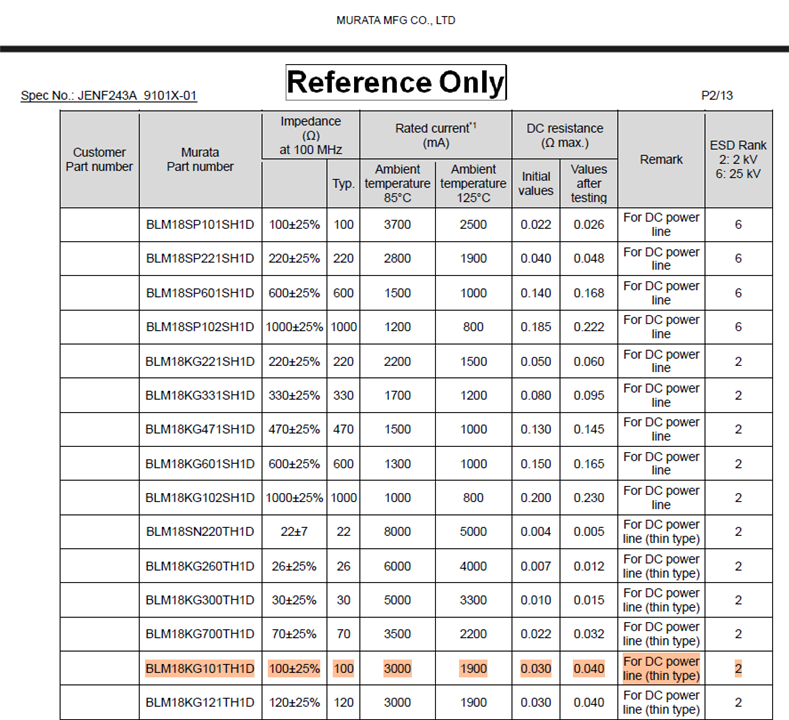
    original ferrite bead in the original circuit, Murata BLM18KG101TH1D:

    murata ferrite bead

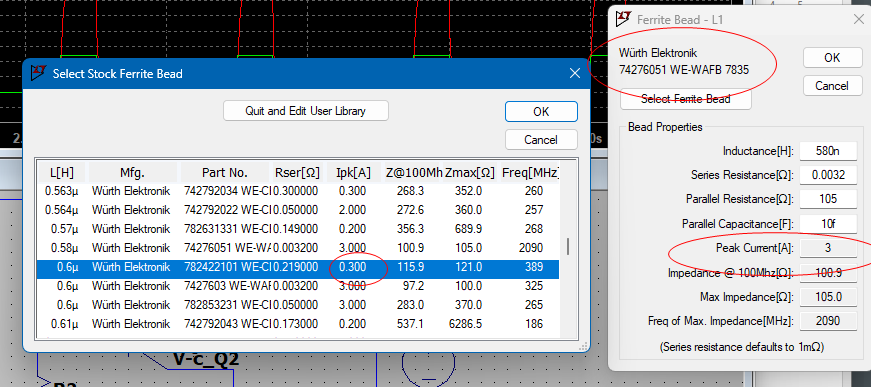
    I've selected the Würth ferrite bead 74276051:

    simulated ferrite bead - 74276051

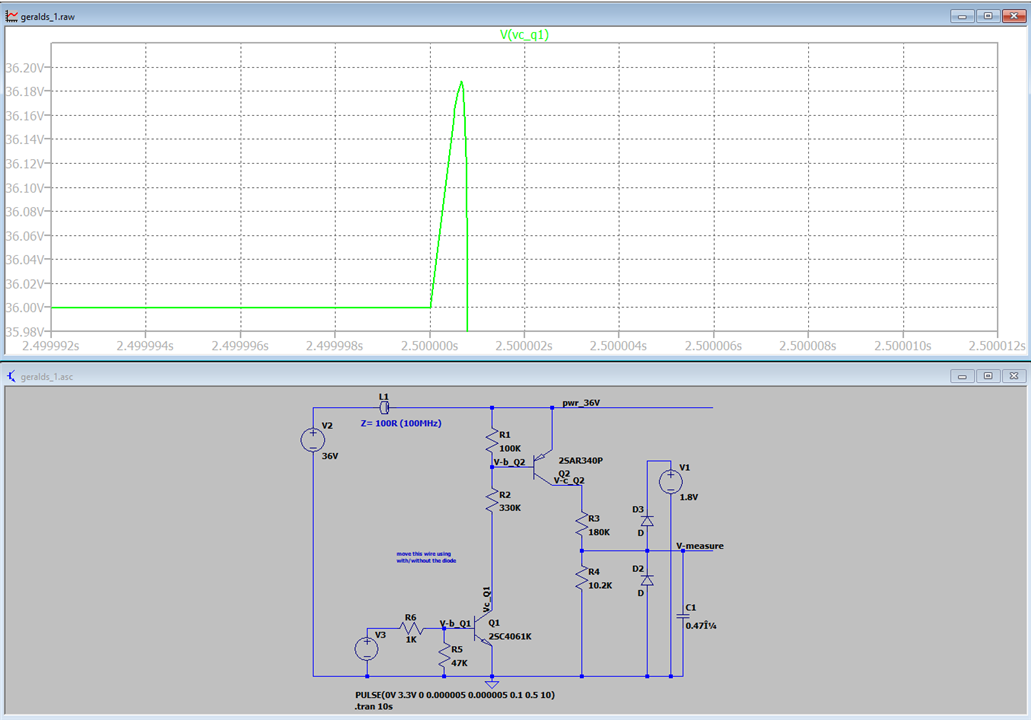
    Well, may be your simulation have other setting in the software.

    I just installed the software and worked with default settings, in the simulation settings.

    Just drag and drop, I selected components that have "real" parameters, I did not use ideal components.

    In the fused wire draws < 3A at 36V, not mA. This is the power rail.

    The measurement circuit is just a small part of a bigger circuit.

    You can ask the developers who inserted the Schottky. 

    • Cancel
    • Vote Up 0 Vote Down
    • Sign in to reply
    • Cancel
  • michaelkellett
    michaelkellett 4 days ago in reply to geralds

    Could you post your .asc file for the simulation an I can try running it here. (I can't copy it as text the way you've posted it above.)

    Here is mine:

    Version 4.1
    SHEET 1 880 692
    WIRE -256 -208 -352 -208
    WIRE 192 -208 -192 -208
    WIRE 320 -208 192 -208
    WIRE 192 -176 192 -208
    WIRE 320 -112 320 -208
    WIRE 192 -64 192 -96
    WIRE 256 -64 192 -64
    WIRE 192 -32 192 -64
    WIRE 560 32 464 32
    WIRE 320 64 320 -16
    WIRE 464 80 464 32
    WIRE 192 112 192 48
    WIRE 192 176 192 112
    WIRE -352 208 -352 -208
    WIRE 320 208 320 144
    WIRE 464 208 464 144
    WIRE 464 208 320 208
    WIRE 688 208 464 208
    WIRE -32 224 -128 224
    WIRE 80 224 48 224
    WIRE 128 224 80 224
    WIRE 80 256 80 224
    WIRE 320 272 320 208
    WIRE 688 272 688 208
    WIRE 464 288 464 208
    WIRE -128 304 -128 224
    WIRE 560 304 560 32
    WIRE -352 416 -352 288
    WIRE -128 416 -128 384
    WIRE -128 416 -352 416
    WIRE 80 416 80 336
    WIRE 80 416 -128 416
    WIRE 192 416 192 272
    WIRE 192 416 80 416
    WIRE 240 416 192 416
    WIRE 320 416 320 352
    WIRE 320 416 240 416
    WIRE 464 416 464 352
    WIRE 464 416 320 416
    WIRE 560 416 560 384
    WIRE 560 416 464 416
    WIRE 688 416 688 336
    WIRE 688 416 560 416
    WIRE 240 432 240 416
    FLAG 240 432 0
    FLAG 192 112 Q1_C
    FLAG 688 208 OUT
    SYMBOL npn 128 176 R0
    SYMATTR InstName Q1
    SYMATTR Value 2SC4061K
    SYMBOL res 64 240 R0
    SYMATTR InstName R1
    SYMATTR Value 47k
    SYMBOL res 64 208 R90
    WINDOW 0 0 56 VBottom 2
    WINDOW 3 32 56 VTop 2
    SYMATTR InstName R2
    SYMATTR Value 1k
    SYMBOL voltage -128 288 R0
    WINDOW 3 -165 160 Left 2
    WINDOW 123 0 0 Left 0
    WINDOW 39 0 0 Left 0
    SYMATTR Value PULSE(0 3.3 .1 5u 5u 0.1 0.5 3)
    SYMATTR InstName V1
    SYMBOL voltage -352 192 R0
    WINDOW 123 0 0 Left 0
    WINDOW 39 0 0 Left 0
    SYMATTR InstName V2
    SYMATTR Value 36
    SYMBOL pnp 256 -16 M180
    SYMATTR InstName Q2
    SYMATTR Value 2SAR340P
    SYMBOL res 176 -192 R0
    SYMATTR InstName R3
    SYMATTR Value 100k
    SYMBOL res 176 -48 R0
    SYMATTR InstName R4
    SYMATTR Value 330k
    SYMBOL res 304 48 R0
    SYMATTR InstName R5
    SYMATTR Value 180k
    SYMBOL res 304 256 R0
    SYMATTR InstName R6
    SYMATTR Value 10.2k
    SYMBOL diode 480 352 R180
    WINDOW 0 24 64 Left 2
    WINDOW 3 24 0 Left 2
    SYMATTR InstName D2
    SYMATTR Value 1N4148
    SYMBOL diode 480 144 R180
    WINDOW 0 24 64 Left 2
    WINDOW 3 24 0 Left 2
    SYMATTR InstName D3
    SYMATTR Value 1N4148
    SYMBOL voltage 560 288 R0
    WINDOW 123 0 0 Left 0
    WINDOW 39 0 0 Left 0
    SYMATTR InstName V3
    SYMATTR Value 1.8
    SYMBOL cap 672 272 R0
    SYMATTR InstName C1
    SYMATTR Value 0.47µ
    SYMBOL FerriteBead -224 -208 R90
    WINDOW 0 -16 0 VBottom 2
    SYMATTR InstName L1
    SYMATTR Value 600n
    SYMATTR SpiceLine Ipk=0.3 Rser=0.219 Rpar=121 Cpar=279f mfg="Würth Elektronik" pn="782422101 WE-CBA 0402"
    TEXT -96 -256 Left 2 !.tran 0 5 0

    MK

    • Cancel
    • Vote Up 0 Vote Down
    • Sign in to reply
    • Cancel
  • geralds
    geralds 4 days ago in reply to michaelkellett

    sorry, uploading the .asc file is not allowed.

    I uploaded above the .docx file to Humaninsane postings.

    Please download this docx file and rename the extension from .docx to asc.

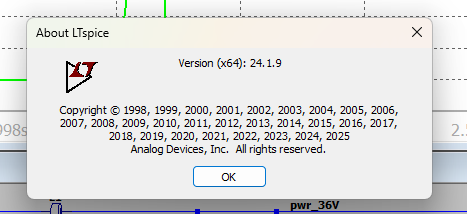
    I use the newest version of LTSpice. Please update it or download it.

    • Cancel
    • Vote Up 0 Vote Down
    • Sign in to reply
    • Cancel
  • michaelkellett
    michaelkellett 4 days ago in reply to geralds
    geralds said:
    I uploaded above the .docx file to Humaninsane postings.

    I know that's what you tried to do but the rendering of that upload is incomplete and if it is downloaded MS Word can't decode it. The easy way to this is to just paste the text into a post.

    Thanks.

    MK

    • Cancel
    • Vote Up 0 Vote Down
    • Sign in to reply
    • Cancel
  • michaelkellett
    michaelkellett 4 days ago in reply to michaelkellett

    WARNING - LONG REPLY BUT WITH A HAPPY ENDING

    Found I could download as a .pdf and translate that.

    But - no overshoots:

    image

    image

    image

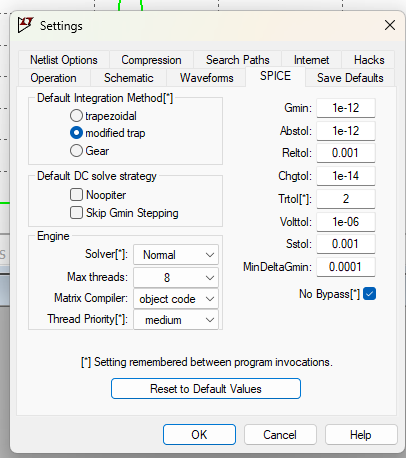
    Same overshoot result if I press reset to defaults and run again.

    Updated to latest version.

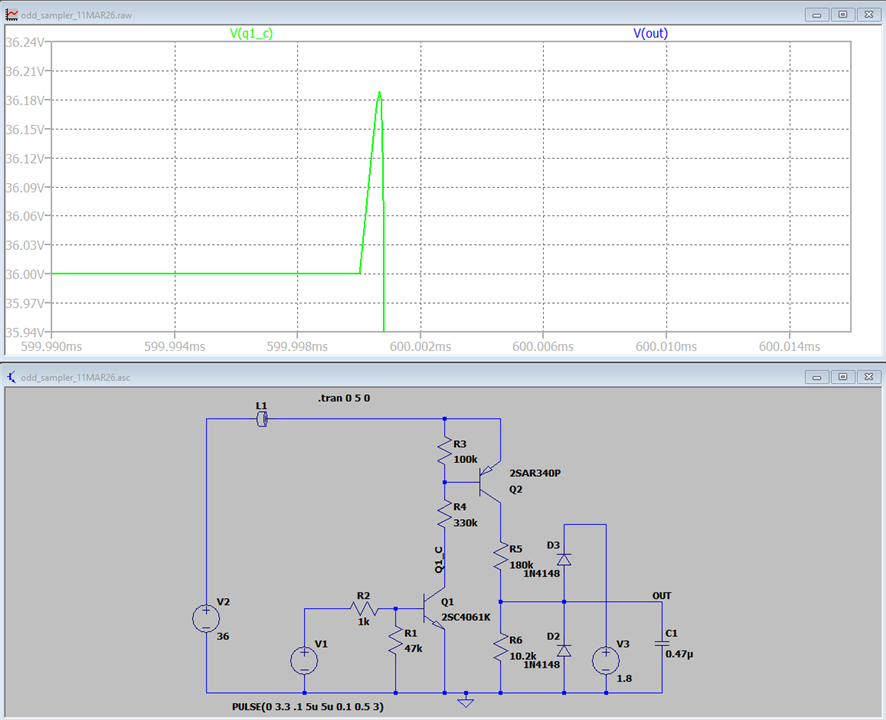
    And huge overshoot on Q1 collector is visible.

    No picture of it here - see Geralds plots above.

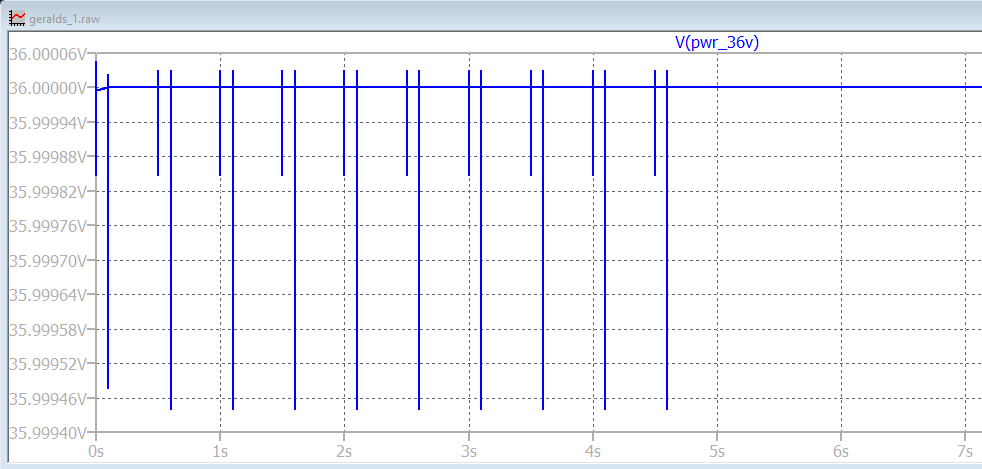
    But we know this is false because there is no big overshoot on the 36V power rail:

    image

    Let's remove the inductor:

    image

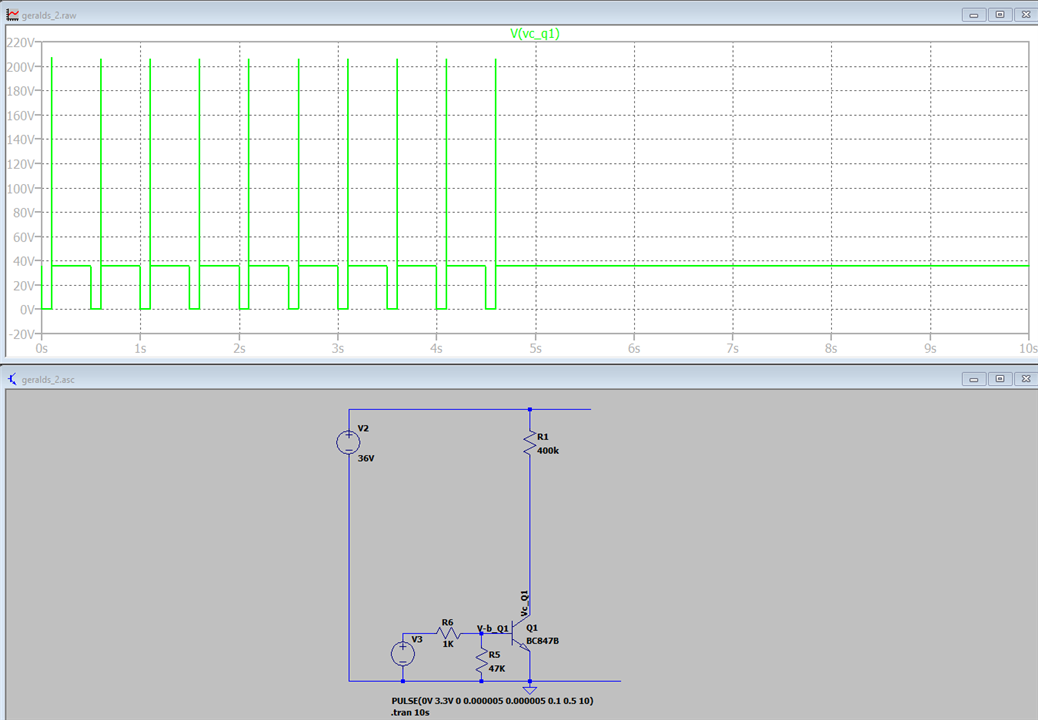
    Now we have a design with NO INDUCTANCE but we still get the 200V spike.

    Analog seem to have broken LTSpice.

    let's prove that:

    image

    There you are - no inductance and we get the nonsense spike.

    This is so disappointing - LTSpice has been great for ages and now they have broken it.

    The spike varies if you change the transistor model to npn2 or the type of device but it doesn't go away.

    So let's find out what's wrong,

    ........................ several abortive tests I won't bore you with.

    image

    Here is a clue - only one rising edge is spikey, and less than they were, but all I've done is change the quiet intervals between edges.

    Lets make a wild guess and set the minimum time step to 1us (its at the default setting of whatever it decides right now)

    image

    Suddenly it looks sensible.

    image

    And if the min time step is set then Gerald's original model works OK as well.

    So all they have changed/broken is how the auto time step works - I preferred the older version.

    So the take away from this - never trust a simulator - the hierarchy of truth is:

    Lies

    Damn lies

    Statistics

    SImulators

    AI

    But we have learnt that we don't need a diode in the collector circuit of Q1.

    MK

    MK

    • Cancel
    • Vote Up 0 Vote Down
    • Sign in to reply
    • Cancel
Reply
  • michaelkellett
    michaelkellett 4 days ago in reply to michaelkellett

    WARNING - LONG REPLY BUT WITH A HAPPY ENDING

    Found I could download as a .pdf and translate that.

    But - no overshoots:

    image

    image

    image

    Same overshoot result if I press reset to defaults and run again.

    Updated to latest version.

    And huge overshoot on Q1 collector is visible.

    No picture of it here - see Geralds plots above.

    But we know this is false because there is no big overshoot on the 36V power rail:

    image

    Let's remove the inductor:

    image

    Now we have a design with NO INDUCTANCE but we still get the 200V spike.

    Analog seem to have broken LTSpice.

    let's prove that:

    image

    There you are - no inductance and we get the nonsense spike.

    This is so disappointing - LTSpice has been great for ages and now they have broken it.

    The spike varies if you change the transistor model to npn2 or the type of device but it doesn't go away.

    So let's find out what's wrong,

    ........................ several abortive tests I won't bore you with.

    image

    Here is a clue - only one rising edge is spikey, and less than they were, but all I've done is change the quiet intervals between edges.

    Lets make a wild guess and set the minimum time step to 1us (its at the default setting of whatever it decides right now)

    image

    Suddenly it looks sensible.

    image

    And if the min time step is set then Gerald's original model works OK as well.

    So all they have changed/broken is how the auto time step works - I preferred the older version.

    So the take away from this - never trust a simulator - the hierarchy of truth is:

    Lies

    Damn lies

    Statistics

    SImulators

    AI

    But we have learnt that we don't need a diode in the collector circuit of Q1.

    MK

    MK

    • Cancel
    • Vote Up 0 Vote Down
    • Sign in to reply
    • Cancel
Children
No Data
element14 Community

element14 is the first online community specifically for engineers. Connect with your peers and get expert answers to your questions.

  • Members
  • Learn
  • Technologies
  • Challenges & Projects
  • Products
  • Store
  • About Us
  • Feedback & Support
  • FAQs
  • Terms of Use
  • Privacy Policy
  • Legal and Copyright Notices
  • Sitemap
  • Cookies

An Avnet Company © 2026 Premier Farnell Limited. All Rights Reserved.

Premier Farnell Ltd, registered in England and Wales (no 00876412), registered office: Farnell House, Forge Lane, Leeds LS12 2NE.

ICP 备案号 10220084.

Follow element14

  • X
  • Facebook
  • linkedin
  • YouTube