element14 Community
element14 Community
    Register Log In
  • Site
  • Search
  • Log In Register
  • Community Hub
    Community Hub
    • What's New on element14
    • Feedback and Support
    • Benefits of Membership
    • Personal Blogs
    • Members Area
    • Achievement Levels
  • Learn
    Learn
    • Ask an Expert
    • eBooks
    • element14 presents
    • Learning Center
    • Tech Spotlight
    • STEM Academy
    • Webinars, Training and Events
    • Learning Groups
  • Technologies
    Technologies
    • 3D Printing
    • FPGA
    • Industrial Automation
    • Internet of Things
    • Power & Energy
    • Sensors
    • Technology Groups
  • Challenges & Projects
    Challenges & Projects
    • Design Challenges
    • element14 presents Projects
    • Project14
    • Arduino Projects
    • Raspberry Pi Projects
    • Project Groups
  • Products
    Products
    • Arduino
    • Avnet & Tria Boards Community
    • Dev Tools
    • Manufacturers
    • Multicomp Pro
    • Product Groups
    • Raspberry Pi
    • RoadTests & Reviews
  • About Us
  • Store
    Store
    • Visit Your Store
    • Choose another store...
      • Europe
      •  Austria (German)
      •  Belgium (Dutch, French)
      •  Bulgaria (Bulgarian)
      •  Czech Republic (Czech)
      •  Denmark (Danish)
      •  Estonia (Estonian)
      •  Finland (Finnish)
      •  France (French)
      •  Germany (German)
      •  Hungary (Hungarian)
      •  Ireland
      •  Israel
      •  Italy (Italian)
      •  Latvia (Latvian)
      •  
      •  Lithuania (Lithuanian)
      •  Netherlands (Dutch)
      •  Norway (Norwegian)
      •  Poland (Polish)
      •  Portugal (Portuguese)
      •  Romania (Romanian)
      •  Russia (Russian)
      •  Slovakia (Slovak)
      •  Slovenia (Slovenian)
      •  Spain (Spanish)
      •  Sweden (Swedish)
      •  Switzerland(German, French)
      •  Turkey (Turkish)
      •  United Kingdom
      • Asia Pacific
      •  Australia
      •  China
      •  Hong Kong
      •  India
      • Japan
      •  Korea (Korean)
      •  Malaysia
      •  New Zealand
      •  Philippines
      •  Singapore
      •  Taiwan
      •  Thailand (Thai)
      • Vietnam
      • Americas
      •  Brazil (Portuguese)
      •  Canada
      •  Mexico (Spanish)
      •  United States
      Can't find the country/region you're looking for? Visit our export site or find a local distributor.
  • Translate
  • Profile
  • Settings
FPGA
  • Technologies
  • More
FPGA
Forum Some FPGA Beginner Questions
  • Blog
  • Forum
  • Documents
  • Quiz
  • Events
  • Polls
  • Files
  • Members
  • Mentions
  • Sub-Groups
  • Tags
  • More
  • Cancel
  • New
Join FPGA to participate - click to join for free!
Actions
  • Share
  • More
  • Cancel
Forum Thread Details
  • State Suggested Answer
  • Replies 78 replies
  • Answers 19 answers
  • Subscribers 559 subscribers
  • Views 11074 views
  • Users 0 members are here
Related

Some FPGA Beginner Questions

Former Member
Former Member over 13 years ago

Hi element14!


Some time ago I've watched a talk of the nand2tetris course/project. If you've never heard of it you can check it out here: http://www.nand2tetris.org/ Basically it is a course designed to build a computer from the very ground up. It starts with logic gates and goes all the way up to programming a small game project (hence the name nand2tetris). There is also a video available from someone who has been doing the course on FPGA hardware ( http://www.youtube.com/watch?v=UHty1KKjaZw ).

[At one point in the above linked youtube video you can see the designation "ep2c8q208", which should mean the project is running on Altera Cyclone II hardware.]


I've always been curious about doing something with FPGA hardware, but never had any idea of a feasible, yet interesting-result-yielding project. Well, as you can probably guess, up until now that is image


During my university days I attended an FPGA workshop and I've read some stuff about the hardware components and the available course material, so I think I kind of have an idea about the difficulty of the project. But since everything I've been reading just made me more excited, I decided I absolutely want to give this a shot. Now there's a lot of FPGA information out there, so I'm surely still missing a lot of important information, but I would like to get started and think the best way to learn is to actually experiment with a real FPGA instead of wasting too much time with HDL simulations only to become used to functions that aren't going to synthesize on the board anyway.


So I now would like to ask you about some things I'm still unsure about and would like to have clarified before buying an expensive development kit. I've read several articles about Altera and Xilinx and right now my choice would be a Spartan 3E Starter Board - this one to be exact: http://shop.embedded-projects.net/index.php?module=artikel&action=artikel&id=549


The main questions I'm having right now:

- Is there a general reason that would argue against getting the Spartan E3 board?

- I actually have no idea how powerful an FPGA really is.. but assuming it's running on Cyclone II hardware, it probably should run on a Spartan 3 as well? Or is that in itself already a stupid question, as FPGA comparison doesn't work so easily?

- As you can see, the price for the above board is about 150 Euro, which translates to something just short of $200. Yet I continue to find offers (on ebay or other websites) where boards are being sold for under $150 but even include small screens(!)*  What am I missing here? Did I pick an especially expensive outlet, or is there something shady about these cheap deals..?

- In general, who is more newbie-friendly, Altera or Xilinx? (I've worked with VHDL before, which I think is Xilinx, right? Altera's Quartus is probably very similar?)

- From how I understand the FPGA toolchain, in the above linked offer there should be everything included to get me going.. right? o_O


I also have this second candidate: http://www.digilentinc.com/Products/Detail.cfm?NavPath=2,400,836&Prod=ATLYS

- Maybe I'm an idiot, but as I read the offer, *only* the board is sold? I.e., in contrast to the first offer, I would need additional stuff to get something running on the board?

- It also strikes me as a mayor drawback that there is not really an output option besides a few LEDs.. which for me would be very annoying; I'm already unhappy about the board linked before *only* having a small display (which in itself, however, is awesome to have of course).

- This might also be a stupid question: I remember from back in the FPGA workshop I mentioned that getting a number-display to run is not that hard at all. How much more effort is it to get something displayed on a screen (either an attached one or a PC screen accessed via one of the available ports)?


And as a final question: I've also seen some very much smaller boards than the ones linked here, that are also much cheaper.. are the boards I'm looking it overkill for what I'd like to do with them? Or does actually the contrary hold, and such a project wouldn't even run on one of the smaller boards available?


Thanks for your help!


Cheers,

pan


________________________

* Here for example:

http://www.sainsmart.com/evaluation-board/fpga-cpld-board/new-ep2c8q208c8n-development-board-kit-fpga-altera-cyclone-nios-ii-with-2-4-lcd.html

  • Sign in to reply
  • Cancel

Top Replies

  • johnbeetem
    johnbeetem over 13 years ago +2 suggested
    Hi Christian, I just saw your discussion today. I don't check the element14 FPGA page much since activity is rare. There's some good FPGA discussion in this thread at the Raspberry Pi group, including…
  • michaelkellett
    michaelkellett over 10 years ago in reply to Former Member +2 suggested
    I'm going to offer some advice which has worked well for me over the last 10 years. Forget Xilinx and Altera and download the Lattice toolset - not as capable as the full Xilinx kit but good enough to…
  • michaelkellett
    michaelkellett over 10 years ago in reply to michaelkellett +2 suggested
    A simple counter example for LED twinkles ! There must be a way to add a text file - someone please tell how ! MK
Parents
  • Former Member
    0 Former Member over 10 years ago

    hey dear...Greeting of the Day!!!!!

    I am beginner of FPGA and VHDLl coding,I'm using spartan6(lx9,tqg144) development board i want to display text and images on monitor display by VGA connector is is possible with spartan6???!! IS, IS POSSIBLE to dispay any text ?? any image?? on monitor.

    Small help also would be great helpful

    thanks!!

    • Cancel
    • Vote Up 0 Vote Down
    • Sign in to reply
    • Verify Answer
    • Cancel
  • johnbeetem
    0 johnbeetem over 10 years ago in reply to Former Member

    Here are some VGA 'blogs at Gadget Factory, the maker of the Papilio Spartan-3E and Spartan-6 FPGA boards: http://www.gadgetfactory.net/tag/vga/

    • Cancel
    • Vote Up 0 Vote Down
    • Sign in to reply
    • Verify Answer
    • Cancel
  • Former Member
    0 Former Member over 10 years ago in reply to johnbeetem

    hey john Thanks allot !

    Thanks for your warm welcome and support ..

    since 11days i have been reading different tutorials and materials but

    i am not satisfied how to display text and how to display image but up

    to now i think i will be possible...

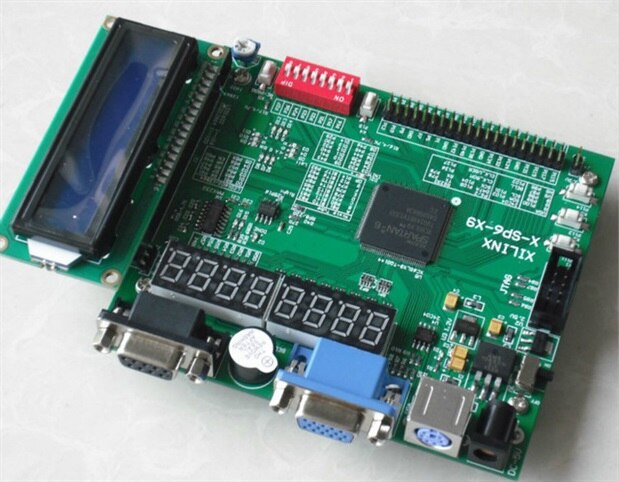
    last question i am using spartan 6(XC6SLX9-TQG144) (xilinx X-SP6-X9)

    board (it is not micro board) and i cant find its proper

    configurations as well as all functions i have google it hundrads of

    times but i got all information about micro board so how can i get

    proper configuration..

    thank you very much for your reply..

    • Cancel
    • Vote Up 0 Vote Down
    • Sign in to reply
    • Verify Answer
    • Cancel
  • johnbeetem
    0 johnbeetem over 10 years ago in reply to Former Member

    narendra rathod wrote:


    last question i am using spartan 6(XC6SLX9-TQG144) (xilinx X-SP6-X9)

    board (it is not micro board) and i cant find its proper

    configurations as well as all functions i have google it hundrads of

    times but i got all information about micro board so how can i get

    proper configuration..

    Can you tell who manufactures the board and get a part number?  I couldn't find "X-SP6-X9" either.  You might want to post an image to see if someone here recognizes it.

    • Cancel
    • Vote Up 0 Vote Down
    • Sign in to reply
    • Verify Answer
    • Cancel
  • Former Member
    0 Former Member over 10 years ago in reply to johnbeetem

    image

    This is the board i am using..and the below link contain it's sellers detail

    http://artofcircuits.com/product/spartan-6-fpga-development-board-xc6slx9-tqg144

    • Cancel
    • Vote Up +1 Vote Down
    • Sign in to reply
    • Verify Answer
    • Cancel
  • johnbeetem
    0 johnbeetem over 10 years ago in reply to Former Member

    So I guess it didn't come with a user manual or a schematic?  That's pretty annoying.  You might ask the vendor if either of those is available -- maybe they forgot to include a link with the board.


    The board does seem to be "self-documenting" to a certain extent.  (I followed the artofcircuits.com link to get higher resolution photo.) There's a bunch of tables on the silkscreen showing which functions are attached to which FPGA pins.  For example, diodes D3 - D14 are connected to FPGA pins P33, P34, P35, etc.  So you can use these pin numbers in a User Contraint File (.ucf) to assign your signal names to functions on the board.  You'll need to play around a little to see whether the diodes are active-high or active-low.


    Some of the tables are misleading.  For example, the LED digits are called "Nixie Tube", I guess out of nostalgia.  The LED segments are numbered A-G, plus DP for Decimal Point.  I would guess that BIT0-BIT7 really mean Digit 0 - Digit 7.  The BIT0-BIT7 FPGA pins probably drive transistors Q50-Q57 to turn on the digits.  I have a 'blog describing using a LOGI-Bone, LOGI-Pi, and LOGI-EDU to display a BCD counter using 7-segment displays that might be a useful reference: http://www.element14.com/community/groups/fpga-group/blog/2014/10/12/seven-segment-bcd-counter-using-the-valentfx-logi-edu


    It looks like the routing is mostly on the top layer, so you can see how FPGA pins route to other components.  The Xilinx Spartan-6 data sheet shows how the FPGA pins are numbered.


    It looks like you need a separate JTAG programmer with 10-pin cable to program the FPGA.  Xilinx brand programmers are pretty expensive, but there are low-cost FTDI FT2232H or FT232H modules that can do the job.  I don't know what would be available in Pakistan.

    • Cancel
    • Vote Up 0 Vote Down
    • Sign in to reply
    • Verify Answer
    • Cancel
  • Former Member
    0 Former Member over 10 years ago in reply to johnbeetem

    Thank you very much john..now i can understand this board some how ...there is no user guide or manual is included with this board ...i am doing the project you suggested ..but if any help about keyboard key press and display on VGA monitor it will be very helpful for my project thanks a lot..!!

    • Cancel
    • Vote Up 0 Vote Down
    • Sign in to reply
    • Verify Answer
    • Cancel
  • johnbeetem
    0 johnbeetem over 10 years ago in reply to Former Member

    For VGA, I'd start with Wikipedia which gives a good overview: https://en.wikipedia.org/wiki/Video_Graphics_Array

    Since you only have three FPGA outputs for Red, Green, and Blue, you'll only be able to do 8 colors without modifying the board.  Start with something really simple like vertical color bands, and then expand to something more interesting like checker board.  At some point you can use Xilinx Block RAMs to make a character generator.


    Your board should be able to interface with a PS/2 keyboard.  WIkipedia has a good overview https://en.wikipedia.org/wiki/PS/2_port and a link to a site with more details: http://www.computer-engineering.org/ps2protocol/


    According to the detailed site, PS/2 has open-collector (or open-drain) I/Os, which is good because Spartan-6 has 3.3V maximum I/Os.  They're not 5V tolerant and need to be protected from external 5V signals.  I expect a PS/2 keyboard will work with 3.3V pull-ups instead of 5V pull-ups, but I'd try checking it off line just be be sure before risking damage to the Spartan-6.  It's probably been done before, so see if there are already successful projects out there.

    • Cancel
    • Vote Up 0 Vote Down
    • Sign in to reply
    • Verify Answer
    • Cancel
  • Former Member
    0 Former Member over 10 years ago in reply to johnbeetem

    yes that's an important thing. i read it .. honestly i understand that keyboard ps/2 has one input(clock in) and one inout(i.e data)  and VGA has one input(clock 50mhz ) and  has  five outputs (i.e. red,green,blue,horizontal sync and vertical sync)  .i am using xilinx 13.1 ISE if i want to display keyboard on vga should i have to include files like vga_controller, vga_selector ,keyboard scancodes , keyboard interfacing program with project???? should  i attach ucf filse for individuals one(i.e for vga_controller,Vga selector,keyboard )??? i am confused..

    • Cancel
    • Vote Up 0 Vote Down
    • Sign in to reply
    • Verify Answer
    • Cancel
  • Former Member
    0 Former Member over 10 years ago in reply to Former Member

    For displaying an image is it convert in .coe file and then attach with project??? i read somewhere..

    • Cancel
    • Vote Up 0 Vote Down
    • Sign in to reply
    • Verify Answer
    • Cancel
  • johnbeetem
    0 johnbeetem over 10 years ago in reply to Former Member

    XIlinx ISE has a pretty steep learning curve for a new user.  I would strongly suggest you start with some simple examples, such as controlling LEDs using push-button inputs.  Then move on to more interesting examples such as a binary counter that displays its values in the LEDs.  I did this as a demo project for the LOGI-Pi and LOGI-Bone FPGA boards.  Take a look at Experiment 2 in  http://www.element14.com/community/groups/fpga-group/blog/2014/10/03/first-experiences-with-the-valentfx-logi-bone.  The 'blog includes Verilog source code and a UCF that assigns top-level module I/Os to FPGA pins.


    Once you're familiar with ISE using simple examples, then start playing with VGA.  If you do a binary counter as an example, you can then adapt it for VGA's horizontal and vertical counters.

    • Cancel
    • Vote Up 0 Vote Down
    • Sign in to reply
    • Verify Answer
    • Cancel
Reply
  • johnbeetem
    0 johnbeetem over 10 years ago in reply to Former Member

    XIlinx ISE has a pretty steep learning curve for a new user.  I would strongly suggest you start with some simple examples, such as controlling LEDs using push-button inputs.  Then move on to more interesting examples such as a binary counter that displays its values in the LEDs.  I did this as a demo project for the LOGI-Pi and LOGI-Bone FPGA boards.  Take a look at Experiment 2 in  http://www.element14.com/community/groups/fpga-group/blog/2014/10/03/first-experiences-with-the-valentfx-logi-bone.  The 'blog includes Verilog source code and a UCF that assigns top-level module I/Os to FPGA pins.


    Once you're familiar with ISE using simple examples, then start playing with VGA.  If you do a binary counter as an example, you can then adapt it for VGA's horizontal and vertical counters.

    • Cancel
    • Vote Up 0 Vote Down
    • Sign in to reply
    • Verify Answer
    • Cancel
Children
  • Former Member
    0 Former Member over 10 years ago in reply to johnbeetem

    Okay john as you say...but which language you suggest that i should learn verilog or vhdl up to now i read and learnt vhdl.!!

    • Cancel
    • Vote Up 0 Vote Down
    • Sign in to reply
    • Verify Answer
    • Cancel
  • michaelkellett
    0 michaelkellett over 10 years ago in reply to Former Member

    You can use VHDL perfectly well with the Xilinx, Altera, Lattice or Micro-Semi free tools.


    John uses Verilog and I use VHDL so you can ask one of us if you get stuck whichever language you use.


    John's suggested approach to learning is good advice.


    It's easy to find lots of simple examples on the web but the important thing is to actually implement them on your hardware.  Don't forget to use the simulator before you try the code on an actual chip - you can learn a great deal by simulating !


    MK

    • Cancel
    • Vote Up +2 Vote Down
    • Sign in to reply
    • Verify Answer
    • Reject Answer
    • Cancel
  • Former Member
    0 Former Member over 10 years ago in reply to michaelkellett

    Thank you very much Micheal and John l!!

    I  am starting to learn basic exampls with this website .      http://www.fpgacenter.com/examples/index.php.......but displaying text and image on vga is my project so it has time deadline it's my first project so please if you have any help regarding that also please tell me..thanks


    naren.

    • Cancel
    • Vote Up +1 Vote Down
    • Sign in to reply
    • Verify Answer
    • Reject Answer
    • Cancel
  • michaelkellett
    0 michaelkellett over 10 years ago in reply to Former Member

    I only had a very quick look at this site but I strongly recommend that you find another - why - because its examples use deprecated and non standard libraries which will cause you trouble in the end.


    (They use IEEE.STD_LOGIC_ARITH.ALL; which is not really a standard at all, despite the name, you should use numeric_std - see here for why http://vhdlguru.blogspot.co.uk/2010/03/why-library-numericstd-is-preferred.html


    Have a look here:


    https://www.doulos.com/knowhow/vhdl_designers_guide/


    much better.


    Lattice, Xilinx and Altera have lots of examples.


    MK

    • Cancel
    • Vote Up +1 Vote Down
    • Sign in to reply
    • Verify Answer
    • Reject Answer
    • Cancel
  • Former Member
    0 Former Member over 10 years ago in reply to michaelkellett

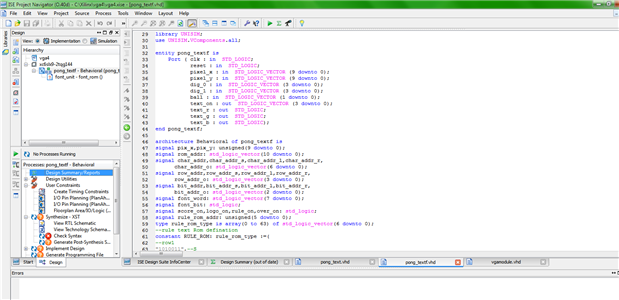
    okay than ....how to generate block memory or BROM?? i am at half of the way but now i don't know what to do.. i am giving some snap shot below


    library IEEE;

    use IEEE.STD_LOGIC_1164.ALL;


    -- Uncomment the following library declaration if using

    -- arithmetic functions with Signed or Unsigned values

    use IEEE.NUMERIC_STD.ALL;


    -- Uncomment the following library declaration if instantiating

    -- any Xilinx primitives in this code.

    library UNISIM;

    use UNISIM.VComponents.all;


    entity pong_textf is

        Port ( clk : in  STD_LOGIC;

               reset : in  STD_LOGIC;

               pixel_x : in  STD_LOGIC_VECTOR (9 downto 0);

               pixel_y : in  STD_LOGIC_VECTOR (9 downto 0);

               dig_0 : in  STD_LOGIC_VECTOR (3 downto 0);

               dig_1 : in  STD_LOGIC_VECTOR (3 downto 0);

               ball : in  STD_LOGIC_VECTOR (1 downto 0);

               text_on : out  STD_LOGIC_VECTOR (3 downto 0);

               text_r : out  STD_LOGIC;

               text_g : out  STD_LOGIC;

               text_b : out  STD_LOGIC);

    end pong_textf;


    architecture Behavioral of pong_textf is

    signal pix_x,pix_y: unsigned(9 downto 0);

    signal rom_addr: std_logic_vector(10 downto 0);

    signal char_addr,char_addr_s,char_addr_l,char_addr_r,

            char_addr_o: std_logic_vector(6 downto 0);

    signal row_addr,row_addr_s,row_addr_l,row_addr_r,

            row_addr_o: std_logic_vector(3 downto 0);

    signal bit_addr,bit_addr_s,bit_addr_l,bit_addr_r,

            bit_addr_o: std_logic_vector(2 downto 0);

    signal font_word: std_logic_vector(7 downto 0);

    signal font_bit: std_logic;

    signal score_on,logo_on,rule_on,over_on: std_logic;

    signal rule_rom_addr: unsigned(5 downto 0);

    type rule_rom_type is array(0 to 63) of std_logic_vector(6 downto 0);

    --rule text Rom defination

    constant RULE_ROM: rule_rom_type :=(

    --row1

    "1010011",--S

    "1010000",--P

    "1000101",--E

    "1010010",--R

    "1010010",--R

    "1001111",--O

    "1010111",--W

    "1010011",--S

    "1001111",--O

    "1000110",--F

    "1010100",--T

    "1010100",--T

    "1000101",--E

    "1000011",--C

    "1001000",--H

    "0000000"

    );


    begin

    pix_x<= unsigned(pixel_x);

    pix_y<= unsigned(pixel_y);

    --instantiate font ROM

    font_unit: entity work.font_rom

    port map(clk=>clk, addr=>rom_addr,data=>font_word);

    ------------------------------------------------------

    --score region

    --display score and ball at top

    --text: "score: dd ball:d"

    --scale to 16-by32 font

    --------------------------------------------------------

    score_on<=

    '1' when pix_y(9 downto 5)=0 and

    pix_x(9 downto 4)<16 else

    '0';

    row_addr_s<=std_logic_vector(pix_y(4 downto 1));

    bit_addr_s<=std_logic_vector(pix_x(3 downto 1));

    with pix_x(7 downto 4) select

    char_addr_s<=

    "1010011" when "0000",--S

    "1010000"when "0001",--P

    "1010010" when "0010",--P

    "1010111" when  others;--w


    ----------------------------------------------------------

    --logo region:

    --display sprw

    --used as a background

    --scale to 64 by 128 font

    ------------------------------------------------------------

    logo_on<=

    '1' when pix_y(9 downto 7)=2 and

    (3<= pix_x(9 downto 6) and pix_x(9 downto 6)<=6) else

    '0';

    row_addr_l<= std_logic_vector(pix_y(6 downto 3));

    bit_addr_l<=std_logic_vector(pix_x(5 downto 3));

    with pix_x(8 downto 6) select

    char_addr_l<=

    "1010011" when "011",--s

    "1010000" when "100",--p

    "1010010" when "101",--r

    "1001000" when others;--w

    ----------------------------------------------------------------

    --rule region

    --------------------------------------------------------------

    rule_on<= '1' when pix_x(9 downto 7)="010" and

                             pix_y(9 downto 6)="0010" else

                             '0';

                             row_addr_r<= std_logic_vector(pix_y(3 downto 0));

                             bit_addr_r<= std_logic_vector(pix_x(2 downto 0));

                             rule_rom_addr<=pix_y(5 downto 4) & pix_x(6 downto 3);

                             char_addr_r<=RULE_ROM(to_integer(rule_rom_addr));

    ------------------------------------------------------------------------------------

    --game region

                             ---------------------------------------------------------------

    over_on<= '1' when pix_y (9 downto 6)=3 and

    5 <= pix_x (9 downto 5) and pix_x(9 downto 5)<=13 else

    '0';

    row_addr_o<= std_logic_vector(pix_y(5 downto 2));

    bit_addr_o<= std_logic_vector(pix_x(4 downto 2));

    with pix_x(8 downto 5) select

    char_addr_o <=

    "1010011" when "0101",

    "1010000" when "0110",

    "1010010" when "0111",

    "1010111" when others;


    process(score_on,logo_on,rule_on,pix_x,pix_y,font_bit,char_addr_s,char_addr_l,char_addr_r,char_addr_o,

    row_addr_s,row_addr_l,row_addr_r,row_addr_o,

    bit_addr_s,bit_addr_l,bit_addr_r,bit_addr_o)

    begin


      text_r<='0';

        text_g<='1';

        text_b<='1';

        if score_on ='1' then

    char_addr <= char_addr_s;

    row_addr<=row_addr_s;

    bit_addr<= bit_addr_s;

    if font_bit='1' then

       text_r<='0';

        text_g<='0';

        text_b<='1';


        end if;

        else if score_on ='1' then

    char_addr <= char_addr_r;

    row_addr<=row_addr_r;

    bit_addr<= bit_addr_r;

    if font_bit='1' then

      text_r<='0';

        text_g<='0';

        text_b<='1';


        end if;

    else if logo_on ='1' then

    char_addr <= char_addr_l;

    row_addr<=row_addr_l;

    bit_addr<= bit_addr_l;

    if font_bit='1' then

    text_r<='0';

        text_g<='0';

        text_b<='1';


        end if;

    else 

    char_addr <= char_addr_o;

    row_addr<=row_addr_o;

    bit_addr<= bit_addr_o;

    if font_bit='1' then

      text_r<='0';

        text_g<='0';

        text_b<='1';

            end if;


        end if;


    end process;


    text_on <= score_on & logo_on & rule_on & over_on;

    -- f o n t ROM i n t e r f a c e

    rom_addr <= char_addr & row_addr;

    font_bit <= font_word(to_integer(unsigned(not bit_addr)));


    end Behavioral;


    should include font_rom file?? i have it's .vhd file ??!! is it required in other formate??

    i want to also add vga_sync.vhd file ....should it be .vhd file??

    image


    i use the referance of pong game text subsystem and want to edit vga syncronisation with it,,,,

    • Cancel
    • Vote Up 0 Vote Down
    • Sign in to reply
    • Verify Answer
    • Cancel
  • michaelkellett
    0 michaelkellett over 10 years ago in reply to Former Member

    Sorry Narenda, your code is pretty much incomprehensible in this form.

    I assume that there was some indentation and that pasting it into E14 has lost that but you also should consider the following:


    1) comments - if you want help with code think in terms of 1 comment for EVERY SINGLE LINE OF CODE

    2) never declare two things at once, lines in the editor are free !

    so not signal score_on,logo_on,rule_on,over_on: std_logic;

    but

    signal score_on : std_logic;               -- comment explaining what it's for

    signal logo_on : std_logic;                 -- another comment

    and so on.

    3) Use white space it's free


    so not text_b<='1';

    but

    text_b <= '1';                                   -- and every line needs a comment


    4) Every process should have a name


    Now to your question: I don't use Xilinx so I have never needed to use a block memory. I suggest that you make a little project who's sole purpose is to work out how to do this. All you need is a process to write to an address and then read from it (use a state machine). Then look up some examples: I Googled "spartan6 instantiate block ram" and found AR# 46748 - Spartan-6 FPGA Design Assistant - How to infer the use of block RAM and FIFO primitives in your HDL code which leads you to a .pdf and on page 130 you find:


    --

    -- Read-First Mode

    --

    library ieee;

    use ieee.std_logic_1164.all;

    use ieee.std_logic_unsigned.all;

    entity rams_01 is

    port (clk : in std_logic;

    we : in std_logic;

    en : in std_logic;

    addr : in std_logic_vector(5 downto 0);

    di : in std_logic_vector(15 downto 0);

    do : out std_logic_vector(15 downto 0));

    end rams_01;

    architecture syn of rams_01 is

    type ram_type is array (63 downto 0) of std_logic_vector (15 downto 0);

    signal RAM: ram_type;

    begin

    process (clk)

    begin

    if clk’event and clk = ’1’ then

    if en = ’1’ then

    if we = ’1’ then

    RAM(conv_integer(addr)) <= di;

    end if;

    do <= RAM(conv_integer(addr)) ;

    end if;

    end if;

    end process;

    end syn;


    (Note the evil E14 cut and paste strikes again) There are lots of examples like this - read the whole chapter !!

    Put this in a file of its own - give it the same name as the ram entity (in this case rams_01.vhd )

    Then write a top level file that works as a test bench for this - (Xilinx tools may well make a test bench for you).


    I can't tell how your project is constructed but it should be done with a top level file which calls up all the lower level entities and links them together - I use a graphical tool (Aldec HDL Block Diagram Editor)  to make these files but it doesn't come free with Xilinx tools. There may well be a graphical tool in the Xilinx toolset.


    For future help you would do better to post a .zip file of the entire project  since it gets round trying to look at formatted files in E14 editor.


    I know the style stuff seems tedious and nitpicking - but I assure you that now is the time to get into good habits. In 40 years+ of working on this kind of thingI have NEVER had an a problem with too many comments, but on countless occasionsI have had to waste time trying to work out what code is meant to be doing due to a lack of comments.


    MK

    • Cancel
    • Vote Up +2 Vote Down
    • Sign in to reply
    • Verify Answer
    • Reject Answer
    • Cancel
  • Former Member
    0 Former Member over 10 years ago in reply to michaelkellett

    Greeting dear !!!

    have read tutorial on the ram interference...and now i am going to display font on the vga but in vga synchronization circuit same were wrong..the output does not supported by my lcd(1920*1200 also support 800*600 mode) lcd goes blank and go to power saving mode in short input not supported to lcd i dont know where i am wrong so please help me figur out where is misteck(or are mistechs:-)) firt of all for vga testing project i attached vga_sync_test.vhd  ,vga_sync.vhd and ucf file vga_synnaren togather but it doesn't work all files i have atteched with this post.........secondly in second project i want to display font actully four row of 128 character of 16*8 pixels on vga so i have atteched font_gen_top.vhd    ,font_test_gen.vhd,  vga_sync.vhd,   font_rom.vhd and ucf file named font_top_gen in the project sinthsize report there is successfully 4096*8 bit rom inferred but in this also same problem that it is enable to display ..may be folt in vga _sync....my fpga board use 50mhz clk and i want to use 800*600 mode with 72hz refresh rate......i am excited to display font so please help me...:-) i think  it can noy be atteched so i just copy here...


    ----------------------------------------------------------------------------------------------------------------------------------------------------------------------------------------------------------------------------

    vga_sync_test:


    library IEEE;

    use IEEE.STD_LOGIC_1164.ALL;


    -- Uncomment the following library declaration if using

    -- arithmetic functions with Signed or Unsigned values

    use IEEE.NUMERIC_STD.ALL;


    -- Uncomment the following library declaration if instantiating

    -- any Xilinx primitives in this code.

    library UNISIM;

    use UNISIM.VComponents.all;


    entity vga_test is

        Port ( clk : in  STD_LOGIC;

               reset : in  STD_LOGIC;

               sw : in  STD_LOGIC_VECTOR (2 downto 0);---switches

               rgb: inout std_logic_vector(2 downto 0);

               hsync : out  STD_LOGIC;

               vsync : out  STD_LOGIC);

    end vga_test;


    architecture Behavioral of vga_test is

    signal rgb_reg:std_logic_vector(2 downto 0);

    signal video_on:std_logic;


    begin

    --instantiate vga sync. circuit

    vga_sync_unit:entity work.vga_sync

    port map(clk=> clk,reset=> reset,hsync=> hsync,vsync=> vsync,video_on=> video_on,pixel_x=> open,pixel_y=> open);

    --rgb buffer

    process(clk,rgb_reg)

    begin

    if reset='1' then

    rgb_reg<=(others=>'0');

    elsif(clk'event and clk='1')

    then rgb_reg<=sw;

    end if;

    end process;

    process(video_on,rgb_reg)

    begin

    if video_on='1' then

    rgb<=rgb_reg;

    else

    rgb<="000";

    end if;

    end process;

    end Behavioral;


    -------------------------------------------------------------------------------------------------------------------------------------------------------------------------------------------------------------------------------


    vga_sync.vhd:


    library IEEE;

    use IEEE.STD_LOGIC_1164.ALL;


    -- Uncomment the following library declaration if using

    -- arithmetic functions with Signed or Unsigned values

    use IEEE.NUMERIC_STD.ALL;


    -- Uncomment the following library declaration if instantiating

    -- any Xilinx primitives in this code.

    library UNISIM;

    use UNISIM.VComponents.all;


    entity vga_sync is

        Port ( clk : in  STD_LOGIC;

               reset : in  STD_LOGIC;

               hsync : out  STD_LOGIC;

               vsync : out  STD_LOGIC;

               video_on : inout  STD_LOGIC;

               pixel_x : inout  STD_LOGIC_VECTOR (9 downto 0);

               pixel_y : inout  STD_LOGIC_VECTOR (9 downto 0)


                   );


    end vga_sync;


    architecture Behavioral of vga_sync is


    constant HD :integer := 800;-- horizontal display area

    constant HF :integer := 64;-- horizontal fron porch

    constant HB :integer := 56;-- horizontal back porch

    constant HR :integer := 120;-- horizontal retrace

    constant VD :integer := 600;-- vertical display area

    constant VF :integer := 23;-- vertical front porch

    constant VB :integer := 37;-- vertical back porch

    constant VR :integer := 6;-- vertical retrace


    --sync signals counter

    signal v_count_reg ,v_count_next:unsigned(9 downto 0);

    signal h_count_reg, h_count_next:unsigned(9 downto 0);

    --output buffer

    signal v_sync_reg,h_sync_reg:std_logic;

    signal v_sync_next,h_sync_next:std_logic;

    -- status signal

    signal h_end,v_end,pixel_tick:std_logic;


    begin

    --regigtors..

    process(clk,reset)

    begin


    if reset='1' then

    v_count_reg<=(others=>'0');

    h_count_reg<=(others=>'0');

    v_sync_reg<='0';

    h_sync_reg<='0';

    elsif (clk'event and clk='1') then

    v_count_reg<=v_count_next;

    h_count_reg<=h_count_next;

    v_sync_reg<=v_sync_next;

    h_sync_reg<=h_sync_next;

    end if;


    end process;


    --status

    h_end<=  --end of horizontal counter

    '1' when h_count_reg =(HD+HF+HB+HR-1)

    else

    '0';

    v_end<=----------end of vertical counter

    '1' when h_count_reg=(VD+VF+VB+VR-1)

    else

    '0';


    process(h_count_reg,h_count_next,h_end)

    begin


    if h_end ='1' then

    h_count_next<=(others=>'0');

    else

    h_count_next<= h_count_reg + 1;

    end if;


    end process;


    process(v_count_reg,v_count_next,h_end,v_end)

    begin

    if h_end='1' then

    if(v_end='1') then

    v_count_next<=(others=>'0');

    else

    v_count_next<=v_count_reg +1;

    end if;

    else

    v_count_next<=v_count_reg;

    end if;

    end process;

    --test

    --horizontal and vertical buffer to avoid the glitch

    h_sync_next<=

    '1' when (h_count_reg>=(HD+HF)) and (h_count_reg<=(HD+HF+HR-1))

    else

    '0';

    v_sync_next<=

    '1' when (v_count_reg>=(VD+VF)) and (v_count_reg<=(VD+VF+VR-1))

    else

    '0';

    --video on/off

    video_on<=

    '1' when (h_count_reg<HD) and (v_count_reg<VD)

    else

    '0';


    --output signal


    hsync<= h_sync_reg;

    vsync<=v_sync_reg;

    pixel_x<=std_logic_vector(h_count_reg);

    pixel_y<=std_logic_vector(v_count_reg);


    end Behavioral;


    ---------------------------------------------------------------------------------------------------------------------------------------------------------------------------------------------------------------------------------


    vga_synaren----ucf file


    NET "clk" LOC = "P126";

    NET "hsync" LOC = "P95";

    NET "vsync" LOC = "P97";

    NET "rgb<0>" LOC = "P100";

    NET "rgb<1>" LOC = "P99";

    NET "rgb<2>" LOC = "P98";

    NET "reset" LOC = "P111";

    NET "sw<0>" LOC ="P112";

    NET "sw<1>" LOC ="P15";

    NET "sw<2>" LOC ="P114";


    -----------------------------------------------------------------------------------------------------------------------------------------------------------------------------------------------------------------------------


    font_test_top.vhd:


    library IEEE;

    use IEEE.STD_LOGIC_1164.ALL;


    -- Uncomment the following library declaration if using

    -- arithmetic functions with Signed or Unsigned values

    --use IEEE.NUMERIC_STD.ALL;


    -- Uncomment the following library declaration if instantiating

    -- any Xilinx primitives in this code.

    --library UNISIM;

    --use UNISIM.VComponents.all;


    entity font_test_top is

        Port ( clk : in  STD_LOGIC;

               reset : in  STD_LOGIC;

               hsync : out  STD_LOGIC;

               vsync : out  STD_LOGIC;

               rgb : out  STD_LOGIC_VECTOR (2 downto 0));

    end font_test_top;


    architecture Behavioral of font_test_top is


    signal pixel_x: std_logic_vector(9 downto 0);

    signal pixel_y: std_logic_vector(9 downto 0);

    signal video_on:std_logic;

    signal rgb_reg: std_logic_vector(2 downto 0);

    signal rgb_next: std_logic_vector(2 downto 0);


    begin

    --------instantate vga sync ckt


    vga_sync_unit:entity work.vga_sync

    port map( clk=>clk,reset=>reset,hsync=>hsync,vsync=>vsync,video_on=>video_on,pixel_x=>

    pixel_x,pixel_y=>pixel_y);


    -----instantate fontrom--------------------


    font_gen_unit:entity work.font_test_gen

    port map(clk=>clk,video_on=>video_on,pixel_x=>pixel_x,pixel_y=>pixel_y,rgb_text=>rgb_next);


    -------rgb_buffer-----------------


    process(clk)

    begin


    if (clk'event and clk='1') then


        rgb_reg<=rgb_next;


    end if;


    end process;

    rgb<=rgb_reg;


    end Behavioral;


    -------------------------------------------------------------------------------------------------------------------------------------------------------------------------------------------------------------------------------------


    font_test_gen.vhd:


    library IEEE;

    use IEEE.STD_LOGIC_1164.ALL;


    -- Uncomment the following library declaration if using

    -- arithmetic functions with Signed or Unsigned values

    use IEEE.NUMERIC_STD.ALL;


    -- Uncomment the following library declaration if instantiating

    -- any Xilinx primitives in this code.

    library UNISIM;

    use UNISIM.VComponents.all;


    entity vga_sync is

        Port ( clk : in  STD_LOGIC;

               reset : in  STD_LOGIC;

               hsync : out  STD_LOGIC;

               vsync : out  STD_LOGIC;

               video_on : inout  STD_LOGIC;

               pixel_x : inout  STD_LOGIC_VECTOR (9 downto 0);

               pixel_y : inout  STD_LOGIC_VECTOR (9 downto 0)


                   );


    end vga_sync;


    architecture Behavioral of vga_sync is


    constant HD :integer := 800;-- horizontal display area

    constant HF :integer := 64;-- horizontal fron porch

    constant HB :integer := 56;-- horizontal back porch

    constant HR :integer := 120;-- horizontal retrace

    constant VD :integer := 600;-- vertical display area

    constant VF :integer := 23;-- vertical front porch

    constant VB :integer := 37;-- vertical back porch

    constant VR :integer := 6;-- vertical retrace


    --sync signals counter

    signal v_count_reg ,v_count_next:unsigned(9 downto 0);

    signal h_count_reg, h_count_next:unsigned(9 downto 0);

    --output buffer

    signal v_sync_reg,h_sync_reg:std_logic;

    signal v_sync_next,h_sync_next:std_logic;

    -- status signal

    signal h_end,v_end,pixel_tick:std_logic;


    begin

    --regigtors..

    process(clk,reset)

    begin


    if reset='1' then

    v_count_reg<=(others=>'0');

    h_count_reg<=(others=>'0');

    v_sync_reg<='0';

    h_sync_reg<='0';

    elsif (clk'event and clk='1') then

    v_count_reg<=v_count_next;

    h_count_reg<=h_count_next;

    v_sync_reg<=v_sync_next;

    h_sync_reg<=h_sync_next;

    end if;


    end process;


    --status

    h_end<=  --end of horizontal counter

    '1' when h_count_reg =(HD+HF+HB+HR-1)

    else

    '0';

    v_end<=----------end of vertical counter

    '1' when h_count_reg=(VD+VF+VB+VR-1)

    else

    '0';


    process(h_count_reg,h_count_next,h_end)

    begin


    if h_end ='1' then

    h_count_next<=(others=>'0');

    else

    h_count_next<= h_count_reg + 1;

    end if;


    end process;


    process(v_count_reg,v_count_next,h_end,v_end)

    begin

    if h_end='1' then

    if(v_end='1') then

    v_count_next<=(others=>'0');

    else

    v_count_next<=v_count_reg +1;

    end if;

    else

    v_count_next<=v_count_reg;

    end if;

    end process;

    --test

    --horizontal and vertical buffer to avoid the glitch

    h_sync_next<=

    '1' when (h_count_reg>=(HD+HF)) and (h_count_reg<=(HD+HF+HR-1))

    else

    '0';

    v_sync_next<=

    '1' when (v_count_reg>=(VD+VF)) and (v_count_reg<=(VD+VF+VR-1))

    else

    '0';

    --video on/off

    video_on<=

    '1' when (h_count_reg<HD) and (v_count_reg<VD)

    else

    '0';


    --output signal


    hsync<= h_sync_reg;

    vsync<=v_sync_reg;

    pixel_x<=std_logic_vector(h_count_reg);

    pixel_y<=std_logic_vector(v_count_reg);


    end Behavioral;

    • Cancel
    • Vote Up 0 Vote Down
    • Sign in to reply
    • Verify Answer
    • Cancel
  • Former Member
    0 Former Member over 10 years ago in reply to michaelkellett

    Greeting dear !!!

    have read tutorial on the ram interference...and now i am going to display font on the vga but in vga synchronization circuit same were wrong..the output does not supported by my lcd(1920*1200 also support 800*600 mode) lcd goes blank and go to power saving mode in short input not supported to lcd i dont know where i am wrong so please help me figur out where is misteck(or are mistechs:-)) firt of all for vga testing project i attached vga_sync_test.vhd  ,vga_sync.vhd and ucf file vga_synnaren togather but it doesn't work all files i have atteched with this post.........secondly in second project i want to display font actully four row of 128 character of 16*8 pixels on vga so i have atteched font_gen_top.vhd    ,font_test_gen.vhd,  vga_sync.vhd,   font_rom.vhd and ucf file named font_top_gen in the project sinthsize report there is successfully 4096*8 bit rom inferred but in this also same problem that it is enable to display ..may be folt in vga _sync....my fpga board use 50mhz clk and i want to use 800*600 mode with 72hz refresh rate......i am excited to display font so please help me...:-) i think  it can noy be atteched so i just copy here...


    ----------------------------------------------------------------------------------------------------------------------------------------------------------------------------------------------------------------------------

    vga_sync_test:


    library IEEE;

    use IEEE.STD_LOGIC_1164.ALL;


    -- Uncomment the following library declaration if using

    -- arithmetic functions with Signed or Unsigned values

    use IEEE.NUMERIC_STD.ALL;


    -- Uncomment the following library declaration if instantiating

    -- any Xilinx primitives in this code.

    library UNISIM;

    use UNISIM.VComponents.all;


    entity vga_test is

        Port ( clk : in  STD_LOGIC;

               reset : in  STD_LOGIC;

               sw : in  STD_LOGIC_VECTOR (2 downto 0);---switches

               rgb: inout std_logic_vector(2 downto 0);

               hsync : out  STD_LOGIC;

               vsync : out  STD_LOGIC);

    end vga_test;


    architecture Behavioral of vga_test is

    signal rgb_reg:std_logic_vector(2 downto 0);

    signal video_on:std_logic;


    begin

    --instantiate vga sync. circuit

    vga_sync_unit:entity work.vga_sync

    port map(clk=> clk,reset=> reset,hsync=> hsync,vsync=> vsync,video_on=> video_on,pixel_x=> open,pixel_y=> open);

    --rgb buffer

    process(clk,rgb_reg)

    begin

    if reset='1' then

    rgb_reg<=(others=>'0');

    elsif(clk'event and clk='1')

    then rgb_reg<=sw;

    end if;

    end process;

    process(video_on,rgb_reg)

    begin

    if video_on='1' then

    rgb<=rgb_reg;

    else

    rgb<="000";

    end if;

    end process;

    end Behavioral;


    -------------------------------------------------------------------------------------------------------------------------------------------------------------------------------------------------------------------------------


    vga_sync.vhd:


    library IEEE;

    use IEEE.STD_LOGIC_1164.ALL;


    -- Uncomment the following library declaration if using

    -- arithmetic functions with Signed or Unsigned values

    use IEEE.NUMERIC_STD.ALL;


    -- Uncomment the following library declaration if instantiating

    -- any Xilinx primitives in this code.

    library UNISIM;

    use UNISIM.VComponents.all;


    entity vga_sync is

        Port ( clk : in  STD_LOGIC;

               reset : in  STD_LOGIC;

               hsync : out  STD_LOGIC;

               vsync : out  STD_LOGIC;

               video_on : inout  STD_LOGIC;

               pixel_x : inout  STD_LOGIC_VECTOR (9 downto 0);

               pixel_y : inout  STD_LOGIC_VECTOR (9 downto 0)


                   );


    end vga_sync;


    architecture Behavioral of vga_sync is


    constant HD :integer := 800;-- horizontal display area

    constant HF :integer := 64;-- horizontal fron porch

    constant HB :integer := 56;-- horizontal back porch

    constant HR :integer := 120;-- horizontal retrace

    constant VD :integer := 600;-- vertical display area

    constant VF :integer := 23;-- vertical front porch

    constant VB :integer := 37;-- vertical back porch

    constant VR :integer := 6;-- vertical retrace


    --sync signals counter

    signal v_count_reg ,v_count_next:unsigned(9 downto 0);

    signal h_count_reg, h_count_next:unsigned(9 downto 0);

    --output buffer

    signal v_sync_reg,h_sync_reg:std_logic;

    signal v_sync_next,h_sync_next:std_logic;

    -- status signal

    signal h_end,v_end,pixel_tick:std_logic;


    begin

    --regigtors..

    process(clk,reset)

    begin


    if reset='1' then

    v_count_reg<=(others=>'0');

    h_count_reg<=(others=>'0');

    v_sync_reg<='0';

    h_sync_reg<='0';

    elsif (clk'event and clk='1') then

    v_count_reg<=v_count_next;

    h_count_reg<=h_count_next;

    v_sync_reg<=v_sync_next;

    h_sync_reg<=h_sync_next;

    end if;


    end process;


    --status

    h_end<=  --end of horizontal counter

    '1' when h_count_reg =(HD+HF+HB+HR-1)

    else

    '0';

    v_end<=----------end of vertical counter

    '1' when h_count_reg=(VD+VF+VB+VR-1)

    else

    '0';


    process(h_count_reg,h_count_next,h_end)

    begin


    if h_end ='1' then

    h_count_next<=(others=>'0');

    else

    h_count_next<= h_count_reg + 1;

    end if;


    end process;


    process(v_count_reg,v_count_next,h_end,v_end)

    begin

    if h_end='1' then

    if(v_end='1') then

    v_count_next<=(others=>'0');

    else

    v_count_next<=v_count_reg +1;

    end if;

    else

    v_count_next<=v_count_reg;

    end if;

    end process;

    --test

    --horizontal and vertical buffer to avoid the glitch

    h_sync_next<=

    '1' when (h_count_reg>=(HD+HF)) and (h_count_reg<=(HD+HF+HR-1))

    else

    '0';

    v_sync_next<=

    '1' when (v_count_reg>=(VD+VF)) and (v_count_reg<=(VD+VF+VR-1))

    else

    '0';

    --video on/off

    video_on<=

    '1' when (h_count_reg<HD) and (v_count_reg<VD)

    else

    '0';


    --output signal


    hsync<= h_sync_reg;

    vsync<=v_sync_reg;

    pixel_x<=std_logic_vector(h_count_reg);

    pixel_y<=std_logic_vector(v_count_reg);


    end Behavioral;


    ---------------------------------------------------------------------------------------------------------------------------------------------------------------------------------------------------------------------------------


    vga_synaren----ucf file


    NET "clk" LOC = "P126";

    NET "hsync" LOC = "P95";

    NET "vsync" LOC = "P97";

    NET "rgb<0>" LOC = "P100";

    NET "rgb<1>" LOC = "P99";

    NET "rgb<2>" LOC = "P98";

    NET "reset" LOC = "P111";

    NET "sw<0>" LOC ="P112";

    NET "sw<1>" LOC ="P15";

    NET "sw<2>" LOC ="P114";


    -----------------------------------------------------------------------------------------------------------------------------------------------------------------------------------------------------------------------------


    font_test_top.vhd:


    library IEEE;

    use IEEE.STD_LOGIC_1164.ALL;


    -- Uncomment the following library declaration if using

    -- arithmetic functions with Signed or Unsigned values

    --use IEEE.NUMERIC_STD.ALL;


    -- Uncomment the following library declaration if instantiating

    -- any Xilinx primitives in this code.

    --library UNISIM;

    --use UNISIM.VComponents.all;


    entity font_test_top is

        Port ( clk : in  STD_LOGIC;

               reset : in  STD_LOGIC;

               hsync : out  STD_LOGIC;

               vsync : out  STD_LOGIC;

               rgb : out  STD_LOGIC_VECTOR (2 downto 0));

    end font_test_top;


    architecture Behavioral of font_test_top is


    signal pixel_x: std_logic_vector(9 downto 0);

    signal pixel_y: std_logic_vector(9 downto 0);

    signal video_on:std_logic;

    signal rgb_reg: std_logic_vector(2 downto 0);

    signal rgb_next: std_logic_vector(2 downto 0);


    begin

    --------instantate vga sync ckt


    vga_sync_unit:entity work.vga_sync

    port map( clk=>clk,reset=>reset,hsync=>hsync,vsync=>vsync,video_on=>video_on,pixel_x=>

    pixel_x,pixel_y=>pixel_y);


    -----instantate fontrom--------------------


    font_gen_unit:entity work.font_test_gen

    port map(clk=>clk,video_on=>video_on,pixel_x=>pixel_x,pixel_y=>pixel_y,rgb_text=>rgb_next);


    -------rgb_buffer-----------------


    process(clk)

    begin


    if (clk'event and clk='1') then


        rgb_reg<=rgb_next;


    end if;


    end process;

    rgb<=rgb_reg;


    end Behavioral;


    -------------------------------------------------------------------------------------------------------------------------------------------------------------------------------------------------------------------------------------


    font_test_gen.vhd:


    library IEEE;

    use IEEE.STD_LOGIC_1164.ALL;


    -- Uncomment the following library declaration if using

    -- arithmetic functions with Signed or Unsigned values

    use IEEE.NUMERIC_STD.ALL;


    -- Uncomment the following library declaration if instantiating

    -- any Xilinx primitives in this code.

    library UNISIM;

    use UNISIM.VComponents.all;


    entity vga_sync is

        Port ( clk : in  STD_LOGIC;

               reset : in  STD_LOGIC;

               hsync : out  STD_LOGIC;

               vsync : out  STD_LOGIC;

               video_on : inout  STD_LOGIC;

               pixel_x : inout  STD_LOGIC_VECTOR (9 downto 0);

               pixel_y : inout  STD_LOGIC_VECTOR (9 downto 0)


                   );


    end vga_sync;


    architecture Behavioral of vga_sync is


    constant HD :integer := 800;-- horizontal display area

    constant HF :integer := 64;-- horizontal fron porch

    constant HB :integer := 56;-- horizontal back porch

    constant HR :integer := 120;-- horizontal retrace

    constant VD :integer := 600;-- vertical display area

    constant VF :integer := 23;-- vertical front porch

    constant VB :integer := 37;-- vertical back porch

    constant VR :integer := 6;-- vertical retrace


    --sync signals counter

    signal v_count_reg ,v_count_next:unsigned(9 downto 0);

    signal h_count_reg, h_count_next:unsigned(9 downto 0);

    --output buffer

    signal v_sync_reg,h_sync_reg:std_logic;

    signal v_sync_next,h_sync_next:std_logic;

    -- status signal

    signal h_end,v_end,pixel_tick:std_logic;


    begin

    --regigtors..

    process(clk,reset)

    begin


    if reset='1' then

    v_count_reg<=(others=>'0');

    h_count_reg<=(others=>'0');

    v_sync_reg<='0';

    h_sync_reg<='0';

    elsif (clk'event and clk='1') then

    v_count_reg<=v_count_next;

    h_count_reg<=h_count_next;

    v_sync_reg<=v_sync_next;

    h_sync_reg<=h_sync_next;

    end if;


    end process;


    --status

    h_end<=  --end of horizontal counter

    '1' when h_count_reg =(HD+HF+HB+HR-1)

    else

    '0';

    v_end<=----------end of vertical counter

    '1' when h_count_reg=(VD+VF+VB+VR-1)

    else

    '0';


    process(h_count_reg,h_count_next,h_end)

    begin


    if h_end ='1' then

    h_count_next<=(others=>'0');

    else

    h_count_next<= h_count_reg + 1;

    end if;


    end process;


    process(v_count_reg,v_count_next,h_end,v_end)

    begin

    if h_end='1' then

    if(v_end='1') then

    v_count_next<=(others=>'0');

    else

    v_count_next<=v_count_reg +1;

    end if;

    else

    v_count_next<=v_count_reg;

    end if;

    end process;

    --test

    --horizontal and vertical buffer to avoid the glitch

    h_sync_next<=

    '1' when (h_count_reg>=(HD+HF)) and (h_count_reg<=(HD+HF+HR-1))

    else

    '0';

    v_sync_next<=

    '1' when (v_count_reg>=(VD+VF)) and (v_count_reg<=(VD+VF+VR-1))

    else

    '0';

    --video on/off

    video_on<=

    '1' when (h_count_reg<HD) and (v_count_reg<VD)

    else

    '0';


    --output signal


    hsync<= h_sync_reg;

    vsync<=v_sync_reg;

    pixel_x<=std_logic_vector(h_count_reg);

    pixel_y<=std_logic_vector(v_count_reg);


    end Behavioral;

    • Cancel
    • Vote Up 0 Vote Down
    • Sign in to reply
    • Verify Answer
    • Cancel
  • Former Member
    0 Former Member over 10 years ago in reply to Former Member

    font_test_gen.vhd


    library IEEE;

    use IEEE.STD_LOGIC_1164.ALL;


    -- Uncomment the following library declaration if using

    -- arithmetic functions with Signed or Unsigned values

    use IEEE.NUMERIC_STD.ALL;


    -- Uncomment the following library declaration if instantiating

    -- any Xilinx primitives in this code.

    library UNISIM;

    use UNISIM.VComponents.all;


    entity font_test_gen is

        Port ( clk : in  STD_LOGIC;

               video_on : inout  STD_LOGIC;

               pixel_x  : inout  STD_LOGIC_VECTOR (9 downto 0);

               pixel_y  : inout  STD_LOGIC_VECTOR (9 downto 0);

               rgb_text : out    std_logic_vector ( 2 downto 0)

                  );

    end font_test_gen;


    architecture Behavioral of font_test_gen is


    signal rom_addr:std_logic_vector(10 downto 0);

    signal char_addr:std_logic_vector(6 downto 0);

    signal row_addr:std_logic_vector(3 downto 0);

    signal bit_addr:std_logic_vector(2 downto 0);

    signal font_word:std_logic_vector(7 downto 0);

    signal font_bit,text_bit_on:std_logic;

    begin

    -----instantiatiate font ROM

    font_unit:entity work.font_rom

    port map( clka=>clk,addra=>rom_addr,douta=>font_word);


    -----fontRAM interface

    char_addr<=pixel_y(5 downto 4 ) & pixel_x(7 downto 3);

    row_addr<=pixel_y(3 downto 0);

    rom_addr<= char_addr & row_addr;

    bit_addr<=pixel_x(2 downto 0);

    font_bit<= font_word(to_integer(unsigned(not bit_addr)));

    --"on" region limited to top left corner


    text_bit_on<=

                    font_bit when pixel_x(9 downto 8)="00" and

                                        pixel_y(9 downto 6)="0000" else

                                        '0';


    ----------rgb multiplexing circuit


    process(video_on,font_bit,text_bit_on)

    begin


    if video_on='0' then

            rgb_text<="000";--blank

    else

      if text_bit_on='1' then

            rgb_text<="010";----green

      else

            rgb_text<="000";----black

      end if;

    end if;

    end process; 

    end Behavioral;

    • Cancel
    • Vote Up 0 Vote Down
    • Sign in to reply
    • Verify Answer
    • Cancel
  • Former Member
    0 Former Member over 10 years ago in reply to Former Member

    font_test_gen.vhd


    library IEEE;

    use IEEE.STD_LOGIC_1164.ALL;


    -- Uncomment the following library declaration if using

    -- arithmetic functions with Signed or Unsigned values

    use IEEE.NUMERIC_STD.ALL;


    -- Uncomment the following library declaration if instantiating

    -- any Xilinx primitives in this code.

    library UNISIM;

    use UNISIM.VComponents.all;


    entity font_test_gen is

        Port ( clk : in  STD_LOGIC;

               video_on : inout  STD_LOGIC;

               pixel_x  : inout  STD_LOGIC_VECTOR (9 downto 0);

               pixel_y  : inout  STD_LOGIC_VECTOR (9 downto 0);

               rgb_text : out    std_logic_vector ( 2 downto 0)

                  );

    end font_test_gen;


    architecture Behavioral of font_test_gen is


    signal rom_addr:std_logic_vector(10 downto 0);

    signal char_addr:std_logic_vector(6 downto 0);

    signal row_addr:std_logic_vector(3 downto 0);

    signal bit_addr:std_logic_vector(2 downto 0);

    signal font_word:std_logic_vector(7 downto 0);

    signal font_bit,text_bit_on:std_logic;

    begin

    -----instantiatiate font ROM

    font_unit:entity work.font_rom

    port map( clka=>clk,addra=>rom_addr,douta=>font_word);


    -----fontRAM interface

    char_addr<=pixel_y(5 downto 4 ) & pixel_x(7 downto 3);

    row_addr<=pixel_y(3 downto 0);

    rom_addr<= char_addr & row_addr;

    bit_addr<=pixel_x(2 downto 0);

    font_bit<= font_word(to_integer(unsigned(not bit_addr)));

    --"on" region limited to top left corner


    text_bit_on<=

                    font_bit when pixel_x(9 downto 8)="00" and

                                        pixel_y(9 downto 6)="0000" else

                                        '0';


    ----------rgb multiplexing circuit


    process(video_on,font_bit,text_bit_on)

    begin


    if video_on='0' then

            rgb_text<="000";--blank

    else

      if text_bit_on='1' then

            rgb_text<="010";----green

      else

            rgb_text<="000";----black

      end if;

    end if;

    end process; 

    end Behavioral;

    • Cancel
    • Vote Up 0 Vote Down
    • Sign in to reply
    • Verify Answer
    • Cancel
element14 Community

element14 is the first online community specifically for engineers. Connect with your peers and get expert answers to your questions.

  • Members
  • Learn
  • Technologies
  • Challenges & Projects
  • Products
  • Store
  • About Us
  • Feedback & Support
  • FAQs
  • Terms of Use
  • Privacy Policy
  • Legal and Copyright Notices
  • Sitemap
  • Cookies

An Avnet Company © 2025 Premier Farnell Limited. All Rights Reserved.

Premier Farnell Ltd, registered in England and Wales (no 00876412), registered office: Farnell House, Forge Lane, Leeds LS12 2NE.

ICP 备案号 10220084.

Follow element14

  • X
  • Facebook
  • linkedin
  • YouTube