element14 Community
element14 Community
    Register Log In
  • Site
  • Search
  • Log In Register
  • Community Hub
    Community Hub
    • What's New on element14
    • Feedback and Support
    • Benefits of Membership
    • Personal Blogs
    • Members Area
    • Achievement Levels
  • Learn
    Learn
    • Ask an Expert
    • eBooks
    • element14 presents
    • Learning Center
    • Tech Spotlight
    • STEM Academy
    • Webinars, Training and Events
    • Learning Groups
  • Technologies
    Technologies
    • 3D Printing
    • FPGA
    • Industrial Automation
    • Internet of Things
    • Power & Energy
    • Sensors
    • Technology Groups
  • Challenges & Projects
    Challenges & Projects
    • Design Challenges
    • element14 presents Projects
    • Project14
    • Arduino Projects
    • Raspberry Pi Projects
    • Project Groups
  • Products
    Products
    • Arduino
    • Avnet & Tria Boards Community
    • Dev Tools
    • Manufacturers
    • Multicomp Pro
    • Product Groups
    • Raspberry Pi
    • RoadTests & Reviews
  • About Us
    About the element14 Community
  • Store
    Store
    • Visit Your Store
    • Choose another store...
      • Europe
      •  Austria (German)
      •  Belgium (Dutch, French)
      •  Bulgaria (Bulgarian)
      •  Czech Republic (Czech)
      •  Denmark (Danish)
      •  Estonia (Estonian)
      •  Finland (Finnish)
      •  France (French)
      •  Germany (German)
      •  Hungary (Hungarian)
      •  Ireland
      •  Israel
      •  Italy (Italian)
      •  Latvia (Latvian)
      •  
      •  Lithuania (Lithuanian)
      •  Netherlands (Dutch)
      •  Norway (Norwegian)
      •  Poland (Polish)
      •  Portugal (Portuguese)
      •  Romania (Romanian)
      •  Russia (Russian)
      •  Slovakia (Slovak)
      •  Slovenia (Slovenian)
      •  Spain (Spanish)
      •  Sweden (Swedish)
      •  Switzerland(German, French)
      •  Turkey (Turkish)
      •  United Kingdom
      • Asia Pacific
      •  Australia
      •  China
      •  Hong Kong
      •  India
      •  Japan
      •  Korea (Korean)
      •  Malaysia
      •  New Zealand
      •  Philippines
      •  Singapore
      •  Taiwan
      •  Thailand (Thai)
      •  Vietnam
      • Americas
      •  Brazil (Portuguese)
      •  Canada
      •  Mexico (Spanish)
      •  United States
      Can't find the country/region you're looking for? Visit our export site or find a local distributor.
  • Translate
  • Profile
  • Settings
WorkBench Wednesdays
  • Challenges & Projects
  • element14 presents
  • WorkBench Wednesdays
  • More
  • Cancel
WorkBench Wednesdays
Documents Checking Out Digilent's Analog Discovery - Workbench Wednesdays 76
  • Blog
  • Forum
  • Documents
  • Quiz
  • Events
  • Polls
  • Files
  • Members
  • Mentions
  • Sub-Groups
  • Tags
  • More
  • Cancel
  • New
Join WorkBench Wednesdays to participate - click to join for free!
Actions
  • Share
  • More
  • Cancel
Engagement
  • Author Author: tariq.ahmad
  • Date Created: 19 Jul 2023 5:23 PM Date Created
  • Last Updated Last Updated: 26 Jul 2023 7:24 AM
  • Views 24515 views
  • Likes 9 likes
  • Comments 17 comments
Related
Recommended

Checking Out Digilent's Analog Discovery - Workbench Wednesdays 76

Digilent’s Analog Discovery 3 is a multifunction electronics test tool. It includes an oscilloscope, function generator, spectrum analyzer, voltmeter, power supply, logic analyzer, and more. Learn how to use it to make a few everyday measurements and what James thinks of it overall. 

Watch the Video:

You don't have permission to edit metadata of this video.
Edit media
x
image
Upload Preview
image

Analog Discovery 3 (AD3) is incredibly useful for circuit debugging and design. This Workbench Wednesdays covers what the AD3 is, how it differs from the Analog Discovery 2, and demonstrates a few measurements you can do with one. 

Equipment on workbench

One key component of Digilent’s Analog Discovery family is its PC-based software, Waveforms. Even though some parts of the user interface can be daunting, James is enthusiastic about how easy it is to combine multiple instruments into a single user interface. Check out the AD2 (  Digilent Analog Discovery 2 Review -- Workbench Wednesdays 18  ) and Analog Discovery Pro 3000 (  Exploring the Digilent Analog Discovery 3000 Pro Series - Workbench Wednesdays 48  ) for more information about Waveforms. 

Scope and Wavegen Screenshot

Next, James uses the new Arduino Uno R4 to demonstrate a couple of digital measurements. First, he uses the Analog Discovery 3 Oscilloscope to verify that the R4 outputs 5 volts for a digital high. (The first 32-bit Arduino board to do this!) Then he uses the oscilloscope’s automatic measurements to measure the frequency of a digital pin toggling. He makes an unexpected discovery by using cursors and the AD3 Persistence mode.

One analogue measurement demo determines the AD3’s front-end bandwidth. (Does it agree with the datasheet?) James uses a sweeping function generator to input sine waves into the Analog Discovery 3 Spectrum Analyzer. See the bandwidth performance with BNC and without the optional Digilent Analog Discovery adapter .
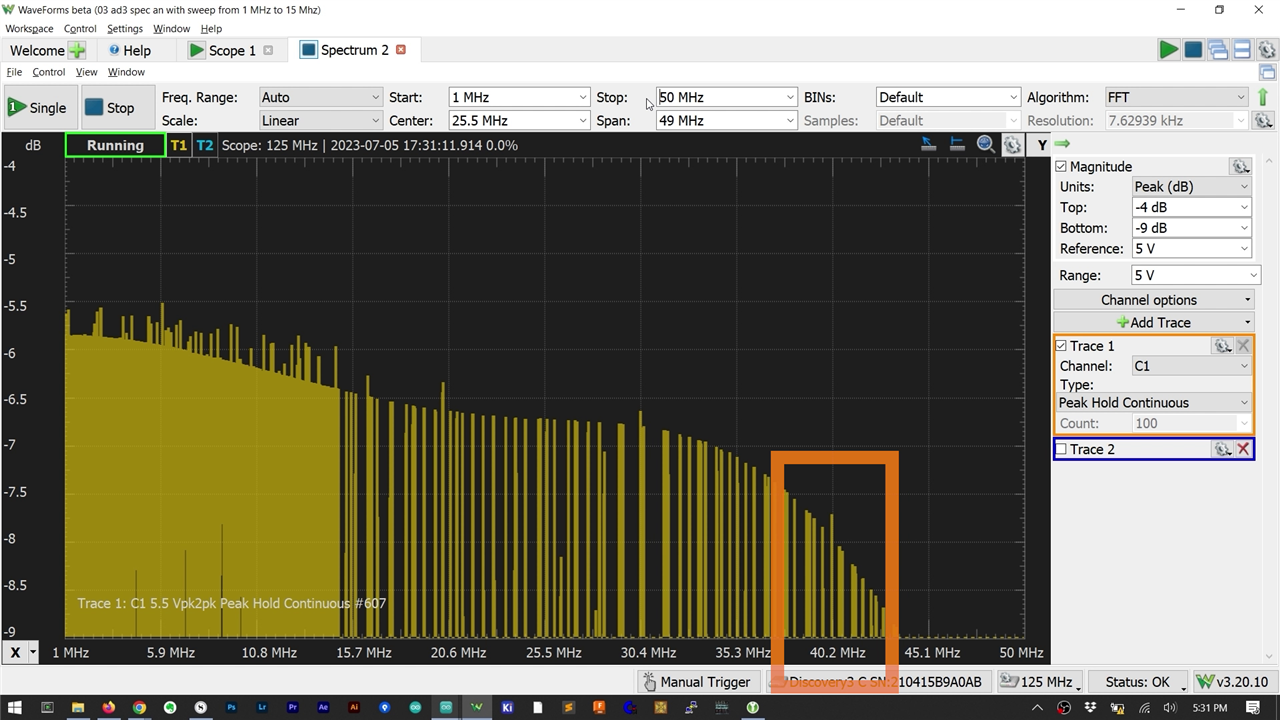
30mhz response

Another analogue measurement available on Analog Discovery 3 is an impedance analyzer. This tool uses the waveform generator, oscilloscope, and optional adapter to generate Bode plots of passive components like capacitors, inductors, and filters. You can see their impedance, ESR, and more. Check out this tutorial on Bode plots (  Learn Three Ways You Can Create Bode Plots - Workbench Wednesdays 64  ) if you need a refresher! 

James as Happy as can Be

In conclusion, James praises the Analog Discovery 3 as a highly capable and powerful test tool, making it a worthy upgrade for those who do not already own a similar device. The improvements in various aspects, along with its multifunctional nature, make it an excellent addition to any electronics workbench, especially for circuit debugging and design tasks. AD3 improves over AD2 in every regard. Digilent has only removed a few features from the new tool, Audio Jack and 1.8-volt support, but they have added several. For example, there is a mode with a faster sample rate (125 MHz!), and all tools have deeper memory. 

Bonus Content:

  •  Exploring the Digilent Analog Discovery 3000 Pro Series - Workbench Wednesdays 48 
  •  Digilent Analog Discovery 2 Review -- Workbench Wednesdays 18 
  •  What's different with Analog Discovery 3
  •  element14 Presents: Decoding Capacitors: Understanding Types, Considerations, and Circuit Examples!  
  •  Making an Analog Discovery 3 prop to "tear down."  

Bill of Material:

Product Name Manufacturer Quantity Buy Kit
Analog Discovery 3 Series, 2 Channel, 30 MHz, 125 MSPS Digilent 1 Buy Now
Analog Discovery 2 Impedance Analyzer Add-On (410-378) Digilent 1 Buy Now
Transistor Tester for Analog Discovery (410-413) Digilent 1 Buy Now
BNC Adapter Board (410-263) Digilent 1 Buy Now
 

element14 presents

element14 Presents  |  About James |  Workbench Wednesdays

  • ad2
  • product review
  • Digilent Analog Discovery
  • oscilloscope
  • digilent
  • Analog Discovery 3
  • ad3
  • analog discovery
  • Share
  • History
  • More
  • Cancel
  • Sign in to reply

Top Comments

  • baldengineer
    baldengineer over 2 years ago in reply to scottiebabe +1
    Well, those are interesting ideas, but with the current state of Waveforms, you cannot do anything to the signal other than change its amplitude. And since you cannot use the scope to make measurements…
  • kovacslattila
    kovacslattila over 2 years ago in reply to baldengineer +1
    Hello, The Wavegen output of Scope Filter input is fixed in the latest version: https://forum.digilent.com/topic/8908-waveforms-beta-download/ I got notified about this issue yesterday. The newer version…
  • scottiebabe
    scottiebabe over 2 years ago in reply to baldengineer

    Very cool! Even if it can't run the DSP itself, it definitely is an awesome all-in-one test and development tool for working on one of those projects!

    Great video!

    • Cancel
    • Vote Up 0 Vote Down
    • Sign in to reply
    • More
    • Cancel
  • baldengineer
    baldengineer over 2 years ago in reply to baldengineer

    er Hamming.

    • Cancel
    • Vote Up 0 Vote Down
    • Sign in to reply
    • More
    • Cancel
  • baldengineer
    baldengineer over 2 years ago in reply to scottiebabe

    Well, those are interesting ideas, but with the current state of Waveforms, you cannot do anything to the signal other than change its amplitude. And since you cannot use the scope to make measurements (at least not easily) while doing this in-to-out, then you lose a powerful analysis tool when doing those kinds of activities.

    I did not cover it in the video, but the Scope also has some digital FIRs in its acquisition path. As in, the FPGA applies the FIR and not the software. There are some built-in window functions and you can define the taps (6 I think) for the FIR.

    What was weird is the Wavegen input list shows "Scope Filter" as one of its waveshapes. However, the waveform generator did not use the FIR. So either that is a bug or not the intended use. (My other thought is the "scope filter" channel is actually the IIRs that the Analog Discovery Pro supports--which seem far more useful in multiple ways.)

    So, as is, I'm not seeing how the capability can really do much. (and I was also at a loss to how to make use of the FIRs. Great, you can apply a Hanning window to the scope's acquired data... why?)

    • Cancel
    • Vote Up +1 Vote Down
    • Sign in to reply
    • More
    • Cancel
  • scottiebabe
    scottiebabe over 2 years ago in reply to dougw

    It sounds like a great feature for students to experiment with DSP, audio effects, or a PID controller. 

    • Cancel
    • Vote Up 0 Vote Down
    • Sign in to reply
    • More
    • Cancel
  • baldengineer
    baldengineer over 2 years ago in reply to dougw

    That's an interesting idea. The wavegen can source up to 40 milliamps (30 is recommended.)

    So it could be good for about 100 milliwatts.

    A downside to this approach is that it would complicate using the Analog Discovery as an oscilloscope (for looking at something else) while doing the in-to-out.

    • Cancel
    • Vote Up 0 Vote Down
    • Sign in to reply
    • More
    • Cancel
  • dougw
    dougw over 2 years ago

    It sounds like the in-to-out feature provides an amplifier function. It may be a little overkill to use it for this, but it can be pretty useful to have a general purpose amplifier on the bench.

    • Cancel
    • Vote Up 0 Vote Down
    • Sign in to reply
    • More
    • Cancel
  • baldengineer
    baldengineer over 2 years ago

    Here's a blog post with some pictures of the AD3 prop I made and "used" in the video.

    community.element14.com/.../making-an-analog-discovery-3-to-tear-down

    • Cancel
    • Vote Up 0 Vote Down
    • Sign in to reply
    • More
    • Cancel
<
element14 Community

element14 is the first online community specifically for engineers. Connect with your peers and get expert answers to your questions.

  • Members
  • Learn
  • Technologies
  • Challenges & Projects
  • Products
  • Store
  • About Us
  • Feedback & Support
  • FAQs
  • Terms of Use
  • Privacy Policy
  • Legal and Copyright Notices
  • Sitemap
  • Cookies

An Avnet Company © 2026 Premier Farnell Limited. All Rights Reserved.

Premier Farnell Ltd, registered in England and Wales (no 00876412), registered office: Farnell House, Forge Lane, Leeds LS12 2NE.

ICP 备案号 10220084.

Follow element14

  • X
  • Facebook
  • linkedin
  • YouTube