element14 Community
element14 Community
    Register Log In
  • Site
  • Search
  • Log In Register
  • Community Hub
    Community Hub
    • What's New on element14
    • Feedback and Support
    • Benefits of Membership
    • Personal Blogs
    • Members Area
    • Achievement Levels
  • Learn
    Learn
    • Ask an Expert
    • eBooks
    • element14 presents
    • Learning Center
    • Tech Spotlight
    • STEM Academy
    • Webinars, Training and Events
    • Learning Groups
  • Technologies
    Technologies
    • 3D Printing
    • FPGA
    • Industrial Automation
    • Internet of Things
    • Power & Energy
    • Sensors
    • Technology Groups
  • Challenges & Projects
    Challenges & Projects
    • Design Challenges
    • element14 presents Projects
    • Project14
    • Arduino Projects
    • Raspberry Pi Projects
    • Project Groups
  • Products
    Products
    • Arduino
    • Avnet & Tria Boards Community
    • Dev Tools
    • Manufacturers
    • Multicomp Pro
    • Product Groups
    • Raspberry Pi
    • RoadTests & Reviews
  • About Us
    About the element14 Community
  • Store
    Store
    • Visit Your Store
    • Choose another store...
      • Europe
      •  Austria (German)
      •  Belgium (Dutch, French)
      •  Bulgaria (Bulgarian)
      •  Czech Republic (Czech)
      •  Denmark (Danish)
      •  Estonia (Estonian)
      •  Finland (Finnish)
      •  France (French)
      •  Germany (German)
      •  Hungary (Hungarian)
      •  Ireland
      •  Israel
      •  Italy (Italian)
      •  Latvia (Latvian)
      •  
      •  Lithuania (Lithuanian)
      •  Netherlands (Dutch)
      •  Norway (Norwegian)
      •  Poland (Polish)
      •  Portugal (Portuguese)
      •  Romania (Romanian)
      •  Russia (Russian)
      •  Slovakia (Slovak)
      •  Slovenia (Slovenian)
      •  Spain (Spanish)
      •  Sweden (Swedish)
      •  Switzerland(German, French)
      •  Turkey (Turkish)
      •  United Kingdom
      • Asia Pacific
      •  Australia
      •  China
      •  Hong Kong
      •  India
      •  Japan
      •  Korea (Korean)
      •  Malaysia
      •  New Zealand
      •  Philippines
      •  Singapore
      •  Taiwan
      •  Thailand (Thai)
      •  Vietnam
      • Americas
      •  Brazil (Portuguese)
      •  Canada
      •  Mexico (Spanish)
      •  United States
      Can't find the country/region you're looking for? Visit our export site or find a local distributor.
  • Translate
  • Profile
  • Settings
RoadTests & Reviews
  • Products
  • More
RoadTests & Reviews
Review Blogs TI Ultrasonic Sensor - Liquid Identification and Concentration
  • Blogs
  • RoadTest Forum
  • Documents
  • RoadTests
  • Reviews
  • Polls
  • Files
  • Members
  • Sub-Groups
  • More
  • Cancel
  • New
Join RoadTests & Reviews to participate - click to join for free!
  • Share
  • More
  • Cancel
  • Author Author: Jan Cumps
  • Date Created: 27 Dec 2015 6:28 PM Date Created
  • Views 4337 views
  • Likes 6 likes
  • Comments 11 comments
Related
Recommended
  • RoadTest
  • tdc1000-tdc7200evm
  • liquid_level_sensors
  • ultrasonic_sensor
  • steminc
  • texas_instruments
  • tdc1000

TI Ultrasonic Sensor - Liquid Identification and Concentration

Jan Cumps
Jan Cumps
27 Dec 2015

The  TDC1000-TDC7200EVMTDC1000-TDC7200EVM evaluation module has 4 main parts

The TDC1000 analog front-end and a pre-programmed MSP430 microcontroller on the board, a 1MHz Piezo Ceramic sensor that plugs into the board and a GUI client for on your PC.


You don't have permission to edit metadata of this video.
Edit media
x
image
Upload Preview
image


In this blog I measure the concentration of detergent in water.


Test Setup


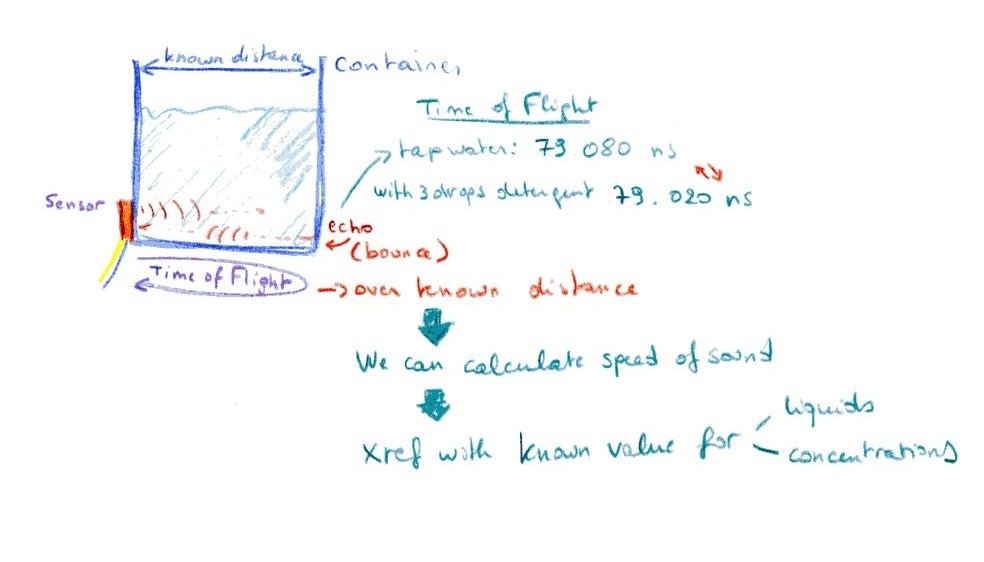
The setup is almost the same as for level measurements. The only difference is that the sensor is placed at the side of the container, very close to the bottom of the receptacle.

That's done because that's an ideal location. When there's fluids in the container, the bottom is always going to be filled first, and will stay filled last when emptying.

And the distance of the liquid is also known. You know the distance between the side of the container where the sensor is glued, and the other side.
 

image


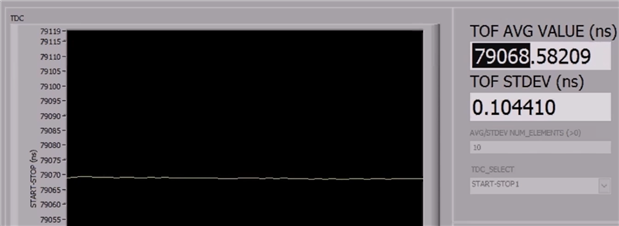
I've filled the container with tap water, and measured the time that one echo takes to go back and forth through the water. The time for the sonar signal to travel back and forth through the liquid is 79 068 ns.
image


When I enter this info, and the size of the container (5.8 cm) in a spreadsheet, I get this speed of sound for tap water in Schaarbeek, Belgium:


container width5.8cm0.058m
Distance = 2 * width0.116m
time of flight79068ns0.000079068s
speed of sound1467.091617342m/s


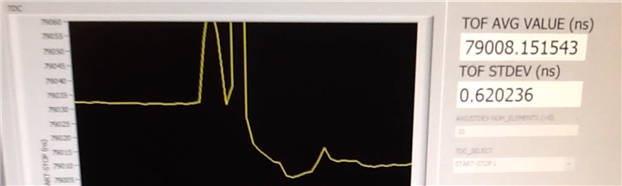
After putting 3 drpops of Ecover dishwasher liquid, and stirring, I get the following time of flight:
image


That gives me a speed of sound of:


container width5.8cm0.058m
Distance = 2 * width0.116m
time of flight79008ns0.000079008s
speed of sound1468.2057513163m/s


Real World Application


I've shown an example of how to measure the concentration of a liquid diluted in water.

I know that 0 drops of detergent in 13.5 ml (width * width of container * height of water level) of tap water gives a speed of sound of 1467 m/s, and 3 drops of detergent give 1468 m/s.

I can create a formula or a lookup table to derive the amount of detergent, and sample the concentration.


Another use case is to collect the speed of sound of a variety of liquids, and sample what liquid is inside the container without opening it.


I've attached the spreadsheet that I used for the calculations to this blog post.


Related Posts
RoadTest: Unboxing the TI Ultrasonic Sensing evaluation module
TI Ultrasonic Sensor - A Very First Trial of the GUI
TI Ultrasonic Sensor - Prepping the Transponder
TI Ultrasonic Sensor - First Measurements
TI Ultrasonic Sensor - Set the Parameters for Level Measurement and Content Identification
TI Ultrasonic Sensor - Show 3 Signals on a 2 Channel Oscilloscope (RIGOL DS1052E)
TI Ultrasonic Sensor - Liquid Identification and Concentration
TI Ultrasonic Sensor - Create a KiCad Part for the Sensor IC with KiPart
TI Ultrasonic Sensor - SPI Traffic Snooping

TI Ultrasonic Sensor - RoadTest Review

Attachments:
speedofsound.zip
  • Sign in to reply

Top Comments

  • mcb1
    mcb1 over 10 years ago in reply to Jan Cumps +2
    A better test would be with isoprophyl alcohol, because the change is more dramatic and it mixes way better than concentrated detergent. No stirring required. I hadn't actually thought about the density…
  • Jan Cumps
    Jan Cumps over 6 years ago in reply to uludag2806 +2
    I never had that. I hope that clem57 's link solves it for you. If not, contact TI's e2e.ti.com forum. They support the evaluation kits.
  • Jan Cumps
    Jan Cumps over 6 years ago in reply to dubbie +2
    There are two use cases that I like in particular: measuring the liquid level (easy, particular in a tank where the fluctuation isn't dramatic) measuring throughput in a utility line (more difficult -…
  • clem57
    clem57 over 6 years ago in reply to uludag2806

    This is due to out of date .NET framework on Windows. https://knowledge.ni.com/KnowledgeArticleDetails?id=kA00Z000000P8fXSAS&l=en-US

    explains this clearly.

    • Cancel
    • Vote Up +1 Vote Down
    • Sign in to reply
    • More
    • Cancel
  • uludag2806
    uludag2806 over 6 years ago

    Hi Jan;

    Have you faced a problem "The VI is not executable. The full development version of LabVIEW is required to fix the errors"

    • Cancel
    • Vote Up +1 Vote Down
    • Sign in to reply
    • More
    • Cancel
  • mcb1
    mcb1 over 10 years ago in reply to Jan Cumps

    A better test would be with isoprophyl alcohol, because the change is more dramatic and it mixes way better than concentrated detergent. No stirring required.

    I hadn't actually thought about the density of water before this blog.

    I was aware that salt water was different to fresh water in terms of bouyancy, but hadn't placed a lot of thought about why.


    I knew that sound travelled faster through water, and that the speed of sound changed with temperature, but again hadn't really applied any "why" to the fact.


    We use ultrasonic wind sensors at work, the direction aspect is self cancelling for any temperature, but it obviously changes the true speed reading.

    I'll have to ask some questions if the temperature is sent in the data stream.


    Thanks for the posts, very informative.

    I'm now wondering why I never went "why".


    Mark

    • Cancel
    • Vote Up +2 Vote Down
    • Sign in to reply
    • More
    • Cancel
  • Jan Cumps
    Jan Cumps over 10 years ago in reply to jc2048

    It's an experiment - I use the things that I have at hand here at the lab. The tap water was room temperature when I did the test.. I don't get significant differences when stirring the water as is - without adding something to it.

    The graph will shake, but it settles to the pre-stirring point. With the contaminant added, it settled at a different point.


    The TDC1000 (and the board and the GUI) has provisioning for two temperature sensors. They are not part of the evaluation kit though.


    A better test would be with isoprophyl alcohol, because the change is more dramatic and it mixes way better than concentrated detergent. No stirring required.

    • Cancel
    • Vote Up +1 Vote Down
    • Sign in to reply
    • More
    • Cancel
  • jc2048
    jc2048 over 10 years ago

    As it stands, I'm not sure I'd call it a "real world" application (the measurement of small concentrations of detergent in water).


    To make it useful you'd need an accurate measurement of the water temperature too, wouldn't you?


    It works with your experiment because you start by measuring the speed with pure water and then add the other material quickly enough that you can assume that there hasn't been much change in the water temperature. (If the temperature of the water has stabilised, that is. If the tap water has just come out of the tap and is heating towards ambient, then the stirring will probably account for at least some of the change you're seeing.) But for an absolute measurement - not a before and after differential one - you'd need a temperature reading too.


    The temperature measurement would need to be pretty accurate: the change you see in the speed (1.1m/s) is equivalent to approx a half degree C change in temperature (if I've worked it out right).

    If you put one of the equations from the following document into a spreadsheet you'll be able to see the range of values for the speed as temperature varies:


    http://resource.npl.co.uk/acoustics/techguides/soundpurewater/speedpw.pdf

    • Cancel
    • Vote Up +1 Vote Down
    • Sign in to reply
    • More
    • Cancel
<>
element14 Community

element14 is the first online community specifically for engineers. Connect with your peers and get expert answers to your questions.

  • Members
  • Learn
  • Technologies
  • Challenges & Projects
  • Products
  • Store
  • About Us
  • Feedback & Support
  • FAQs
  • Terms of Use
  • Privacy Policy
  • Legal and Copyright Notices
  • Sitemap
  • Cookies

An Avnet Company © 2026 Premier Farnell Limited. All Rights Reserved.

Premier Farnell Ltd, registered in England and Wales (no 00876412), registered office: Farnell House, Forge Lane, Leeds LS12 2NE.

ICP 备案号 10220084.

Follow element14

  • X
  • Facebook
  • linkedin
  • YouTube