element14 Community
element14 Community
    Register Log In
  • Site
  • Search
  • Log In Register
  • Community Hub
    Community Hub
    • What's New on element14
    • Feedback and Support
    • Benefits of Membership
    • Personal Blogs
    • Members Area
    • Achievement Levels
  • Learn
    Learn
    • Ask an Expert
    • eBooks
    • element14 presents
    • Learning Center
    • Tech Spotlight
    • STEM Academy
    • Webinars, Training and Events
    • Learning Groups
  • Technologies
    Technologies
    • 3D Printing
    • FPGA
    • Industrial Automation
    • Internet of Things
    • Power & Energy
    • Sensors
    • Technology Groups
  • Challenges & Projects
    Challenges & Projects
    • Design Challenges
    • element14 presents Projects
    • Project14
    • Arduino Projects
    • Raspberry Pi Projects
    • Project Groups
  • Products
    Products
    • Arduino
    • Avnet & Tria Boards Community
    • Dev Tools
    • Manufacturers
    • Multicomp Pro
    • Product Groups
    • Raspberry Pi
    • RoadTests & Reviews
  • About Us
    About the element14 Community
  • Store
    Store
    • Visit Your Store
    • Choose another store...
      • Europe
      •  Austria (German)
      •  Belgium (Dutch, French)
      •  Bulgaria (Bulgarian)
      •  Czech Republic (Czech)
      •  Denmark (Danish)
      •  Estonia (Estonian)
      •  Finland (Finnish)
      •  France (French)
      •  Germany (German)
      •  Hungary (Hungarian)
      •  Ireland
      •  Israel
      •  Italy (Italian)
      •  Latvia (Latvian)
      •  
      •  Lithuania (Lithuanian)
      •  Netherlands (Dutch)
      •  Norway (Norwegian)
      •  Poland (Polish)
      •  Portugal (Portuguese)
      •  Romania (Romanian)
      •  Russia (Russian)
      •  Slovakia (Slovak)
      •  Slovenia (Slovenian)
      •  Spain (Spanish)
      •  Sweden (Swedish)
      •  Switzerland(German, French)
      •  Turkey (Turkish)
      •  United Kingdom
      • Asia Pacific
      •  Australia
      •  China
      •  Hong Kong
      •  India
      •  Japan
      •  Korea (Korean)
      •  Malaysia
      •  New Zealand
      •  Philippines
      •  Singapore
      •  Taiwan
      •  Thailand (Thai)
      •  Vietnam
      • Americas
      •  Brazil (Portuguese)
      •  Canada
      •  Mexico (Spanish)
      •  United States
      Can't find the country/region you're looking for? Visit our export site or find a local distributor.
  • Translate
  • Profile
  • Settings
RoadTests & Reviews
  • Products
  • More
RoadTests & Reviews
Review Blogs SimpleLink™︎ Sub-1 GHz Wireless Microcontroller - Check  Received Signal Strength
  • Blogs
  • RoadTest Forum
  • Documents
  • RoadTests
  • Reviews
  • Polls
  • Files
  • Members
  • Sub-Groups
  • More
  • Cancel
  • New
Join RoadTests & Reviews to participate - click to join for free!
  • Share
  • More
  • Cancel
  • Author Author: Jan Cumps
  • Date Created: 21 Jun 2016 11:47 AM Date Created
  • Views 4606 views
  • Likes 6 likes
  • Comments 18 comments
Related
Recommended
  • RoadTest
  • cc1310
  • rssi
  • texas_instruments
  • sub1ghz
  • simplelink
  • launchpad
  • feature_tutorial
  • ti_rt

SimpleLink™︎ Sub-1 GHz Wireless Microcontroller - Check  Received Signal Strength

Jan Cumps
Jan Cumps
21 Jun 2016

Complexity: easy

What do you need:

  • two CC1310 LaunchPads Out of Box
  • A serial communication program (PuTTY or your personal favourite)


You can test the reception strength of the CC1310 radio straight away after you pulled the devices out of the box.

This exercise works with the pre-loaded firmware.


You don't have permission to edit metadata of this video.
Edit media
x
image
Upload Preview
image


You'll learn the range and the possibilities of the radios by trying this out from different locations in and out your lab.


Setting things up


If you have a Code Composer Studio installation, you will have the right USB drivers.

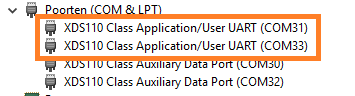
Plug in both LaunchPads, and check the serial port that's assigned to them.


You'll know how to do that for your operating system. Here' how it looks like on my localised Windows 10.
 

image


(you don't have to do this from one pc. This also works when each LaunchPad is attached to a different computer)


Fire up your serial communication program. If you don't have one installed, PuTTY is a possible option.

There is also a Terminal view available in CCS.

Set up communication as 115200 baud, 8 data bits, 1 stop, no parity, no flow control.

Select the first COM port.

image


Press the Reset button on top of one of the LaunchPads.

If nothing happens in the Terminal, press the Reset on the other one.


The one that reacts will be your TX device for today.


Click either button 1 or 2 to get a menu

Push button 2 until you are on the Mode line.

Press the left button to go select TX

image


Now start a second terminal program, and connect to the second serial port.

Push the Reset of the other launchpad. This one will become the receiver.

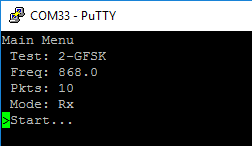
Press any button to go to the menu. This one is already in receive mode, so we don't have to change that.

Use the button 2 to navigate to Start, and press Button 1 to activate the receiving device.
 

image

It's now waiting for traffic.

image


Start the Communication


We're ready now to test the traffic.

Return to your first Terminal session. The one where you set the device to TX.

Use button 2 to navigate to Start

image


Each time you press Button 1, the device will transmit 10 packets.

In the receiver's terminal, you can see the count of received packages increase.

image


You'll also get an indication of the signal's strength. Keep pushing that button 1 of the transmitter, and the count will keep going up.

Try this exercise from different locations in your house, garden, neighbourhood, to appreciate the range of sub-1 GHz.

 

image


What if you have overwritten the Out-of-Box firmware


If you want to re-load the Out-of-Box firmware (the project will be included in the next TI-RTOS release, but currently unavailable), you can do that by:


  • Connecting  the LaunchPad.
  • Navigate to here: Welcome to CC1310 Launchpad
  • Locate the button that says ~ CC1310F128 and Click it

Done.


image


SimpleLinkTm Sub-1 GHz Wireless Microcontroller - Check  Received Signal Strength
SimpleLinkTm Sub-1 GHz Wireless Microcontroller - Use SmartRF to Try Radio Configs
SimpleLinkTm Sub-1 GHz Wireless Microcontroller - Debug 2 LaunchPads at the Same Time
SimpleLinkTm Sub-1 GHz Wireless Microcontroller - Side Note: Recognise your PuTTY Sessions
SimpleLinkTm Sub-1 GHz Wireless Microcontroller - Side Note: Recognise your Code Composer Studio Sessions
SimpleLinkTm Sub-1 GHz Wireless Microcontroller - Debug a Sender to Receiver Conversation
SimpleLinkTm Sub-1 GHz Wireless Microcontroller - Side Note: Start a Fresh Project
SimpleLinkTm Sub-1 GHz Wireless Microcontroller - Create a Transmitter with SmartRF Studio Part 1
SimpleLinkTm Sub-1 GHz Wireless Microcontroller - Create a Transmitter with SmartRF Studio Part 2
SimpleLinkTm Sub-1 GHz Wireless Microcontroller - Sensor Controller Engine Part 1: Dry Run
SimpleLinkTm Sub-1 GHz Wireless Microcontroller - Sensor Controller Engine Part 2: RTOS Integration
SimpleLinkTm Sub-1 GHz Wireless Microcontroller - Sensor Controller Engine Part 3: Wake Up Options
SimpleLinkTm Sub-1 GHz Wireless Microcontroller - Side Note : Measure Power Use of Sensor Controller Engine
SimpleLinkTm Sub-1 GHz Wireless Microcontroller - ToolKit for Range Testing

on TI E2E community: How to connect a CC1310 LaunchPad to the SIGFOX network

  • Sign in to reply

Top Comments

  • Jan Cumps
    Jan Cumps over 9 years ago +2
    Competition time: At the moment Robert Peter Oakes (rural area) and shabaz (metropolitan area) are the owners of the Sub-1GHz range record. Peter claims "the back of his garden". In Canada, where the gardens…
  • Jan Cumps
    Jan Cumps over 9 years ago in reply to Jan Cumps +2
    Cool he:
  • Jan Cumps
    Jan Cumps over 9 years ago in reply to Jan Cumps +2
    I don't think we got any closer to the Soviet Building Ideal than this:
  • Robert Peter Oakes
    Robert Peter Oakes over 9 years ago

    I have just posted a overview of the CC1310 on my YouTube channel for those that are interested, I did a quick crude range test and I have to say, these are awesome compared to earlier boards like the CC110L Booster pack. Over 3X the range in my simple test. If the one module was actually above ground I suspect the range will be way way more. That's a test for another video.

    You don't have permission to edit metadata of this video.
    Edit media
    x
    image
    Upload Preview
    image


    Oh and if you happen to have any BOOST-SHARP96 modules, these will be used with the default app so you don't even need to connect to a PC to try them out. Awesome.


    image

    • Cancel
    • Vote Up +1 Vote Down
    • Sign in to reply
    • More
    • Cancel
  • Jan Cumps
    Jan Cumps over 9 years ago in reply to DAB

    Very true,  DAB. (hey, I think I managed to link in your name?)

    In this case, where the radio is incorporated into the controller, I have no real idea how to do that.

    Maybe by mocking in software feedback? Or using SPI, I2C or UART between the two controllers?


    My actual hope is that the radio part is so simple that I don't have to go for wired first (specifically because there's no hub in between. It's peer-to-peer).

    Let's see if I find an easy way to link the two while learning the platform. If radio is difficult, I'll naturally flean towards a wired makeshift solution.

    It's my nature: if things hurt or annoy me, I look for a way out. If they work good enough, I settle with what I have.

    • Cancel
    • Vote Up 0 Vote Down
    • Sign in to reply
    • More
    • Cancel
  • DAB
    DAB over 9 years ago

    Good simple test for wireless communication.


    Sometimes it is also useful to use a wired connection to verify the protocol before adding the wireless hardware.


    DAB

    • Cancel
    • Vote Up +1 Vote Down
    • Sign in to reply
    • More
    • Cancel
<
element14 Community

element14 is the first online community specifically for engineers. Connect with your peers and get expert answers to your questions.

  • Members
  • Learn
  • Technologies
  • Challenges & Projects
  • Products
  • Store
  • About Us
  • Feedback & Support
  • FAQs
  • Terms of Use
  • Privacy Policy
  • Legal and Copyright Notices
  • Sitemap
  • Cookies

An Avnet Company © 2026 Premier Farnell Limited. All Rights Reserved.

Premier Farnell Ltd, registered in England and Wales (no 00876412), registered office: Farnell House, Forge Lane, Leeds LS12 2NE.

ICP 备案号 10220084.

Follow element14

  • X
  • Facebook
  • linkedin
  • YouTube