In this exciting blog post, I will take apart the Digilent Analog Discovery Pro ADP3450 to see what it’s made of and how it’s been designed. This post will include a few nice photos of the internals along with a listing of some of the maj...
This chapter will cover a number of instrument performance tests that I conducted to ascertain the capability of the instrument and verify its specifications compared to its datasheet. This is perhaps the most exciting part of the review, not least b...
In this blog post, I put the Digilent Analog Discovery Pro ADP3450 into various applications.
Lissajous Waveform Generation
Having access to two waveform generator channels and two oscilloscope channels naturally leads to the temptation to generate L...
What makes a piece of test equipment truly useful is the ability to automate measurements. Instead of interactively twiddling knobs and pushing buttons (even if they are on-screen), the ability for the instrument to be controlled through a program or...
One of the most interesting features of the Digilent Analog Discovery Pro ADP3450 is the Linux Mode for embedded development. This represents a bit of a paradigm shift in USB test instruments – no longer are they just following the commands of ...
In this chapter, I will look more into detail of each of the modules within the Digilent WaveForms application, while also providing some insight into the user experience of using the ADP3450 in these modes.
Digilent WaveForms Tour & User Experie...
This blog posting will consider the initial set-up procedure for the hardware and software, while also evaluating the support and documentation provided.
Obtaining Software
To actually run the ADP3450, you will need to download the WaveForms software...
This blog post is dedicated to the unboxing of the Digilent Analog Discovery Pro ADP3450 Mixed Signal Oscilloscope, featuring images of the unit and included probes for the RoadTest.
Unboxing
The ADP3450 arrived in a surprisingly large box – ...
In this blog, I will be looking at the Digilent Analog Discovery Pro ADP3450 and how it compares with other products on the market. I will also be looking at what is unique about the ADP3450 and who it might appeal to.
Feature Introduction
The Digile...
It wasn't long ago that I posted about saying "Hello" to FPGA thanks to a prize received from one of the many FPGA quizzes on element14. As it turns out, the random number generator must have been smiling down at me because I was select...
When I hear the word "hello", my mind immediately thinks of three things - the greeting "hello", the first program one would probably write - "Hello, world!" and perhaps the Japanese fictional character, "Hello Kitt...
It’s been a great journey reviewing the Aim-TTi QPX750SP 750W Programmable DC Power Supply so far, but wouldn’t it be nice to end it all with a peek under the covers? After all, I don’t see any warranty void seals and the fuse is inside the cover, so...
The most important part of an instrument is how well it performs. This section covers some tests done using other benchtop equipment to try and characterise the performance of the QPX750SP. As the power envelope of the QPX750SP far exceeds most of my...
Being the fortunate recipient of a 750W power supply, I thought it would be a shame if it were not given a chance to stretch its legs. It wasn’t originally part of my RoadTest proposal, but it seemed essential enough that I decided to spend just a li...
As the QPX750SP has an extended voltage range capability that reaches 80V, a key application would be to test telecommunications-based equipment which may be 48V nominal, but require voltages up to 60V to properly test. Initially, I thought I would t...
When it comes to high-current requirements, the first thing that comes to my mind is testing MOSFETs. Ever since I received a batch of counterfeit MOSFETs, I’ve delved down into the rabbit-hole of testing MOSFETs under quasi-realistic application sce...
In this chapter, I will be looking at the various remote interfaces and PC connectivity options, including their latest Test Bridge software which was still in Beta/Release Candidate stage of development at the time of review. PC ConnectivityThe...
This chapter will examine the QPX750SP’s user interface and menus, provide some of my thoughts about the bench-top user experience and evaluate the documentation provided by Aim-TTi to support users. User Interface & MenusTurning on the unit...
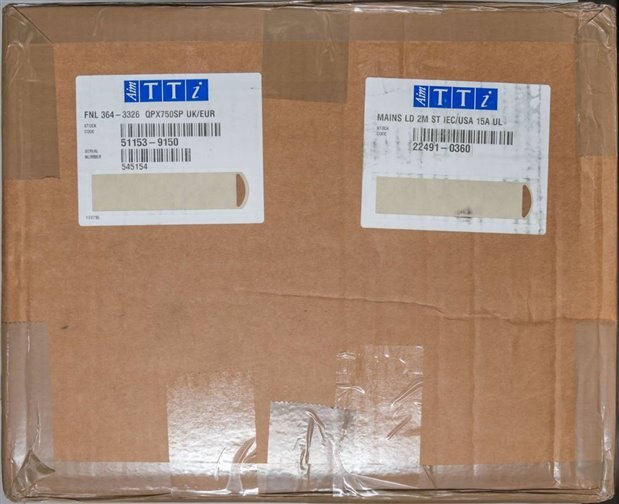
This post will focus on the unboxing process, showing the product from all sides and any included accessories.UnboxingThe power supply is packed in an ordinary plain brown cardboard box. If it were not for the labels on one end, I wouldn’t even know ...
In this section, I will examine the key features of the Aim-TTi QPX750SP and ascertain its value for money by comparing its capabilities and price with similar products on the market. Feature IntroductionAim-TTi are perhaps not as widely known a...
It has been a while since my last update for my Keithley 2450 SMU RoadTest, however, it seems that there have been some relatively-recently released improvements to the firmware and KickStart 2 software which are worth noting. While I was aware of th...
It’s the holiday season – traditionally a time for reflection and being thankful for our blessings. Around element14, there are plenty of reasons to be thankful – a community of mostly like-minded professional engineers, mentors, hobbyists, tinkerers...
While the last section looked at MOSFETs, this final section will cover some of the results from my experiments on lighting technologies. The first section will look at the humble NE-2 neon indicator bulb and trying to build a nice I-V curve from act...
As one of the fortunate members to be selected to RoadTest the Keithley 2450 SMU, I delivered a review earlier this year with a significant caveat as a hardware issue stopped me from being able to perform some of the experiments I had initially plann...
Now that the Keithley 2450 SMU has passed its initiation and been “accepted” by my family of instruments, it’s time to look at various applications of the SMU. During my original RoadTest review, I had already looked at some basic I-V testing (with K...